

Ever wondered how to make your writing sound more polished instead of repeatedly using Other Ways to Say Additionally in an Essay? In academic and professional writing, the way you connect ideas can significantly impact clarity, flow, and overall impression.
The problem is simple. Words like “additionally” are useful, but when overused, they can make your essay feel repetitive and mechanical. And here’s the kicker: examiners and readers often notice these patterns more than you think.
Many students struggle with this and end up searching for more formal transition words for essays, alternative ways to say in addition, or academic linking phrases that improve readability and flow.
But don’t worry—there’s a solution.
In this guide, you’ll discover Other Ways to Say Additionally in an Essay, including formal, semi-formal, and natural alternatives you can use to improve sentence transitions. You’ll also learn how different essay transition words can help you create smoother arguments and stronger academic writing.
So if you want to upgrade your writing style and avoid repetition, keep reading—you’re in the right place.
What Does “Additionally” Mean in an Essay?
“Additionally” is a transition word used to introduce extra information that supports or builds upon a previous idea. It helps the writer smoothly add more points without breaking the flow of thought.
When to Use “Additionally” Alternatives
You should use alternatives when:
- Adding supporting arguments in essays
- Expanding ideas in academic writing
- Writing research papers or reports
- Avoiding repetition of the same transition word
- Improving coherence and readability
Is It Formal to Say “Additionally”?
Yes, “additionally” is formal and widely accepted in academic writing. However, overusing it can make writing sound mechanical. That’s why using varied alternatives improves style and engagement.
1. Moreover
Scenario: Academic essays and arguments
Examples:
- Moreover, this theory is supported by recent studies.
- The results are significant; moreover, they are consistent.
- Moreover, students benefit from practical learning.
- This method is effective; moreover, it is affordable.
- Moreover, the data confirms the hypothesis.
Tone: Formal and academic
Best Use: Essays, research writing
2. Furthermore
Scenario: Expanding ideas in formal writing
Examples:
- Furthermore, the policy improves student outcomes.
- The system is efficient; furthermore, it is scalable.
- Furthermore, evidence supports this conclusion.
- The study is valid; furthermore, it is reliable.
- Furthermore, the results were statistically significant.
Tone: Academic and strong
Best Use: Research papers and essays
3. In Addition
Scenario: General essay writing
Examples:
- In addition, the study highlights key trends.
- The project is successful; in addition, it is cost-effective.
- In addition, several factors contribute to this issue.
- The method is simple; in addition, it is efficient.
- In addition, the results were consistent.
Tone: Neutral and formal
Best Use: Academic essays
4. As Well As
Scenario: Connecting two related ideas
Examples:
- The study includes surveys as well as interviews.
- He is skilled in research as well as analysis.
- The system supports speed as well as accuracy.
- Students learn theory as well as practice.
- The report covers benefits as well as limitations.
Tone: Balanced and descriptive
Best Use: Informative writing
5. Also
Scenario: Simple addition of ideas
Examples:
- Also, the findings are consistent with previous research.
- The method is effective; also, it is easy to apply.
- Also, students showed improvement.
- The system is fast; also, it is reliable.
- Also, the results were encouraging.
Tone: Simple and neutral
Best Use: General academic writing
6. Likewise
Scenario: Similar supporting ideas
Examples:
- Likewise, other studies confirm this result.
- The first group improved; likewise, the second group did too.
- Likewise, the data shows a positive trend.
- The method is effective; likewise, it is efficient.
- Likewise, students benefited from the approach.
Tone: Formal and comparative
Best Use: Research and analysis
7. Correspondingly
Scenario: Showing related outcomes
Examples:
- Correspondingly, higher investment leads to better results.
- The temperature increased; correspondingly, demand rose.
- Correspondingly, performance improved over time.
- The policy changed; correspondingly, outcomes shifted.
- Correspondingly, students achieved higher scores.
Tone: Academic and analytical
Best Use: Data-driven writing
8. What’s More
Scenario: Emphasizing additional points
Examples:
- What’s more, the solution is cost-effective.
- The program is helpful; what’s more, it is accessible.
- What’s more, students enjoy the learning process.
- The system is fast; what’s more, it is secure.
- What’s more, the results exceeded expectations.
Tone: Slightly informal but engaging
Best Use: Essays with persuasive tone
9. On Top of That
Scenario: Informal essay or blog writing
Examples:
- On top of that, the method saves time.
- The system is efficient; on top of that, it is reliable.
- On top of that, costs are reduced significantly.
- Students improve quickly; on top of that, they gain confidence.
- On top of that, the results are impressive.
Tone: Informal and conversational
Best Use: Blogs or reflective essays
10. Along With That
Scenario: Adding supporting details
Examples:
- Along with that, the research includes case studies.
- The system is fast; along with that, it is secure.
- Along with that, students receive practical training.
- The method is simple; along with that, it is effective.
- Along with that, results remain consistent.
Tone: Neutral and descriptive
Best Use: Explanatory writing
11. Coupled With
Scenario: Analytical or formal writing
Examples:
- Coupled with strong evidence, the argument is convincing.
- The policy, coupled with reforms, improved outcomes.
- Coupled with experience, skills increase efficiency.
- The system, coupled with AI, enhances performance.
- Coupled with training, results improved significantly.
Tone: Formal and technical
Best Use: Academic essays
12. Not to Mention
Scenario: Emphasizing additional benefits
Examples:
- The system is fast, not to mention reliable.
- The course is useful, not to mention affordable.
- Not to mention, the results are impressive.
- The design is modern, not to mention efficient.
- The plan is effective, not to mention scalable.
Tone: Emphatic and persuasive
Best Use: Argumentative essays
13. Plus
Scenario: Simple addition in informal writing
Examples:
- The method is easy to use, plus it is effective.
- Students improved, plus they gained confidence.
- The system is fast, plus it is secure.
- The plan works well, plus it is affordable.
- Plus, the results are consistent.
Tone: Casual and simple
Best Use: Informal essays or blogs
14. Over and Above That
Scenario: Strong emphasis on extra points
Examples:
- Over and above that, the system is highly scalable.
- The results are strong; over and above that, they are consistent.
- Over and above that, it saves time and cost.
- Students improved; over and above that, they performed better in exams.
- Over and above that, the method is easy to apply.
Tone: Emphatic and formal
Best Use: Persuasive writing
15. To Add to That
Scenario: Expanding arguments naturally
Examples:
- To add to that, the findings support the theory.
- The system is effective; to add to that, it is affordable.
- To add to that, students showed improvement.
- The process is simple; to add to that, it is efficient.
- To add to that, the results were consistent.
Tone: Smooth and natural
Best Use: Academic essays
16. Besides That
Scenario: Adding extra supporting points
Examples:
- Besides that, the study shows consistent results.
- The method is simple; besides that, it is effective.
- Besides that, students improved significantly.
- The system is fast; besides that, it is secure.
- Besides that, the data supports the claim.
Tone: Neutral and slightly informal
Best Use: General essays
17. In Like Manner
Scenario: Showing similarity and addition
Examples:
- In like manner, other researchers support this view.
- The first group improved; in like manner, the second did too.
- In like manner, the results remained consistent.
- The policy changed; in like manner, outcomes improved.
- In like manner, students showed progress.
Tone: Formal and literary
Best Use: Academic writing
18. By the Same Token
Scenario: Logical extension of ideas
Examples:
- By the same token, the theory applies to real-world cases.
- The system is efficient; by the same token, it is reliable.
- By the same token, results support the hypothesis.
- The method works; by the same token, it is scalable.
- By the same token, students performed better.
Tone: Formal and logical
Best Use: Argumentative essays
19. Equally Important
Scenario: Emphasizing additional point
Examples:
- Equally important, the study considers environmental factors.
- The results are strong; equally important, they are reliable.
- Equally important, the method is cost-effective.
- The system is fast; equally important, it is secure.
- Equally important, students benefit from practice.
Tone: Formal and emphatic
Best Use: Academic essays
20. Not Only That
Scenario: Adding emphasis
Examples:
- Not only that, the system is highly efficient.
- The method is simple; not only that, it is affordable.
- Not only that, students improved their scores.
- The results are strong; not only that, they are consistent.
- Not only that, the process saves time.
Tone: Emphatic and persuasive
Best Use: Argumentative writing
21. In the Same Way
Scenario: Showing similarity + addition
Examples:
- In the same way, other studies confirm this result.
- The first method works; in the same way, the second does too.
- In the same way, students showed improvement.
- The system is fast; in the same way, it is reliable.
- In the same way, the data supports the claim.
Tone: Formal and explanatory
Best Use: Academic comparison
22. To Boot
Scenario: Informal extra point
Examples:
- The system is fast, to boot it is reliable.
- Students improved, to boot they gained confidence.
- The method is simple, to boot effective.
- The results are strong, to boot consistent.
- The product is affordable, to boot high quality.
Tone: Informal and conversational
Best Use: Informal essays or blogs
23. In Effect
Scenario: Emphasizing result or addition
Examples:
- In effect, the policy improves outcomes.
- The change is small; in effect, it is significant.
- In effect, the system becomes more efficient.
- The method reduces errors; in effect, accuracy improves.
- In effect, students benefit greatly.
Tone: Formal and analytical
Best Use: Academic or technical writing
24. On the Other Hand (Addition Use Context)
Scenario: Adding contrasting supporting idea
Examples:
- On the other hand, it also improves efficiency.
- The system is complex; on the other hand, it is powerful.
- On the other hand, results remain consistent.
- The method is slow; on the other hand, it is accurate.
- On the other hand, students benefit from guidance.
Tone: Balanced and analytical
Best Use: Argumentative essays
25. In Consequence
Scenario: Showing result-based addition
Examples:
- In consequence, the results improved significantly.
- The system was updated; in consequence, performance increased.
- In consequence, students achieved higher scores.
- The method changed; in consequence, accuracy improved.
- In consequence, efficiency was enhanced.
Tone: Formal and academic
Best Use: Research writing
26. As a Further Point
Scenario: Adding structured argument
Examples:
- As a further point, the study includes surveys.
- The system is reliable; as a further point, it is scalable.
- As a further point, students improved their understanding.
- The method is cost-effective; as a further point, it is simple.
- As a further point, results were consistent.
Tone: Academic and structured
Best Use: Essays and reports
27. It Should Also Be Noted That
Scenario: Formal emphasis
Examples:
- It should also be noted that the system is efficient.
- It should also be noted that results are consistent.
- It should also be noted that students improved.
- It should also be noted that the method is simple.
- It should also be noted that the data supports the claim.
Tone: Highly formal
Best Use: Academic writing
28. One More Point
Scenario: Adding final supporting idea
Examples:
- One more point, the system is user-friendly.
- One more point, the method is cost-effective.
- One more point, students showed improvement.
- One more point, the results are consistent.
- One more point, the process is efficient.
Tone: Slightly informal
Best Use: Essays or presentations
29. What Should Be Added Is
Scenario: Introducing extra argument
Examples:
- What should be added is the importance of training.
- What should be added is the role of technology.
- What should be added is student engagement.
- What should be added is system efficiency.
- What should be added is cost reduction.
Tone: Formal and explanatory
Best Use: Analytical essays
30. As an Additional Observation
Scenario: Academic reporting
Examples:
- As an additional observation, results were consistent.
- As an additional observation, the system improved.
- As an additional observation, students performed better.
- As an additional observation, efficiency increased.
- As an additional observation, accuracy improved.
Tone: Formal and academic
Best Use: Research writing
31. As Well
Scenario: Simple addition in academic writing
Examples:
- The study includes interviews as well.
- Students improved their skills as well.
- The system is efficient as well.
- The results were consistent as well.
- Teachers benefited as well.
Tone: Neutral and simple
Best Use: General essays
32. Too
Scenario: Informal addition
Examples:
- The method is effective too.
- Students improved too.
- The system works fast too.
- Results were positive too.
- The approach is simple too.
Tone: Informal
Best Use: Casual writing
33. In Tandem With That
Scenario: Formal academic addition
Examples:
- In tandem with that, results improved.
- The system evolved in tandem with that.
- In tandem with that, efficiency increased.
- The policy changed in tandem with that.
- In tandem with that, performance improved.
Tone: Formal and academic
Best Use: Research writing
34. Together With This
Scenario: Structured explanation
Examples:
- Together with this, the study shows progress.
- The method improves results together with this.
- Together with this, students performed better.
- The system evolves together with this.
- Together with this, efficiency increases.
Tone: Formal
Best Use: Academic essays
35. Coupled Therewith
Scenario: Highly formal writing
Examples:
- Coupled therewith, the system becomes efficient.
- The data, coupled therewith, supports the claim.
- Coupled therewith, results improved significantly.
- The policy, coupled therewith, enhances outcomes.
- Coupled therewith, performance increased.
Tone: Very formal
Best Use: Legal or academic writing
36. Added to That
Scenario: Smooth transition
Examples:
- Added to that, the system is reliable.
- The method is simple; added to that, it is fast.
- Added to that, students improved.
- The results are strong; added to that, consistent.
- Added to that, costs are reduced.
Tone: Neutral and clear
Best Use: Essays
37. As an Extra Point
Scenario: Supporting argument
Examples:
- As an extra point, the study is comprehensive.
- The system is fast; as an extra point, secure.
- As an extra point, students showed progress.
- The method is cost-effective; as an extra point, simple.
- As an extra point, results improved.
Tone: Formal
Best Use: Academic writing
38. In Extension
Scenario: Logical continuation
Examples:
- In extension, the results remain valid.
- The policy improves outcomes in extension.
- In extension, efficiency increases.
- The system evolves in extension.
- In extension, performance improves.
Tone: Formal and analytical
Best Use: Research essays
39. To Extend That Point
Scenario: Expanding argument
Examples:
- To extend that point, the system is scalable.
- To extend that point, results are reliable.
- To extend that point, students improved.
- To extend that point, efficiency increased.
- To extend that point, the method works well.
Tone: Academic
Best Use: Essays
40. In Support of That
Scenario: Supporting evidence
Examples:
- In support of that, studies show improvement.
- The data is strong; in support of that, reliable.
- In support of that, results are consistent.
- The method works; in support of that, efficient.
- In support of that, students benefit.
Tone: Formal and persuasive
Best Use: Research writing
41. Alongside This
Scenario: Parallel ideas
Examples:
- Alongside this, performance improved.
- The system evolves alongside this.
- Alongside this, results became better.
- Students improved alongside this.
- Alongside this, efficiency increased.
Tone: Neutral formal
Best Use: Academic essays
42. In Parallel
Scenario: Simultaneous development
Examples:
- In parallel, the system became faster.
- The study progressed in parallel.
- In parallel, results improved.
- Students learned in parallel.
- In parallel, efficiency increased.
Tone: Technical and formal
Best Use: Research or science writing
43. Notably Also
Scenario: Emphasized addition
Examples:
- Notably also, the system is efficient.
- The results improved; notably also, consistent.
- Notably also, students performed better.
- The method is simple; notably also, effective.
- Notably also, costs decreased.
Tone: Formal and emphatic
Best Use: Academic writing
44. It Is Also Worth Mentioning That
Scenario: Formal emphasis
Examples:
- It is also worth mentioning that results improved.
- It is also worth mentioning that the system is efficient.
- It is also worth mentioning that students benefited.
- It is also worth mentioning that accuracy increased.
- It is also worth mentioning that costs reduced.
Tone: Very formal
Best Use: Essays and reports
45. By Extension
Scenario: Logical addition
Examples:
- By extension, the results support the theory.
- The system improves; by extension, efficiency rises.
- By extension, students perform better.
- The method is effective; by extension, reliable.
- By extension, outcomes improve.
Tone: Analytical
Best Use: Academic writing
46. In a Similar Vein
Scenario: Thematic addition
Examples:
- In a similar vein, other studies agree.
- The results improved; in a similar vein, consistent.
- In a similar vein, students performed well.
- The system is effective; in a similar vein, efficient.
- In a similar vein, data supports the claim.
Tone: Formal and literary
Best Use: Essays
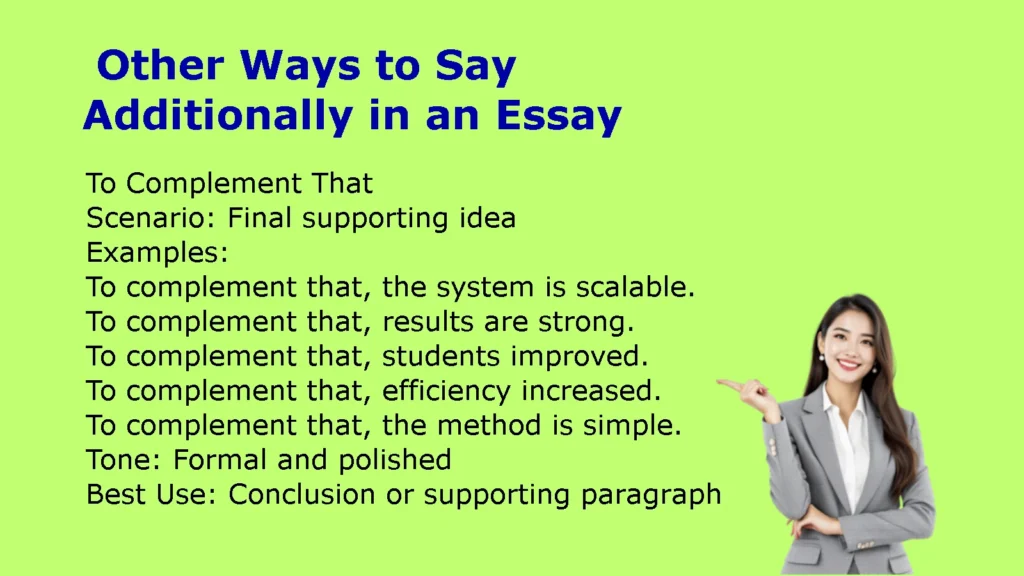
47. To Complement That
Scenario: Final supporting idea
Examples:
- To complement that, the system is scalable.
- To complement that, results are strong.
- To complement that, students improved.
- To complement that, efficiency increased.
- To complement that, the method is simple.
Tone: Formal and polished
Best Use: Conclusion or supporting paragraph
Final Conclusion
Now you have a complete set of 47 powerful alternatives to “additionally” in an essay. Using these transitions helps your writing become more fluid, professional, and academically strong. Instead of repeating one word, you can now choose from a wide range of expressions like “furthermore,” “in support of that,” “by extension,” or “to complement that” to improve clarity and style.

