
Ever had a moment where your mind just… blanks out completely in the middle of a sentence? That awkward, funny, slightly frustrating experience is exactly what people mean when they search for Other Ways to Say Brain Fart.
And yes—you’re not alone. We all forget words, lose thoughts mid-sentence, or suddenly go completely blank at the worst possible moment. It happens in meetings, conversations, exams, and even when you’re saying something simple. But here’s the kicker: having the right expression to describe it can make it feel a lot more fun and less embarrassing.
In this guide, you’ll discover Other Ways to Say Brain Fart that are creative, funny, polite, and even professional depending on the situation. We promise you’ll find the perfect alternative for casual chats, workplace conversations, or content writing.
And it gets better…
You’ll also learn how to use each phrase naturally with real examples so you never feel stuck for words again. From lighthearted slang to more polished expressions, we’ve got you covered.
So whether you want to sound funny, relatable, or simply more refined—this list will give you exactly what you need.
What Does “Brain Fart” Mean?
“Brain fart” is a casual slang term used to describe a temporary mental lapse, such as forgetting something, mixing up words, or losing focus for a moment. It usually refers to harmless mistakes caused by distraction, fatigue, or forgetfulness.
When to Use “Brain Fart”
You typically use this phrase in informal conversations with friends or people you are comfortable with. It’s often used humorously to describe small mistakes, memory slips, or moments of confusion.
Is It Professional or Polite to Say “Brain Fart”?
No, it is generally not considered professional. It may be acceptable in casual speech, but in workplace or formal communication, it’s better to use polite alternatives like “mental lapse,” “slip of the mind,” or “temporary forgetfulness.”
1. Mental Lapse
Scenario: Forgetting something simple during a task
Examples:
- I had a mental lapse and forgot the password.
- That was just a mental lapse, I know the answer.
- Sorry, I experienced a mental lapse during the meeting.
- It was a quick mental lapse, nothing serious.
- I think I had a mental lapse for a second.
Tone: Neutral, professional
Best Use: Work or formal settings
2. Momentary Forgetfulness
Scenario: Brief memory loss
Examples:
- That was just momentary forgetfulness.
- I had momentary forgetfulness about her name.
- It’s simple momentary forgetfulness.
- Sorry, just momentary forgetfulness kicking in.
- Everyone has momentary forgetfulness sometimes.
Tone: Polite, formal
Best Use: Professional communication
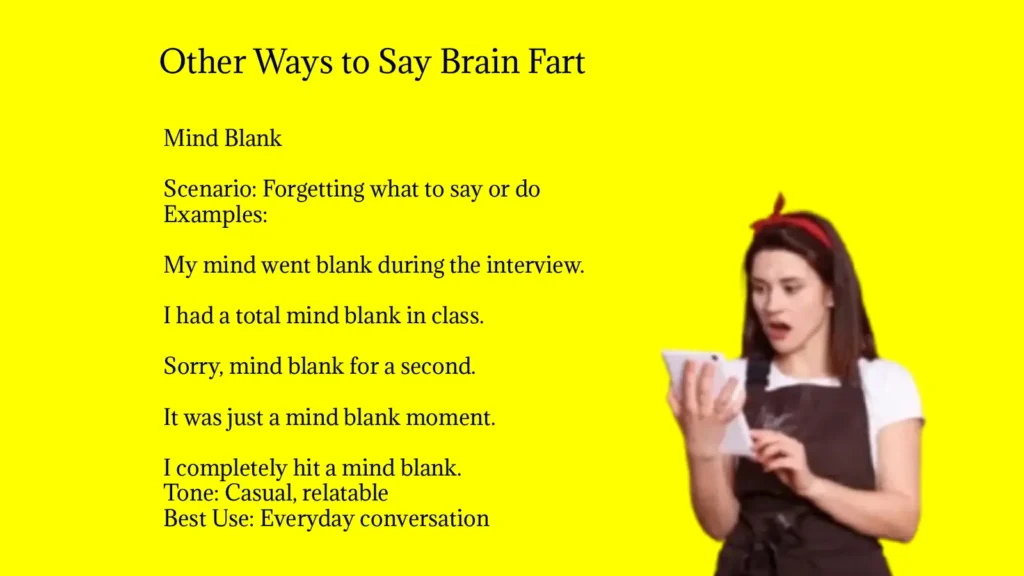
3. Mind Blank
Scenario: Forgetting what to say or do
Examples:
- My mind went blank during the interview.
- I had a total mind blank in class.
- Sorry, mind blank for a second.
- It was just a mind blank moment.
- I completely hit a mind blank.
Tone: Casual, relatable
Best Use: Everyday conversation
4. Temporary Confusion
Scenario: Losing clarity for a moment
Examples:
- I experienced temporary confusion while solving it.
- That was just temporary confusion, I’m fine now.
- Sorry, I had temporary confusion there.
- It was a moment of temporary confusion.
- Temporary confusion made me mess up the answer.
Tone: Neutral
Best Use: General use
5. Slip of the Mind
Scenario: Forgetting something important briefly
Examples:
- That was a slip of the mind.
- Sorry, it slipped my mind earlier.
- It was just a slip of the mind.
- I had a small slip of the mind.
- That detail was a slip of the mind.
Tone: Polite, professional
Best Use: Work or formal apology
6. Forgetful Moment
Scenario: Small memory error
Examples:
- That was a forgetful moment.
- I had a forgetful moment during the call.
- Just a quick forgetful moment.
- It was a forgetful moment, nothing major.
- Everyone has forgetful moments.
Tone: Friendly
Best Use: Casual conversation
7. Mental Blip
Scenario: Sudden minor error in thinking
Examples:
- I had a mental blip just now.
- That was a quick mental blip.
- Sorry, mental blip on my part.
- It was just a mental blip, I’m okay.
- I experienced a mental blip during the test.
Tone: Casual, light
Best Use: Informal settings
8. Brain Freeze
Scenario: Sudden inability to think
Examples:
- I had a brain freeze during the question.
- My brain froze for a second.
- Sorry, total brain freeze.
- I experienced a brain freeze in the interview.
- That was a brain freeze moment.
Tone: Casual, humorous
Best Use: Friendly conversations
9. Temporary Brain Fog
Scenario: Mental cloudiness
Examples:
- I had some brain fog today.
- That was a brain fog moment.
- My brain fog made me forget.
- Sorry, temporary brain fog kicked in.
- I’m dealing with brain fog right now.
Tone: Informal, descriptive
Best Use: Everyday talk
10. Loss of Focus
Scenario: Attention drifting
Examples:
- I had a loss of focus for a second.
- That was just a loss of focus.
- Sorry, I lost focus there.
- It was a momentary loss of focus.
- I experienced loss of focus during class.
Tone: Neutral
Best Use: Academic or work settings
11. Mental Slip
Scenario: Small thinking mistake
Examples:
- That was a mental slip.
- I had a mental slip while speaking.
- Sorry, just a mental slip.
- It was a harmless mental slip.
- I made a mental slip during the meeting.
Tone: Neutral
Best Use: Professional use
12. Brain Malfunction (Humorous)
Scenario: Funny exaggeration
Examples:
- My brain totally malfunctioned.
- That was a brain malfunction moment.
- Sorry, brain malfunction again.
- I had a quick brain malfunction.
- Total brain malfunction there.
Tone: Humorous
Best Use: Casual chats
13. Memory Glitch
Scenario: Short memory failure
Examples:
- I had a memory glitch.
- That was a memory glitch moment.
- Sorry, memory glitch happened.
- Just a quick memory glitch.
- My memory glitch caused that mistake.
Tone: Casual, modern
Best Use: Informal use
14. Cognitive Slip
Scenario: Thinking error
Examples:
- That was a cognitive slip.
- I had a cognitive slip during the task.
- Sorry, cognitive slip on my part.
- It was a small cognitive slip.
- I experienced a cognitive slip.
Tone: Formal
Best Use: Academic or professional
15. Blank Moment
Scenario: Short mental pause
Examples:
- I had a blank moment.
- My mind went blank for a moment.
- That was a blank moment.
- Sorry, blank moment there.
- I experienced a blank moment during speaking.
Tone: Neutral, simple
Best Use: Everyday speech
16. Mental Hiccup
Scenario: Small interruption in thinking
Examples:
- I had a mental hiccup during the presentation.
- That was just a mental hiccup, I’m fine now.
- Sorry, mental hiccup on my part.
- It was a quick mental hiccup.
- I experienced a mental hiccup while answering.
Tone: Casual, light
Best Use: Informal or friendly conversations
17. Thought Slip
Scenario: Brief loss of thought
Examples:
- That was a thought slip.
- I had a thought slip while speaking.
- Sorry, thought slip there.
- It was just a thought slip, nothing serious.
- I experienced a thought slip during class.
Tone: Neutral
Best Use: General or semi-formal use
18. Temporary Mind Glitch
Scenario: Sudden confusion or forgetfulness
Examples:
- I had a temporary mind glitch.
- That was a mind glitch moment.
- Sorry, my mind glitched for a second.
- Just a temporary mind glitch.
- I experienced a mind glitch during the task.
Tone: Casual, modern
Best Use: Informal conversations, texting
19. Brain Short-Circuit
Scenario: Overload or confusion
Examples:
- My brain short-circuited for a moment.
- That was a brain short-circuit.
- Sorry, total brain short-circuit there.
- I had a quick brain short-circuit.
- My brain short-circuited during the question.
Tone: Humorous, exaggerated
Best Use: Friendly chats
20. Moment of Confusion
Scenario: Losing clarity briefly
Examples:
- I had a moment of confusion.
- That was just a moment of confusion.
- Sorry, moment of confusion there.
- It was a quick moment of confusion.
- I experienced a moment of confusion during the call.
Tone: Neutral, polite
Best Use: Professional or general use
21. Memory Slip-Up
Scenario: Forgetting something small
Examples:
- That was a memory slip-up.
- I had a memory slip-up earlier.
- Sorry, memory slip-up on my part.
- It was just a small memory slip-up.
- I experienced a memory slip-up during the meeting.
Tone: Casual, slightly informal
Best Use: Friendly or workplace chats
22. Thinking Error
Scenario: Mistake in reasoning
Examples:
- That was a thinking error.
- I made a thinking error in my calculation.
- Sorry, thinking error there.
- It was just a small thinking error.
- I had a thinking error during the task.
Tone: Neutral, semi-formal
Best Use: Academic or work settings
23. Brain Pause
Scenario: Short mental stop
Examples:
- I had a brain pause for a second.
- That was a brain pause moment.
- Sorry, my brain paused there.
- It was just a quick brain pause.
- I experienced a brain pause during speaking.
Tone: Casual, light
Best Use: Friendly conversations
24. Mental Disconnect
Scenario: Losing connection in thought
Examples:
- I had a mental disconnect.
- That was a mental disconnect moment.
- Sorry, mental disconnect happened.
- It was a brief mental disconnect.
- I experienced a mental disconnect during class.
Tone: Neutral, slightly formal
Best Use: Work or academic context
25. Cognitive Fog
Scenario: Clouded thinking
Examples:
- I was dealing with cognitive fog.
- That was a cognitive fog moment.
- Sorry, cognitive fog hit me.
- It was just temporary cognitive fog.
- I experienced cognitive fog during the task.
Tone: Formal, descriptive
Best Use: Health, academic, or professional tone
26. Mental Stumble
Scenario: Small speaking or thinking mistake
Examples:
- I had a mental stumble while talking.
- That was a mental stumble.
- Sorry, mental stumble there.
- It was just a quick mental stumble.
- I experienced a mental stumble during the meeting.
Tone: Neutral
Best Use: General communication
27. Brain Freeze Moment
Scenario: Sudden inability to think
Examples:
- I had a brain freeze moment again.
- That was a total brain freeze moment.
- Sorry, brain freeze moment there.
- It was just a quick brain freeze moment.
- I experienced a brain freeze moment in class.
Tone: Casual, humorous
Best Use: Informal conversations
28. Forgetful Brain Moment
Scenario: Minor memory lapse
Examples:
- That was a forgetful brain moment.
- I had a forgetful brain moment earlier.
- Sorry, forgetful brain moment there.
- It was just a quick forgetful brain moment.
- I experienced a forgetful brain moment today.
Tone: Light, casual
Best Use: Friendly chats
29. Mental Overload
Scenario: Too much information causing confusion
Examples:
- I had a mental overload.
- That was a mental overload moment.
- Sorry, mental overload hit me.
- It was just a brief mental overload.
- I experienced mental overload during the exam.
Tone: Semi-formal, descriptive
Best Use: Academic or work situations
30. Brain Lag
Scenario: Delayed thinking response
Examples:
- I had a brain lag for a second.
- That was a brain lag moment.
- Sorry, brain lag there.
- It was just a quick brain lag.
- I experienced brain lag during the question.
Tone: Modern, casual
Best Use: Informal chats, texting
31. Mental Freeze-Up
Scenario: Complete temporary stop in thinking
Examples:
- I had a mental freeze-up.
- That was a mental freeze-up moment.
- Sorry, mental freeze-up there.
- It was just a quick mental freeze-up.
- I experienced a mental freeze-up during the test.
Tone: Casual, expressive
Best Use: Friendly or informal use
32. Thought Block
Scenario: Inability to continue thinking
Examples:
- I had a thought block.
- That was a thought block moment.
- Sorry, thought block there.
- It was just a quick thought block.
- I experienced a thought block during speaking.
Tone: Neutral
Best Use: General communication
33. Brain Stutter
Scenario: Hesitation in thought or speech
Examples:
- I had a brain stutter.
- That was a brain stutter moment.
- Sorry, brain stutter there.
- It was just a quick brain stutter.
- I experienced a brain stutter during my answer.
Tone: Casual, humorous
Best Use: Informal conversations
34. Mental Blank Spot
Scenario: Losing track of thought
Examples:
- I had a mental blank spot.
- That was a mental blank spot moment.
- Sorry, mental blank spot there.
- It was just a quick mental blank spot.
- I experienced a mental blank spot during class.
Tone: Neutral, descriptive
Best Use: Everyday use
35. Cognitive Slip-Up
Scenario: Minor thinking mistake
Examples:
- That was a cognitive slip-up.
- I had a cognitive slip-up earlier.
- Sorry, cognitive slip-up on my part.
- It was just a small cognitive slip-up.
- I experienced a cognitive slip-up during the task.
Tone: Semi-formal, professional
Best Use: Academic or workplace settings
36. Mental Blank Out
Scenario: Sudden complete loss of thought
Examples:
- I had a mental blank out during the quiz.
- That was a total mental blank out.
- Sorry, mental blank out there.
- I experienced a quick mental blank out.
- My mind had a blank out for a second.
Tone: Casual, relatable
Best Use: Everyday conversations
37. Brain Fade
Scenario: Gradual loss of focus or memory
Examples:
- I had a brain fade during the question.
- That was just a brain fade moment.
- Sorry, brain fade on my part.
- I experienced a quick brain fade.
- My brain completely faded there for a second.
Tone: Casual, slightly humorous
Best Use: Informal chats
38. Thought Freeze
Scenario: Mind suddenly stopping
Examples:
- I had a thought freeze in the meeting.
- That was a thought freeze moment.
- Sorry, total thought freeze there.
- I experienced a quick thought freeze.
- My thoughts froze for a second.
Tone: Casual
Best Use: Friendly or casual conversation
39. Mental Slip-Out
Scenario: Losing track of thought mid-sentence
Examples:
- I had a mental slip-out while speaking.
- That was a mental slip-out moment.
- Sorry, mental slip-out there.
- I experienced a quick mental slip-out.
- My thought just slipped out of focus.
Tone: Neutral, slightly informal
Best Use: General conversations
40. Brain Stumble Moment
Scenario: Slight confusion while thinking or speaking
Examples:
- I had a brain stumble moment.
- That was just a brain stumble.
- Sorry, brain stumble there.
- I experienced a quick brain stumble moment.
- My brain stumbled for a second.
Tone: Casual, friendly
Best Use: Informal communication
41. Mental Haze
Scenario: Feeling mentally unclear
Examples:
- I was in a mental haze during the task.
- That was a mental haze moment.
- Sorry, mental haze hit me.
- I experienced a brief mental haze.
- My mind was in a haze for a second.
Tone: Slightly descriptive, informal
Best Use: Everyday or reflective talk
42. Cognitive Slip Moment
Scenario: Small reasoning or thinking error
Examples:
- That was a cognitive slip moment.
- I had a cognitive slip moment earlier.
- Sorry, cognitive slip moment there.
- I experienced a quick cognitive slip moment.
- It was just a small cognitive slip moment.
Tone: Semi-formal
Best Use: Academic or work settings
43. Brain Delay
Scenario: Slow reaction or thinking pause
Examples:
- I had a brain delay during the answer.
- That was a brain delay moment.
- Sorry, brain delay there.
- I experienced a quick brain delay.
- My brain had a slight delay.
Tone: Casual, modern
Best Use: Informal conversations
44. Mental Freeze Moment
Scenario: Sudden inability to respond
Examples:
- I had a mental freeze moment in class.
- That was a mental freeze moment.
- Sorry, mental freeze moment there.
- I experienced a quick mental freeze moment.
- My mind froze for a moment.
Tone: Casual, expressive
Best Use: Friendly chats
45. Thought Glitch
Scenario: Sudden interruption in thinking
Examples:
- I had a thought glitch during the test.
- That was a thought glitch moment.
- Sorry, thought glitch there.
- I experienced a quick thought glitch.
- My thinking glitched for a second.
Tone: Casual, modern
Best Use: Informal texting
46. Memory Pause
Scenario: Temporary inability to recall something
Examples:
- I had a memory pause while speaking.
- That was a memory pause moment.
- Sorry, memory pause there.
- I experienced a quick memory pause.
- My memory paused for a second.
Tone: Neutral, polite
Best Use: General use
47. Mental Disconnect Moment
Scenario: Losing connection between thoughts
Examples:
- I had a mental disconnect moment.
- That was a mental disconnect moment earlier.
- Sorry, mental disconnect there.
- I experienced a quick mental disconnect moment.
- My thoughts disconnected for a second.
Tone: Neutral, slightly formal
Best Use: Work or academic settings
Conclusion
“Brain fart” is a funny and expressive slang term, but these 47 alternatives give you a wide range of ways to describe the same idea more appropriately. From casual phrases like “brain fade” to professional ones like “mental lapse” or “cognitive slip,” you now have the perfect expression for every situation—whether you’re talking to friends, colleagues, or in formal settings.

