
Ever struggled to find the right words to describe a funny person without repeating the same phrase over and over? Whether you’re writing a compliment, crafting a social media post, or describing someone with a great sense of humor, using fresh and expressive language can make your message more engaging.
The problem is that calling someone a “funny person” can feel repetitive and lack personality. And here’s the kicker: there are dozens of more colorful ways to describe someone who keeps people laughing, from a comedian and joker to a wit, humorist, or class clown.
But don’t worry—we’ve got you covered.
In this guide, you’ll discover Other Ways to Say Funny Person, including professional, casual, and creative alternatives for different situations. You’ll also learn how related terms like sense of humor, comedic talent, entertainer, funnyman, and comic character can help you express the same idea with greater precision and style.
So whether you’re praising a friend, writing a character description, or looking to expand your vocabulary, these alternatives will help you sound more natural, descriptive, and memorable.
What Does “Funny Person” Mean?
A “funny person” refers to someone who regularly makes people laugh through jokes, clever remarks, amusing behavior, or a playful attitude. They often have a strong sense of humor, quick wit, and a talent for creating enjoyable conversations.
When to Use “Funny Person”
You can use this phrase when describing a friend, coworker, family member, entertainer, or anyone known for being humorous. It works in both casual and professional conversations when discussing someone’s personality.
Is It Professional/Polite to Say “Funny Person”?
Yes, “funny person” is polite and appropriate in most situations. However, depending on the context, alternatives such as “witty individual” or “humorous colleague” may sound more professional, while phrases like “class clown” are better suited for informal settings.
1. Comedian
Scenario: Describing someone who constantly makes people laugh.
Examples:
- He’s such a comedian at family gatherings.
- Everyone thinks she’s a comedian because of her jokes.
- My brother is the comedian of the group.
- She acts like a comedian whenever friends visit.
- He could easily become a comedian someday.
Tone: Playful and complimentary.
Best Use: For naturally humorous people.
2. Jokester
Scenario: Someone who enjoys telling jokes frequently.
Examples:
- Our office jokester keeps meetings entertaining.
- He’s a real jokester around his friends.
- The classroom jokester made everyone laugh.
- She’s known as the family jokester.
- Every group needs a jokester like him.
Tone: Casual and friendly.
Best Use: Informal conversations.
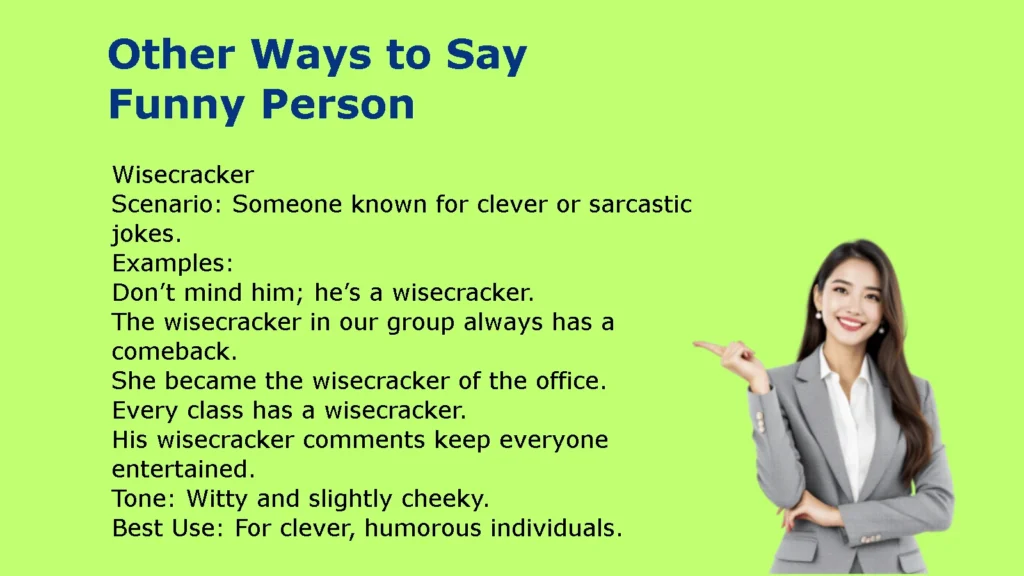
3. Wisecracker
Scenario: Someone known for clever or sarcastic jokes.
Examples:
- Don’t mind him; he’s a wisecracker.
- The wisecracker in our group always has a comeback.
- She became the wisecracker of the office.
- Every class has a wisecracker.
- His wisecracker comments keep everyone entertained.
Tone: Witty and slightly cheeky.
Best Use: For clever, humorous individuals.
4. Wit
Scenario: Highlighting intelligence and humor.
Examples:
- She’s a true wit with her quick responses.
- Everyone admires his wit.
- Her wit makes conversations enjoyable.
- He’s known for being a sharp wit.
- The team appreciates her wit and humor.
Tone: Sophisticated and positive.
Best Use: Professional or educated settings.
5. Entertainer
Scenario: Someone who keeps people amused.
Examples:
- He’s the entertainer at every party.
- She naturally becomes the entertainer in social events.
- The entertainer in our group keeps spirits high.
- Everyone loves being around that entertainer.
- He’s a born entertainer.
Tone: Positive and appreciative.
Best Use: Social gatherings and events.
6. Humorist
Scenario: Someone with a strong sense of humor.
Examples:
- He’s a talented humorist.
- Many consider her a natural humorist.
- The humorist in our office boosts morale.
- She’s a humorist with clever observations.
- His writing shows he’s a humorist.
Tone: Professional and refined.
Best Use: Formal descriptions.
7. Class Clown
Scenario: Someone who makes people laugh in school or groups.
Examples:
- He was the class clown growing up.
- Every classroom has a class clown.
- The class clown kept lessons interesting.
- She became the class clown during high school.
- Teachers often remember the class clown.
Tone: Informal and nostalgic.
Best Use: School-related discussions.
8. Funny Character
Scenario: Describing a uniquely amusing person.
Examples:
- He’s quite a funny character.
- She’s a funny character with endless stories.
- Everyone enjoys that funny character.
- The neighborhood has its own funny character.
- He’s known as a funny character among friends.
Tone: Lighthearted and friendly.
Best Use: Casual conversations.
9. Laugh Generator
Scenario: Someone who consistently makes others laugh.
Examples:
- He’s a true laugh generator.
- The laugh generator in our group never disappoints.
- She’s a laugh generator at parties.
- Everyone loves a good laugh generator.
- He naturally becomes the laugh generator.
Tone: Fun and modern.
Best Use: Casual settings.
10. Comic Genius
Scenario: Someone exceptionally funny.
Examples:
- He’s a comic genius.
- Her timing makes her a comic genius.
- The comic genius had everyone laughing.
- She’s considered a comic genius by friends.
- His humor shows true comic genius.
Tone: Highly complimentary.
Best Use: Praising exceptional humor.
11. Funnyman
Scenario: Referring to a humorous male.
Examples:
- He’s the funnyman of the office.
- Every group has a funnyman.
- The funnyman kept everyone entertained.
- He enjoys being the funnyman.
- The funnyman stole the show.
Tone: Friendly and traditional.
Best Use: Informal conversations.
12. Funny Woman
Scenario: Referring to a humorous female.
Examples:
- She’s a funny woman with great stories.
- Everyone loves that funny woman.
- The funny woman brightened the event.
- She’s known as the funny woman in the family.
- The funny woman kept everyone smiling.
Tone: Positive and respectful.
Best Use: Informal and social settings.
13. Cut-Up
Scenario: Someone who constantly jokes around.
Examples:
- He’s a real cut-up.
- The cut-up in class got everyone laughing.
- She’s always been a cut-up.
- Every office has a cut-up.
- The cut-up lightened the mood.
Tone: Playful and informal.
Best Use: Friendly environments.
14. Prankster
Scenario: Someone who enjoys humorous tricks.
Examples:
- He’s a harmless prankster.
- The prankster planned another joke.
- She’s known as the office prankster.
- Every friend group has a prankster.
- The prankster kept everyone amused.
Tone: Playful and mischievous.
Best Use: Casual situations.
15. Banter Expert
Scenario: Someone skilled at humorous conversation.
Examples:
- He’s a banter expert.
- The banter expert always has a clever reply.
- She became the banter expert of the team.
- Everyone enjoys talking to a banter expert.
- His quick remarks make him a banter expert.
Tone: Friendly and modern.
Best Use: Social interactions.
16. Witty Individual
Scenario: Professional way to describe a funny person.
Examples:
- She’s a witty individual.
- The witty individual impressed everyone.
- He’s known as a witty individual at work.
- A witty individual makes conversations enjoyable.
- Her humor makes her a witty individual.
Tone: Professional and polished.
Best Use: Workplace and formal writing.
17. Comic
Scenario: Someone naturally amusing.
Examples:
- He’s a comic by nature.
- The comic kept everyone laughing.
- She’s the comic of our friend group.
- Everyone appreciates a good comic.
- The comic made the trip memorable.
Tone: Friendly and positive.
Best Use: Informal descriptions.
18. Life of the Party
Scenario: Someone who energizes social gatherings.
Examples:
- He’s the life of the party.
- She’s always the life of the party.
- The life of the party arrived late.
- Everyone loves the life of the party.
- He naturally becomes the life of the party.
Tone: Complimentary and upbeat.
Best Use: Social events.
19. Laugh Riot
Scenario: Someone extremely funny.
Examples:
- He’s a laugh riot.
- The laugh riot entertained the crowd.
- She’s an absolute laugh riot.
- Everyone calls him a laugh riot.
- The laugh riot kept the evening lively.
Tone: Enthusiastic and casual.
Best Use: Strong praise.
20. Amusing Person
Scenario: General alternative for funny person.
Examples:
- He’s an amusing person.
- She’s an amusing person to be around.
- The amusing person made the event enjoyable.
- Everyone likes that amusing person.
- He’s known as an amusing person.
Tone: Neutral and polite.
Best Use: Professional and casual settings.
21. Humor Machine
Scenario: Someone who never runs out of jokes.
Examples:
- He’s a humor machine.
- The humor machine had everyone laughing.
- She’s a humor machine at gatherings.
- Everyone enjoys the humor machine.
- The humor machine keeps conversations lively.
Tone: Fun and energetic.
Best Use: Informal conversations.
22. Gagster
Scenario: Someone who enjoys making humorous remarks.
Examples:
- He’s a talented gagster.
- The gagster entertained the group.
- She became the gagster of the team.
- Everyone likes the gagster.
- The gagster always has a joke ready.
Tone: Playful and casual.
Best Use: Informal settings.
23. Jester
Scenario: Someone who jokes and entertains.
Examples:
- He’s the jester of the family.
- Every group needs a jester.
- The jester kept everyone smiling.
- She plays the role of jester well.
- The jester brightened the evening.
Tone: Lighthearted and creative.
Best Use: Friendly conversations.
24. Comedy Lover
Scenario: Someone who enjoys humor and shares it.
Examples:
- He’s a comedy lover.
- The comedy lover always finds something funny.
- She’s known as a comedy lover.
- Every comedy lover appreciates good jokes.
- The comedy lover keeps people smiling.
Tone: Positive and casual.
Best Use: Humor-related discussions.
25. Quick Wit
Scenario: Someone with fast and clever humor.
Examples:
- He has a quick wit.
- Her quick wit impresses everyone.
- The quick wit in our team keeps meetings fun.
- Everyone admires his quick wit.
- A quick wit makes conversations enjoyable.
Tone: Intelligent and complimentary.
Best Use: Professional and social situations.
26. Storyteller
Scenario: Someone who entertains with funny stories.
Examples:
- He’s a gifted storyteller.
- The storyteller had everyone laughing.
- She’s the storyteller in our family.
- Everyone listens to the storyteller.
- The storyteller made the trip unforgettable.
Tone: Warm and appreciative.
Best Use: Family and social gatherings.
27. Crowd-Pleaser
Scenario: Someone who easily entertains others.
Examples:
- He’s a crowd-pleaser.
- The crowd-pleaser energized the room.
- She’s always a crowd-pleaser.
- Everyone appreciates a crowd-pleaser.
- The crowd-pleaser kept the audience engaged.
Tone: Positive and admiring.
Best Use: Events and performances.
28. Humor Champion
Scenario: Someone known for making others laugh.
Examples:
- He’s a humor champion.
- The humor champion lifted everyone’s mood.
- She became the humor champion of the group.
- Everyone enjoys the humor champion.
- The humor champion made the gathering memorable.
Tone: Cheerful and complimentary.
Best Use: Casual praise.
29. Funny Soul
Scenario: Warm and affectionate description.
Examples:
- He’s a funny soul.
- She’s a funny soul with endless energy.
- Everyone loves that funny soul.
- The funny soul brightened the day.
- He remains a funny soul wherever he goes.
Tone: Affectionate and warm.
Best Use: Friends and family.
30. Master of Humor
Scenario: Someone exceptionally skilled at making people laugh.
Examples:
- He’s a master of humor.
- The master of humor entertained the crowd.
- She’s truly a master of humor.
- Everyone recognizes his talent as a master of humor.
- The master of humor made the event unforgettable.
Tone: Highly complimentary and respectful.
Best Use: Describing someone with exceptional comedic talent.
31. Barrel of Laughs
Scenario: Someone who is consistently entertaining and funny.
Examples:
- He’s a barrel of laughs at every gathering.
- Spending time with her is a barrel of laughs.
- The whole trip was fun thanks to that barrel of laughs.
- Everyone enjoys being around a barrel of laughs.
- She’s known as a barrel of laughs among friends.
Tone: Cheerful and affectionate.
Best Use: Informal conversations and social settings.
32. Fun-Loving Person
Scenario: Someone who enjoys humor and creates a fun atmosphere.
Examples:
- He’s a fun-loving person who brightens every room.
- Everyone likes working with a fun-loving person.
- She’s a fun-loving person with a great sense of humor.
- The team appreciates his fun-loving personality.
- Being around a fun-loving person is refreshing.
Tone: Positive and friendly.
Best Use: Casual and professional descriptions.
33. Comic Relief
Scenario: Someone who lightens serious situations with humor.
Examples:
- He provides comic relief during stressful meetings.
- She’s the comic relief in our family.
- Everyone appreciates a little comic relief.
- The comic relief helped ease the tension.
- He naturally becomes the comic relief of the group.
Tone: Appreciative and lighthearted.
Best Use: Group settings and workplace discussions.
34. Hilarious Individual
Scenario: A formal way to describe a very funny person.
Examples:
- He’s a hilarious individual with endless stories.
- Everyone agrees she’s a hilarious individual.
- The hilarious individual kept the audience laughing.
- Working with a hilarious individual is enjoyable.
- He’s known as a hilarious individual among colleagues.
Tone: Complimentary and professional.
Best Use: Formal and semi-formal writing.
35. Natural Comedian
Scenario: Someone who is effortlessly funny.
Examples:
- He’s a natural comedian.
- She doesn’t even try—she’s a natural comedian.
- The natural comedian entertained everyone.
- Everyone loves a natural comedian.
- His humor proves he’s a natural comedian.
Tone: Highly complimentary.
Best Use: Praising someone’s innate humor.
36. Smile Maker
Scenario: Someone who regularly cheers people up.
Examples:
- She’s a real smile maker.
- The smile maker lifted everyone’s spirits.
- He’s always been a smile maker in our family.
- Everyone needs a smile maker in their life.
- The smile maker brightened the workplace.
Tone: Warm and affectionate.
Best Use: Friends, family, and positive descriptions.
37. Mischief Maker
Scenario: Someone whose humor often comes from playful antics.
Examples:
- He’s a harmless mischief maker.
- The mischief maker pulled another funny stunt.
- She’s the mischief maker of the group.
- Everyone expects surprises from the mischief maker.
- The mischief maker kept the party lively.
Tone: Playful and fun.
Best Use: Informal conversations.
38. Pun Master
Scenario: Someone who enjoys making puns and wordplay.
Examples:
- He’s the office pun master.
- The pun master had everyone groaning and laughing.
- She’s a true pun master.
- Everyone knows him as a pun master.
- The pun master never misses a chance for wordplay.
Tone: Clever and humorous.
Best Use: Conversations about wordplay and witty humor.
39. Giggle Generator
Scenario: Someone who constantly causes laughter.
Examples:
- She’s a giggle generator around children.
- The giggle generator kept everyone entertained.
- He became the giggle generator at the event.
- Everyone loves the group’s giggle generator.
- The giggle generator brightened the afternoon.
Tone: Playful and affectionate.
Best Use: Informal and family settings.
40. Humor Specialist
Scenario: Someone especially skilled at making people laugh.
Examples:
- He’s the humor specialist in our team.
- The humor specialist eased everyone’s stress.
- She acts like a humor specialist during events.
- Everyone appreciates a humor specialist.
- The humor specialist made the presentation enjoyable.
Tone: Professional yet fun.
Best Use: Workplace and social environments.
41. Joke Machine
Scenario: Someone who always has a joke ready.
Examples:
- He’s a complete joke machine.
- The joke machine entertained everyone all night.
- She’s the joke machine in our friend group.
- Everyone expects laughs from the joke machine.
- The joke machine kept the conversation lively.
Tone: Casual and energetic.
Best Use: Friendly conversations.
42. Humor Enthusiast
Scenario: Someone who loves humor and sharing laughs.
Examples:
- He’s a humor enthusiast who enjoys making people smile.
- The humor enthusiast always finds something funny.
- She’s known as a humor enthusiast.
- Every humor enthusiast appreciates good comedy.
- The humor enthusiast made the gathering enjoyable.
Tone: Positive and conversational.
Best Use: Casual and professional contexts.
43. Laugh Magnet
Scenario: Someone who naturally attracts laughter.
Examples:
- He’s a laugh magnet wherever he goes.
- The laugh magnet had the whole room smiling.
- She’s a laugh magnet among friends.
- Everyone enjoys spending time with a laugh magnet.
- The laugh magnet made the event memorable.
Tone: Fun and complimentary.
Best Use: Informal praise.
44. Waggish Person
Scenario: A literary or sophisticated term for a funny person.
Examples:
- He’s a waggish person with clever remarks.
- The waggish person entertained the guests.
- She’s known as a waggish person among colleagues.
- Everyone appreciated the waggish person’s humor.
- The waggish person kept the conversation lively.
Tone: Formal and intellectual.
Best Use: Writing and sophisticated descriptions.
45. Cheerful Entertainer
Scenario: Someone who combines positivity with humor.
Examples:
- He’s a cheerful entertainer at family events.
- The cheerful entertainer made everyone feel welcome.
- She’s a cheerful entertainer with endless energy.
- Everyone loves a cheerful entertainer.
- The cheerful entertainer brought joy to the occasion.
Tone: Warm and positive.
Best Use: Social and family gatherings.
46. Humor Hero
Scenario: Someone who saves dull moments with laughter.
Examples:
- He’s the humor hero of our office.
- The humor hero turned a boring meeting around.
- She became the humor hero at the party.
- Everyone appreciates a humor hero.
- The humor hero kept the group energized.
Tone: Playful and complimentary.
Best Use: Informal praise and social situations.
47. King or Queen of Comedy
Scenario: Someone widely recognized as the funniest person in a group.
Examples:
- He’s the king of comedy among our friends.
- She’s the queen of comedy in the family.
- The king of comedy had everyone laughing nonstop.
- Everyone agrees she’s the queen of comedy.
- The king of comedy stole the spotlight again.
Tone: Highly complimentary and celebratory.
Best Use: Highlighting exceptional humor and popularity.
Conclusion
Whether you’re describing a comedian, jokester, wit, pun master, laugh magnet, or the king or queen of comedy, these alternatives help you express different shades of humor and personality. Choosing the right term can make your writing more engaging, vivid, and relatable while highlighting exactly what makes someone such a memorable and entertaining person.

