

Other Ways to Say It Is My Understanding is a phrase many people rely on in emails, meetings, and formal conversations—but let’s be honest, it can often sound repetitive or overly cautious when used too frequently.
Have you ever felt unsure if your message sounds too stiff or indirect in professional communication? You’re not alone. Many writers and professionals struggle to sound clear, confident, and polite at the same time. And here’s the real issue: the same phrase keeps showing up again and again.
But here’s the good news: this article solves that problem. You’ll discover powerful alternatives to “It Is My Understanding” that help you sound more natural, professional, and confident in any situation. And it gets better…
In this guide, you will learn a variety of tone-friendly replacements you can use in emails, reports, and conversations. You’ll also see when to use each alternative so your message always fits the context. Plus, you’ll get practical examples to make everything easy to apply right away.
So, whether you want to sound more assertive, more polite, or simply more polished—this guide will help you upgrade your communication instantly.
What Does “It Is My Understanding” Mean?
“It is my understanding” means that you believe something to be true based on the information you have received, but you are not claiming it as an absolute fact. It often adds a polite or cautious tone to statements.
When to Use “It Is My Understanding”
This phrase is commonly used in professional emails, meetings, reports, and formal discussions. It is especially useful when you want to avoid sounding too direct or when confirming information indirectly.
Is It Professional/Polite to Say “It Is My Understanding”?
Yes, it is highly professional and polite. It is widely used in business communication, legal writing, academic discussions, and formal correspondence to maintain a respectful and neutral tone.
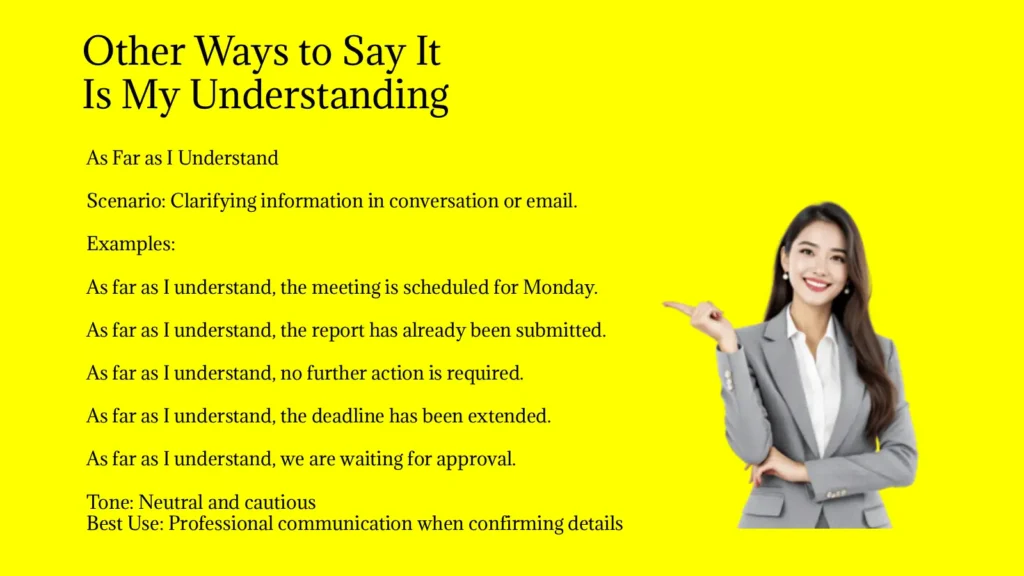
1. As Far as I Understand
Scenario: Clarifying information in conversation or email.
Examples:
- As far as I understand, the meeting is scheduled for Monday.
- As far as I understand, the report has already been submitted.
- As far as I understand, no further action is required.
- As far as I understand, the deadline has been extended.
- As far as I understand, we are waiting for approval.
Tone: Neutral and cautious
Best Use: Professional communication when confirming details
2. From What I Understand
Scenario: Summarizing information received from others.
Examples:
- From what I understand, the project is nearly complete.
- From what I understand, changes will be made next week.
- From what I understand, the policy has been updated.
- From what I understand, the client agreed to the terms.
- From what I understand, the issue has been resolved.
Tone: Informative and polite
Best Use: Emails, meetings, reports
3. My Understanding Is That
Scenario: Stating a belief or interpretation.
Examples:
- My understanding is that the meeting was postponed.
- My understanding is that we are following the old procedure.
- My understanding is that the budget has been approved.
- My understanding is that she will lead the project.
- My understanding is that no changes are needed.
Tone: Professional and clear
Best Use: Workplace discussions and documentation
4. I Understand That
Scenario: Direct yet polite communication.
Examples:
- I understand that the deadline is tight.
- I understand that the team is under pressure.
- I understand that changes are being made.
- I understand that approval is pending.
- I understand that the situation is complex.
Tone: Respectful and straightforward
Best Use: Professional conversations
5. It Appears That
Scenario: Observational or inferred statements.
Examples:
- It appears that the system is down.
- It appears that the document is incomplete.
- It appears that changes were not saved.
- It appears that the issue has been resolved.
- It appears that we are missing data.
Tone: Observational and cautious
Best Use: Reporting issues or findings
6. It Seems That
Scenario: Expressing inference or assumption.
Examples:
- It seems that the meeting has been delayed.
- It seems that the file was not updated.
- It seems that we need further clarification.
- It seems that the process has changed.
- It seems that everything is on track.
Tone: Soft and tentative
Best Use: Informal and formal discussions
7. I Believe That
Scenario: Stating a confident opinion.
Examples:
- I believe that the task is complete.
- I believe that this is the correct approach.
- I believe that we are on schedule.
- I believe that the client agreed.
- I believe that changes are necessary.
Tone: Confident and assertive
Best Use: Decision-making discussions
8. I’ve Been Led to Believe That
Scenario: Indirect or second-hand information.
Examples:
- I’ve been led to believe that the meeting is cancelled.
- I’ve been led to believe that updates are pending.
- I’ve been led to believe that approval was given.
- I’ve been led to believe that changes are minor.
- I’ve been led to believe that the issue is resolved.
Tone: Formal and cautious
Best Use: Sensitive or unclear situations
9. It Is My Impression That
Scenario: Personal interpretation of information.
Examples:
- It is my impression that the project is delayed.
- It is my impression that communication is improving.
- It is my impression that changes are coming.
- It is my impression that the team is aligned.
- It is my impression that progress is steady.
Tone: Reflective and polite
Best Use: Meetings or reports
10. I Have Been Informed That
Scenario: Relaying received information.
Examples:
- I have been informed that the deadline has changed.
- I have been informed that the file is ready.
- I have been informed that approval is pending.
- I have been informed that updates are ongoing.
- I have been informed that the issue is fixed.
Tone: Formal and factual
Best Use: Official communication
11. From My Perspective
Scenario: Sharing viewpoint or interpretation.
Examples:
- From my perspective, the process is working well.
- From my perspective, changes are needed.
- From my perspective, the plan is solid.
- From my perspective, we should proceed.
- From my perspective, risks are minimal.
Tone: Professional and balanced
Best Use: Discussions and presentations
12. As I Understand It
Scenario: Clarifying understanding of information.
Examples:
- As I understand it, the meeting is rescheduled.
- As I understand it, we are waiting for approval.
- As I understand it, the task is complete.
- As I understand it, no changes are required.
- As I understand it, the client agreed.
Tone: Neutral and polite
Best Use: Emails and clarifications
13. It Has Been Communicated That
Scenario: Reporting formal information.
Examples:
- It has been communicated that the project is delayed.
- It has been communicated that changes are approved.
- It has been communicated that the file is updated.
- It has been communicated that deadlines remain unchanged.
- It has been communicated that the issue is resolved.
Tone: Formal and structured
Best Use: Official reporting
14. To the Best of My Knowledge
Scenario: Expressing limited certainty.
Examples:
- To the best of my knowledge, the report is complete.
- To the best of my knowledge, no issues remain.
- To the best of my knowledge, the client agreed.
- To the best of my knowledge, the system is stable.
- To the best of my knowledge, nothing has changed.
Tone: Careful and responsible
Best Use: Legal or formal communication
15. I Understand It to Be That
Scenario: Formal interpretation of information.
Examples:
- I understand it to be that the meeting is cancelled.
- I understand it to be that changes are approved.
- I understand it to be that the task is complete.
- I understand it to be that we are proceeding.
- I understand it to be that no updates are needed.
Tone: Formal and precise
Best Use: Business writing
16. As I See It
Scenario: Giving your interpretation of a situation.
Examples:
- As I see it, the project is on track.
- As I see it, we need more time for testing.
- As I see it, the issue is already resolved.
- As I see it, changes are necessary.
- As I see it, the team is aligned.
Tone: Balanced and professional
Best Use: Meetings and discussions
17. From My Understanding
Scenario: Summarizing received information.
Examples:
- From my understanding, the deadline has been extended.
- From my understanding, approval is pending.
- From my understanding, the file has been updated.
- From my understanding, the issue is minor.
- From my understanding, no further changes are needed.
Tone: Neutral and polite
Best Use: Emails and workplace communication
18. I Am Led to Understand That
Scenario: Indirect or second-hand information.
Examples:
- I am led to understand that the meeting is postponed.
- I am led to understand that changes are approved.
- I am led to understand that the system is stable.
- I am led to understand that the client agreed.
- I am led to understand that the issue is resolved.
Tone: Formal and cautious
Best Use: Legal or sensitive communication
19. It Is My Belief That
Scenario: Confident interpretation.
Examples:
- It is my belief that this approach will work.
- It is my belief that the timeline is realistic.
- It is my belief that the issue is minor.
- It is my belief that the team is ready.
- It is my belief that we should proceed.
Tone: Confident and assertive
Best Use: Decision-making discussions
20. I Take It That
Scenario: Assuming based on available information.
Examples:
- I take it that the meeting is confirmed.
- I take it that the report is complete.
- I take it that no changes are required.
- I take it that we are proceeding as planned.
- I take it that approval has been granted.
Tone: Direct yet polite
Best Use: Workplace conversations
21. It Is My Impression
Scenario: Personal interpretation of information.
Examples:
- It is my impression that the project is delayed.
- It is my impression that communication has improved.
- It is my impression that changes are coming soon.
- It is my impression that everything is on track.
- It is my impression that the team is aligned.
Tone: Reflective and polite
Best Use: Meetings and reports
22. I Gather That
Scenario: Inferring from information received.
Examples:
- I gather that the deadline has changed.
- I gather that the file is ready.
- I gather that the issue is resolved.
- I gather that approval is pending.
- I gather that changes are minor.
Tone: Professional and thoughtful
Best Use: Email communication
23. It Seems to Me That
Scenario: Personal observation or judgment.
Examples:
- It seems to me that we need more data.
- It seems to me that the plan is working.
- It seems to me that the issue is fixed.
- It seems to me that changes are needed.
- It seems to me that the team is ready.
Tone: Cautious and polite
Best Use: Discussions and feedback
24. I Understand It As
Scenario: Interpreting information.
Examples:
- I understand it as the project being delayed.
- I understand it as no further action required.
- I understand it as the report being complete.
- I understand it as approval already given.
- I understand it as changes being minimal.
Tone: Clear and professional
Best Use: Formal communication
25. I Have It That
Scenario: Informal but professional assumption.
Examples:
- I have it that the meeting is cancelled.
- I have it that changes are approved.
- I have it that the file is updated.
- I have it that the issue is resolved.
- I have it that we are moving forward.
Tone: Concise and slightly formal
Best Use: Business discussions
26. My Impression Is That
Scenario: Personal interpretation.
Examples:
- My impression is that progress is steady.
- My impression is that the team is aligned.
- My impression is that changes are needed.
- My impression is that everything is fine.
- My impression is that delays are minor.
Tone: Reflective and neutral
Best Use: Reports and discussions
27. I Am Under the Impression That
Scenario: Cautious assumption.
Examples:
- I am under the impression that the meeting is today.
- I am under the impression that approval is given.
- I am under the impression that changes are complete.
- I am under the impression that the issue is fixed.
- I am under the impression that we are ready.
Tone: Polite and careful
Best Use: Formal clarification
28. From What I Can Tell
Scenario: Based on observation.
Examples:
- From what I can tell, the system is working.
- From what I can tell, the issue is resolved.
- From what I can tell, changes are pending.
- From what I can tell, the project is on track.
- From what I can tell, no errors exist.
Tone: Observational and neutral
Best Use: Technical or professional updates
29. It Would Appear That
Scenario: Formal and indirect observation.
Examples:
- It would appear that the deadline has changed.
- It would appear that the file is missing.
- It would appear that approval is pending.
- It would appear that the issue is fixed.
- It would appear that changes are ongoing.
Tone: Formal and cautious
Best Use: Reports and analysis
30. I Suspect That
Scenario: Mild uncertainty or inference.
Examples:
- I suspect that the meeting is delayed.
- I suspect that the issue is technical.
- I suspect that changes are needed.
- I suspect that approval is pending.
- I suspect that the file is outdated.
Tone: Informal but thoughtful
Best Use: Internal discussions
31. It Is Understood That
Scenario: Shared or assumed knowledge.
Examples:
- It is understood that the project is ongoing.
- It is understood that changes are approved.
- It is understood that deadlines remain unchanged.
- It is understood that the issue is resolved.
- It is understood that we are proceeding.
Tone: Formal and neutral
Best Use: Reports and official writing
32. I Am Given to Understand That
Scenario: Received or indirect information.
Examples:
- I am given to understand that the meeting is cancelled.
- I am given to understand that changes are approved.
- I am given to understand that the issue is fixed.
- I am given to understand that the file is ready.
- I am given to understand that we are moving forward.
Tone: Formal and careful
Best Use: Legal or professional communication
33. It Is Assumed That
Scenario: General assumption.
Examples:
- It is assumed that the report is complete.
- It is assumed that approval has been given.
- It is assumed that the issue is resolved.
- It is assumed that no changes are required.
- It is assumed that the project is ongoing.
Tone: Neutral and formal
Best Use: Documentation and reports
34. I Would Assume That
Scenario: Polite assumption.
Examples:
- I would assume that the meeting is confirmed.
- I would assume that changes are complete.
- I would assume that approval is pending.
- I would assume that the issue is fixed.
- I would assume that we are ready.
Tone: Polite and cautious
Best Use: Professional communication
35. From All I Know
Scenario: Limited knowledge statement.
Examples:
- From all I know, the project is on track.
- From all I know, no changes are needed.
- From all I know, the issue is resolved.
- From all I know, approval is given.
- From all I know, the file is updated.
Tone: Informal and cautious
Best Use: Casual professional updates
36. I Am of the View That
Scenario: Formal opinion.
Examples:
- I am of the view that the plan is effective.
- I am of the view that changes are required.
- I am of the view that the timeline is realistic.
- I am of the view that the issue is minor.
- I am of the view that we should proceed.
Tone: Formal and assertive
Best Use: Reports and official statements
37. It Is Evident That
Scenario: Clear conclusion from facts.
Examples:
- It is evident that progress is being made.
- It is evident that the issue has been resolved.
- It is evident that changes are working.
- It is evident that delays occurred.
- It is evident that the team is improving.
Tone: Strong and factual
Best Use: Analysis and reporting
Conclusion
Using alternatives to “it is my understanding” helps you sound more natural, precise, and professional in different contexts. Whether you want to sound cautious, confident, formal, or neutral, these 37 variations give you flexibility in communication. Mastering them will improve your clarity in emails, meetings, reports, and everyday professional conversations.

