

Looking for other ways to say “it is my understanding” that sound clearer, more natural, and more professional in writing? This phrase is often used in emails, reports, and workplace communication, but repeating it too much can make your message feel formal, stiff, or indirect.
The right alternative can help you express the same idea with more confidence, clarity, and flow—without losing professionalism. Whether you’re summarizing information, confirming details, or sharing what you’ve been told, small wording changes can improve how your message is received.
In this article, you’ll discover practical and easy-to-use alternatives to “it is my understanding” that fit both formal and semi-formal communication.
What Does “It Is My Understanding” Mean?
“It is my understanding” is used to express what you believe to be true based on the information you have. It shows that your statement is based on knowledge, but you remain open to clarification if needed.
When to Use “It Is My Understanding”
This phrase is commonly used in professional settings, emails, meetings, or formal discussions. It helps communicate information politely without sounding overly assertive, especially when confirming facts or assumptions.
Is It Professional/Polite to Say “It Is My Understanding”?
Yes, it is both professional and polite. However, in modern communication, shorter and clearer alternatives are often preferred to improve readability and avoid sounding too formal or repetitive.
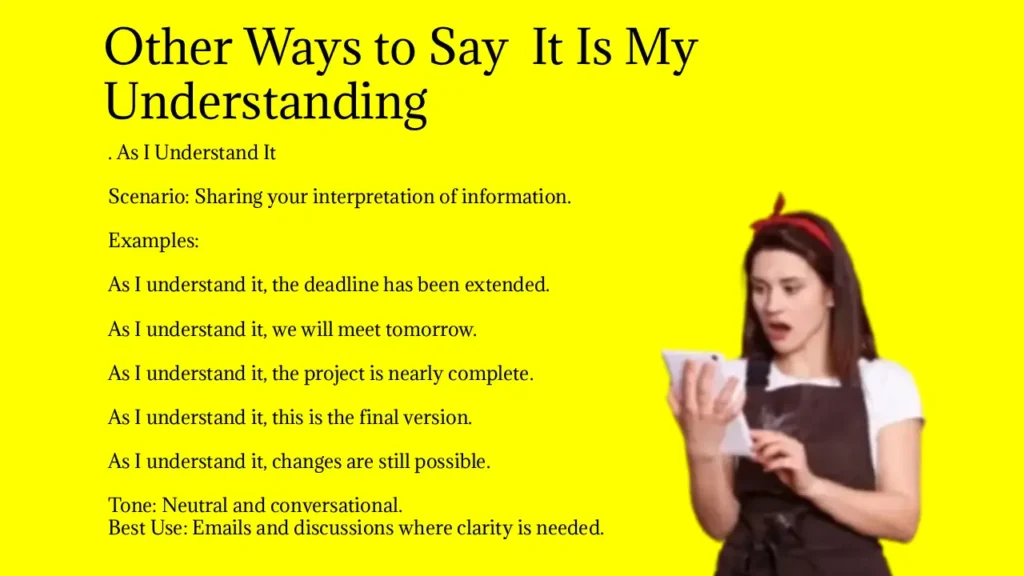
1. As I Understand It
Scenario: Sharing your interpretation of information.
Examples:
- As I understand it, the deadline has been extended.
- As I understand it, we will meet tomorrow.
- As I understand it, the project is nearly complete.
- As I understand it, this is the final version.
- As I understand it, changes are still possible.
Tone: Neutral and conversational.
Best Use: Emails and discussions where clarity is needed.
2. From What I Understand
Scenario: Referring to gathered information.
Examples:
- From what I understand, the meeting is postponed.
- From what I understand, the policy has changed.
- From what I understand, this is the correct process.
- From what I understand, the team agreed on this.
- From what I understand, updates will follow soon.
Tone: Polite and slightly informal.
Best Use: Workplace communication and casual emails.
3. To My Knowledge
Scenario: Stating something based on your knowledge.
Examples:
- To my knowledge, the report has been submitted.
- To my knowledge, no issues have been reported.
- To my knowledge, the system is working fine.
- To my knowledge, the client approved it.
- To my knowledge, everything is on track.
Tone: Professional and confident.
Best Use: Formal emails and reports.
4. As Far as I Know
Scenario: Expressing uncertainty politely.
Examples:
- As far as I know, the event is still scheduled.
- As far as I know, we’re following the same plan.
- As far as I know, no changes were made.
- As far as I know, the issue is resolved.
- As far as I know, everything is ready.
Tone: Casual and honest.
Best Use: Informal conversations and quick updates.
5. I Believe That
Scenario: Sharing a belief or assumption.
Examples:
- I believe that the deadline is next week.
- I believe that we should proceed with the plan.
- I believe that this is the correct approach.
- I believe that the team agrees.
- I believe that we’re ready to launch.
Tone: Confident and direct.
Best Use: When expressing opinions or assumptions.
6. I Understand That
Scenario: Confirming information.
Examples:
- I understand that the meeting is canceled.
- I understand that this task is urgent.
- I understand that you need assistance.
- I understand that changes were requested.
- I understand that we are moving forward.
Tone: Clear and professional.
Best Use: Emails and confirmations.
7. It Seems That
Scenario: Expressing a tentative conclusion.
Examples:
- It seems that the issue has been resolved.
- It seems that we need more time.
- It seems that the client is satisfied.
- It seems that progress is steady.
- It seems that changes are required.
Tone: Neutral and cautious.
Best Use: When you are not fully certain.
8. My Understanding Is That
Scenario: Slightly formal clarification.
Examples:
- My understanding is that the project is complete.
- My understanding is that we start next week.
- My understanding is that approval is pending.
- My understanding is that changes are minimal.
- My understanding is that everything is finalized.
Tone: Formal and structured.
Best Use: Professional communication.
9. From My Perspective
Scenario: Sharing a personal viewpoint.
Examples:
- From my perspective, the plan is effective.
- From my perspective, this is the best option.
- From my perspective, progress is steady.
- From my perspective, the issue is resolved.
- From my perspective, we should proceed.
Tone: Personal and thoughtful.
Best Use: Discussions and decision-making.
10. As Per My Information
Scenario: Referring to available data.
Examples:
- As per my information, the meeting is today.
- As per my information, the task is complete.
- As per my information, no updates are needed.
- As per my information, the client responded.
- As per my information, everything is on schedule.
Tone: Formal and factual.
Best Use: Reports and official emails.
11. Based on What I Know
Scenario: Sharing information you are confident about.
Examples:
- Based on what I know, the meeting is still on.
- Based on what I know, the client approved the plan.
- Based on what I know, we are ready to proceed.
- Based on what I know, no changes were made.
- Based on what I know, everything is finalized.
Tone: Confident and factual.
Best Use: Workplace updates and reporting.
12. From What I’ve Been Told
Scenario: Referring to second-hand information.
Examples:
- From what I’ve been told, the project is delayed.
- From what I’ve been told, the issue is resolved.
- From what I’ve been told, the meeting is canceled.
- From what I’ve been told, changes are coming.
- From what I’ve been told, the team agreed.
Tone: Neutral and cautious.
Best Use: Informal professional conversations.
13. As It Was Explained to Me
Scenario: Passing along instructions or information.
Examples:
- As it was explained to me, we start tomorrow.
- As it was explained to me, approval is required first.
- As it was explained to me, the process is simple.
- As it was explained to me, the deadline is fixed.
- As it was explained to me, updates will follow.
Tone: Polite and structured.
Best Use: Formal discussions or clarifications.
14. I Was Under the Impression That
Scenario: Expressing a possible misunderstanding.
Examples:
- I was under the impression that the meeting was today.
- I was under the impression that the task was complete.
- I was under the impression that we had agreed.
- I was under the impression that changes were made.
- I was under the impression that the deadline moved.
Tone: Diplomatic and soft.
Best Use: Avoiding blame in clarification emails.
15. It Appears That
Scenario: Observing or concluding based on evidence.
Examples:
- It appears that the issue is resolved.
- It appears that the system is working fine.
- It appears that we are ready.
- It appears that changes were made.
- It appears that the plan is on track.
Tone: Neutral and analytical.
Best Use: Reports and observations.
16. I Gather That
Scenario: Inferring information indirectly.
Examples:
- I gather that the meeting was productive.
- I gather that the client is satisfied.
- I gather that changes are expected.
- I gather that the project is ongoing.
- I gather that everything is fine.
Tone: Slightly formal and thoughtful.
Best Use: Professional communication.
17. From My Understanding
Scenario: Restating your interpretation.
Examples:
- From my understanding, we are moving forward.
- From my understanding, the issue is minor.
- From my understanding, approval is pending.
- From my understanding, everything is ready.
- From my understanding, changes are minimal.
Tone: Neutral and professional.
Best Use: Emails and summaries.
18. I Assume That
Scenario: Making a logical assumption.
Examples:
- I assume that the meeting is still scheduled.
- I assume that the report is ready.
- I assume that you’ve reviewed it.
- I assume that changes are complete.
- I assume that we are aligned.
Tone: Direct but cautious.
Best Use: Workplace communication.
19. It Looks Like
Scenario: Informal observation.
Examples:
- It looks like everything is ready.
- It looks like the issue is fixed.
- It looks like we’re on track.
- It looks like the plan changed.
- It looks like the deadline moved.
Tone: Casual and conversational.
Best Use: Quick updates or chats.
20. I Take It That
Scenario: Confirming assumptions politely.
Examples:
- I take it that the meeting is confirmed.
- I take it that you received the email.
- I take it that everything is fine.
- I take it that changes were made.
- I take it that we are aligned.
Tone: Polite and slightly formal.
Best Use: Professional conversations.
21. I’ve Learned That
Scenario: Sharing newly acquired information.
Examples:
- I’ve learned that the deadline changed.
- I’ve learned that the project is complete.
- I’ve learned that updates are pending.
- I’ve learned that the team agreed.
- I’ve learned that the issue is resolved.
Tone: Informative and neutral.
Best Use: Updates and reporting.
22. From What I Can Tell
Scenario: Based on observation or limited info.
Examples:
- From what I can tell, everything is fine.
- From what I can tell, we are ready.
- From what I can tell, changes are minimal.
- From what I can tell, the issue is fixed.
- From what I can tell, the plan is working.
Tone: Cautious and analytical.
Best Use: When certainty is limited.
23. I’ve Been Informed That
Scenario: Formal communication of received info.
Examples:
- I’ve been informed that the meeting is canceled.
- I’ve been informed that changes are coming.
- I’ve been informed that the report is ready.
- I’ve been informed that the deadline shifted.
- I’ve been informed that everything is approved.
Tone: Formal and professional.
Best Use: Corporate or official writing.
24. It Has Come to My Attention That
Scenario: Highlighting discovered information.
Examples:
- It has come to my attention that the issue remains.
- It has come to my attention that changes were made.
- It has come to my attention that updates are missing.
- It has come to my attention that the task is delayed.
- It has come to my attention that approval is pending.
Tone: Formal and serious.
Best Use: Official or corrective communication.
25. I Reckon That
Scenario: Informal opinion or belief.
Examples:
- I reckon that we are ready.
- I reckon that the plan will work.
- I reckon that changes are needed.
- I reckon that the issue is small.
- I reckon that everything is fine.
Tone: Casual and conversational.
Best Use: Informal speech or friendly chats.
26. It’s My Impression That
Scenario: Expressing perception or feeling.
Examples:
- It’s my impression that the meeting went well.
- It’s my impression that things are improving.
- It’s my impression that changes are needed.
- It’s my impression that we are aligned.
- It’s my impression that the issue is solved.
Tone: Thoughtful and reflective.
Best Use: Discussions and feedback.
27. From What I’ve Seen
Scenario: Based on direct observation.
Examples:
- From what I’ve seen, everything is fine.
- From what I’ve seen, the issue is fixed.
- From what I’ve seen, the team is ready.
- From what I’ve seen, changes are working.
- From what I’ve seen, progress is steady.
Tone: Observational and neutral.
Best Use: Reports and reviews.
28. I Conclude That
Scenario: Logical conclusion.
Examples:
- I conclude that the project is complete.
- I conclude that changes are required.
- I conclude that the system works.
- I conclude that the issue is minor.
- I conclude that we are ready.
Tone: Formal and analytical.
Best Use: Reports and analysis.
29. It’s Clear That
Scenario: Strong certainty.
Examples:
- It’s clear that the plan is working.
- It’s clear that changes are needed.
- It’s clear that the issue is resolved.
- It’s clear that progress is happening.
- It’s clear that we are aligned.
Tone: Confident and direct.
Best Use: Conclusions or strong statements.
30. From the Information Available
Scenario: Based on existing data.
Examples:
- From the information available, we are ready.
- From the information available, the project is complete.
- From the information available, changes are minimal.
- From the information available, the issue is fixed.
- From the information available, everything is on track.
Tone: Formal and factual.
Best Use: Reports and documentation.
31. I’m Aware That
Scenario: Acknowledging known information.
Examples:
- I’m aware that the deadline has changed.
- I’m aware that the project is still ongoing.
- I’m aware that updates are pending.
- I’m aware that the issue has been raised.
- I’m aware that the team is working on it.
Tone: Neutral and professional.
Best Use: Workplace communication and acknowledgments.
32. I’ve Noted That
Scenario: Recording or acknowledging information.
Examples:
- I’ve noted that the changes are required.
- I’ve noted that the report is incomplete.
- I’ve noted that the meeting was rescheduled.
- I’ve noted that feedback was shared.
- I’ve noted that the task is delayed.
Tone: Formal and structured.
Best Use: Emails, reports, and professional replies.
33. It’s Been Indicated That
Scenario: Referring to suggested or reported information.
Examples:
- It’s been indicated that approval is pending.
- It’s been indicated that changes are coming.
- It’s been indicated that the plan will proceed.
- It’s been indicated that the issue is resolved.
- It’s been indicated that updates will follow.
Tone: Formal and cautious.
Best Use: Reports, official communication, or summaries.
34. As Far as I’m Aware
Scenario: Stating limited but current knowledge.
Examples:
- As far as I’m aware, the meeting is still on.
- As far as I’m aware, no changes have been made.
- As far as I’m aware, the issue is fixed.
- As far as I’m aware, everything is on track.
- As far as I’m aware, the report is ready.
Tone: Honest and slightly informal.
Best Use: Everyday professional communication.
35. I Perceive That
Scenario: Expressing interpretation or insight.
Examples:
- I perceive that the situation is improving.
- I perceive that the team is aligned.
- I perceive that changes are necessary.
- I perceive that progress is steady.
- I perceive that the issue is minor.
Tone: Thoughtful and analytical.
Best Use: Discussions, evaluations, and reflections.
36. I’ve Come to Understand That
Scenario: Showing evolving understanding.
Examples:
- I’ve come to understand that priorities have changed.
- I’ve come to understand that the deadline shifted.
- I’ve come to understand that the issue is resolved.
- I’ve come to understand that the plan is approved.
- I’ve come to understand that updates are ongoing.
Tone: Reflective and formal.
Best Use: Professional summaries and explanations.
37. From My Observations
Scenario: Based on what you have seen or noticed.
Examples:
- From my observations, the system is stable.
- From my observations, the team is improving.
- From my observations, the issue is fixed.
- From my observations, progress is steady.
- From my observations, everything is aligned.
Tone: Analytical and objective.
Best Use: Reports, reviews, and assessments.
Conclusion
“It is my understanding” is a useful phrase in formal communication, but relying on it repeatedly can make your writing sound rigid or repetitive. By using these 37 alternatives, you can express ideas with more clarity, flexibility, and professionalism. Whether you are writing emails, reports, or having discussions, these variations help you sound more natural, confident, and precise in every situation.

