

Looking for other ways to say moving forward without sounding repetitive or overly formal? You’re not alone.
This phrase is commonly used in business writing, emails, and meetings, but it can quickly feel overused.
Relying on the same expression again and again may make your communication sound generic.
Choosing the right alternative helps you sound more natural, confident, and professional.
It also allows you to adjust your tone depending on the context, whether formal or casual.
In this article, you’ll discover clear and effective alternatives to “moving forward” with practical examples
What Does “Moving Forward” Mean?
“Moving forward” refers to progressing ahead, continuing after a decision, or focusing on the future rather than the past. It often signals a shift toward action, improvement, or next steps.
When to Use “Moving Forward”
This phrase is commonly used in professional settings, emails, meetings, and planning discussions. It’s useful when outlining future actions, strategies, or changes after a decision has been made.
Is It Professional/Polite to Say “Moving Forward”?
Yes, it’s both professional and polite. However, because it’s widely used in business communication, switching to alternatives can make your message sound fresher and more specific.
1. Going Ahead
Scenario: Planning next steps in a project.
Examples:
- Going ahead, we will focus on improving quality.
- Let’s prioritize customer feedback going ahead.
- Going ahead, the team will meet weekly.
- We’ll adjust the strategy going ahead.
- Going ahead, communication will be more streamlined.
Tone: Professional and direct
Best Use: Business meetings and project planning
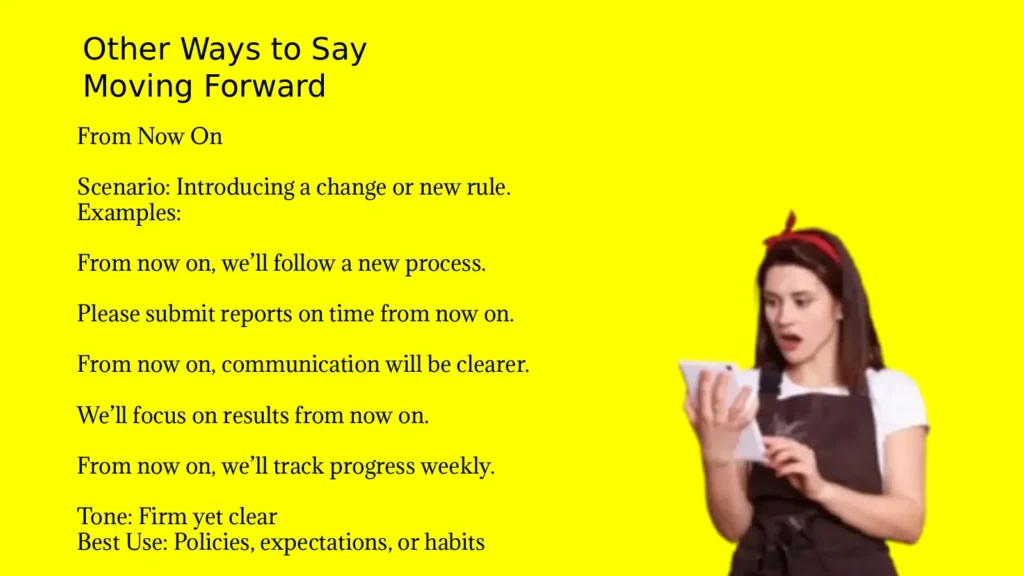
2. From Now On
Scenario: Introducing a change or new rule.
Examples:
- From now on, we’ll follow a new process.
- Please submit reports on time from now on.
- From now on, communication will be clearer.
- We’ll focus on results from now on.
- From now on, we’ll track progress weekly.
Tone: Firm yet clear
Best Use: Policies, expectations, or habits
3. In the Future
Scenario: Talking about long-term plans.
Examples:
- In the future, we aim to expand globally.
- We’ll avoid this mistake in the future.
- In the future, communication will improve.
- Let’s plan better in the future.
- In the future, we’ll invest more in training.
Tone: Neutral and forward-looking
Best Use: General conversations and planning
4. Going Forward
Scenario: Professional discussions.
Examples:
- Going forward, we’ll improve our strategy.
- Let’s stay aligned going forward.
- Going forward, deadlines will be stricter.
- We’ll focus on growth going forward.
- Going forward, communication is key.
Tone: Corporate and formal
Best Use: Emails, meetings
5. Henceforth
Scenario: Formal or legal communication.
Examples:
- Henceforth, all requests must be approved.
- The policy will apply henceforth.
- Henceforth, we follow this guideline.
- Payment is required henceforth.
- Henceforth, the process will change.
Tone: Formal
Best Use: Legal or official writing
6. From This Point On
Scenario: Emphasizing a starting moment.
Examples:
- From this point on, we’ll be more careful.
- Let’s improve from this point on.
- From this point on, quality matters most.
- We’ll adjust our approach from this point on.
- From this point on, we’ll communicate better.
Tone: Clear and decisive
Best Use: Turning points
7. Moving Ahead
Scenario: Motivational or progress-focused talk.
Examples:
- Moving ahead, we’ll stay positive.
- Let’s keep improving moving ahead.
- Moving ahead, teamwork is essential.
- We’ll build stronger systems moving ahead.
- Moving ahead, we focus on growth.
Tone: Encouraging
Best Use: Leadership or team talks
8. As We Proceed
Scenario: Formal presentations or reports.
Examples:
- As we proceed, we’ll monitor results.
- Please stay aligned as we proceed.
- As we proceed, adjustments may be needed.
- We’ll refine the plan as we proceed.
- As we proceed, feedback is welcome.
Tone: Professional and structured
Best Use: Reports, presentations
9. In the Coming Days
Scenario: Short-term planning.
Examples:
- In the coming days, we’ll finalize details.
- Updates will follow in the coming days.
- In the coming days, expect changes.
- We’ll implement this in the coming days.
- In the coming days, progress will be visible.
Tone: Informative
Best Use: Updates and announcements
10. From Here On Out
Scenario: Casual or conversational tone.
Examples:
- From here on out, we’ll stay focused.
- Let’s do better from here on out.
- From here on out, no delays.
- Things will improve from here on out.
- From here on out, we stick to the plan.
Tone: Casual and direct
Best Use: Informal conversations
11. As We Move On
Scenario: Transitioning after an event.
Examples:
- As we move on, lessons will guide us.
- Let’s stay focused as we move on.
- As we move on, improvements will come.
- We’ll grow stronger as we move on.
- As we move on, we’ll adapt better.
Tone: Reflective
Best Use: After challenges or changes
12. In the Next Phase
Scenario: Project stages.
Examples:
- In the next phase, we’ll test the product.
- Growth is key in the next phase.
- In the next phase, we scale operations.
- We’ll expand in the next phase.
- In the next phase, improvements will show.
Tone: Strategic
Best Use: Planning and development
13. As We Continue
Scenario: Ongoing processes.
Examples:
- As we continue, we’ll improve results.
- Feedback matters as we continue.
- As we continue, teamwork is key.
- We’ll adjust as we continue.
- As we continue, progress will grow.
Tone: Smooth and natural
Best Use: Continuous work updates
14. Looking Ahead
Scenario: Future-focused planning.
Examples:
- Looking ahead, we see growth opportunities.
- Let’s stay optimistic looking ahead.
- Looking ahead, changes are coming.
- We’ll improve looking ahead.
- Looking ahead, success is possible.
Tone: Optimistic
Best Use: Vision and strategy
15. Down the Line
Scenario: Informal future reference.
Examples:
- Down the line, we’ll expand the team.
- We may revisit this down the line.
- Down the line, improvements will happen.
- Let’s plan for growth down the line.
- Down the line, things will change.
Tone: Casual
Best Use: Conversations and brainstorming
16. In the Long Run
Scenario: Long-term outcomes.
Examples:
- In the long run, this will benefit us.
- We’ll see results in the long run.
- In the long run, consistency matters.
- This decision helps in the long run.
- In the long run, success is certain.
Tone: Reflective
Best Use: Strategic thinking
17. As Things Progress
Scenario: Gradual development.
Examples:
- As things progress, we’ll adjust plans.
- Feedback helps as things progress.
- As things progress, results improve.
- We’ll learn as things progress.
- As things progress, clarity increases.
Tone: Flexible
Best Use: Evolving situations
18. In Due Course
Scenario: Formal timeline reference.
Examples:
- Results will appear in due course.
- We’ll respond in due course.
- In due course, updates will follow.
- Changes will happen in due course.
- In due course, progress will show.
Tone: Formal
Best Use: Professional communication
19. From This Day Forward
Scenario: Strong commitment or change.
Examples:
- From this day forward, we’ll improve.
- Let’s stay committed from this day forward.
- From this day forward, things will change.
- We’ll focus on quality from this day forward.
- From this day forward, consistency matters.
Tone: Determined
Best Use: Announcements or promises
20. In Upcoming Weeks
Scenario: Short-term planning.
Examples:
- In upcoming weeks, we’ll launch updates.
- Changes will occur in upcoming weeks.
- In upcoming weeks, expect improvements.
- We’ll review progress in upcoming weeks.
- In upcoming weeks, growth will show.
Tone: Informative
Best Use: Timelines and updates
21. As We Advance
Scenario: Professional growth or progress discussion.
Examples:
- As we advance, we’ll refine our strategy.
- Let’s stay focused as we advance.
- As we advance, new opportunities will arise.
- We’ll improve processes as we advance.
- As we advance, teamwork will be essential.
Tone: Professional and forward-thinking
Best Use: Business growth and development
22. As We Go Forward
Scenario: General planning and updates.
Examples:
- As we go forward, communication will improve.
- Let’s stay aligned as we go forward.
- As we go forward, we’ll adjust our plans.
- We’ll learn more as we go forward.
- As we go forward, progress will continue.
Tone: Neutral and flexible
Best Use: Casual or professional contexts
23. In the Next Steps
Scenario: Outlining actions.
Examples:
- In the next steps, we’ll finalize the report.
- Let’s focus on priorities in the next steps.
- In the next steps, improvements will be made.
- We’ll review everything in the next steps.
- In the next steps, clarity is key.
Tone: Clear and structured
Best Use: Project planning and instructions
24. Over Time
Scenario: Gradual progress or change.
Examples:
- Over time, results will improve.
- We’ll see growth over time.
- Over time, this will become easier.
- Skills will develop over time.
- Over time, consistency will pay off.
Tone: Calm and reassuring
Best Use: Long-term expectations
25. In the Days Ahead
Scenario: Near-future planning.
Examples:
- In the days ahead, we’ll implement changes.
- Expect updates in the days ahead.
- In the days ahead, progress will be visible.
- We’ll monitor results in the days ahead.
- In the days ahead, improvements will follow.
Tone: Informative
Best Use: Announcements and updates
26. As We Push Forward
Scenario: Motivational or challenging situations.
Examples:
- As we push forward, resilience is key.
- Let’s stay strong as we push forward.
- As we push forward, we’ll overcome challenges.
- We’ll succeed as we push forward.
- As we push forward, teamwork matters.
Tone: Motivational and strong
Best Use: Leadership and encouragement
27. In Future Steps
Scenario: Strategic planning.
Examples:
- In future steps, we’ll expand operations.
- Improvements will come in future steps.
- In future steps, we’ll refine processes.
- We’ll grow in future steps.
- In future steps, results will improve.
Tone: Professional
Best Use: Planning documents
28. As We Transition
Scenario: Change or shift in direction.
Examples:
- As we transition, communication is key.
- Let’s stay focused as we transition.
- As we transition, improvements will come.
- We’ll adapt as we transition.
- As we transition, support is important.
Tone: Supportive
Best Use: Organizational or role changes
29. In the Near Future
Scenario: Short-term expectations.
Examples:
- In the near future, updates will be shared.
- We’ll improve in the near future.
- In the near future, changes are coming.
- Growth is expected in the near future.
- In the near future, results will show.
Tone: Neutral
Best Use: Forecasting and updates
30. As We Move Along
Scenario: Ongoing progress.
Examples:
- As we move along, we’ll adjust plans.
- Let’s improve as we move along.
- As we move along, things will get better.
- We’ll learn as we move along.
- As we move along, progress continues.
Tone: Casual and smooth
Best Use: Informal or conversational use
31. In the Next Chapter
Scenario: Symbolic or narrative transitions.
Examples:
- In the next chapter, we’ll grow stronger.
- Let’s focus on success in the next chapter.
- In the next chapter, change is coming.
- We’ll improve in the next chapter.
- In the next chapter, new goals await.
Tone: Creative and inspirational
Best Use: Speeches, storytelling
32. From This Moment On
Scenario: Immediate change or decision.
Examples:
- From this moment on, we’ll stay focused.
- Let’s improve from this moment on.
- From this moment on, priorities will shift.
- We’ll do better from this moment on.
- From this moment on, consistency matters.
Tone: Strong and decisive
Best Use: Turning points or commitments
33. In the Time Ahead
Scenario: General future outlook.
Examples:
- In the time ahead, we’ll grow steadily.
- We’ll improve in the time ahead.
- In the time ahead, challenges may arise.
- Success will come in the time ahead.
- In the time ahead, we’ll adapt better.
Tone: Thoughtful
Best Use: Strategic discussions
34. As We Carry On
Scenario: Continuing despite challenges.
Examples:
- As we carry on, we’ll stay strong.
- Let’s stay focused as we carry on.
- As we carry on, improvements will come.
- We’ll succeed as we carry on.
- As we carry on, teamwork is key.
Tone: Encouraging
Best Use: Motivational contexts
35. In the Next Stage
Scenario: Project or lifecycle progression.
Examples:
- In the next stage, we’ll test the product.
- Growth is key in the next stage.
- In the next stage, we’ll expand.
- We’ll improve in the next stage.
- In the next stage, results will show.
Tone: Strategic
Best Use: Business or project planning
36. As We Step Forward
Scenario: Positive or motivational tone.
Examples:
- As we step forward, we’ll stay confident.
- Let’s improve as we step forward.
- As we step forward, success is possible.
- We’ll grow as we step forward.
- As we step forward, change will happen.
Tone: Inspirational
Best Use: Leadership and encouragement
37. Looking to the Future
Scenario: Vision and long-term planning.
Examples:
- Looking to the future, we see growth.
- Let’s stay optimistic looking to the future.
- Looking to the future, opportunities are endless.
- We’ll improve looking to the future.
- Looking to the future, success is near.
Tone: Optimistic and visionary
Best Use: Strategy, vision statements
Conclusion
While “moving forward” is a common and useful phrase, relying on it too often can make your communication feel repetitive. These 37 alternatives give you a wide range of expressions—from formal and professional to casual and motivational—so you can match your tone to any situation. By choosing more specific and engaging phrases, you can communicate your ideas more clearly, inspire confidence, and make a stronger impact in both personal and professional conversations.

