

Ever wondered why the word “obsession” sometimes feels too strong, too negative, or just not quite right in everyday conversation? The truth is, using Other Ways to Say Obsession can help you sound more natural, expressive, and emotionally accurate—especially when talking about passions, habits, or strong interests.
The problem is simple. You want to describe strong feelings, but “obsession” often sounds intense or even unhealthy. You’re not alone if you’ve struggled to find softer or more positive wording in writing, social media captions, or daily speech. And here’s the kicker: the right phrase can completely change how your message is perceived.
But don’t worry—there are plenty of better options.
In this guide, you’ll explore Other Ways to Say Obsession, including alternative phrases for obsession, polite ways to describe strong interest, and casual expressions for passion or fixation. You’ll also learn how to choose between emotional, professional, and friendly tones depending on the situation.
So whether you’re writing creatively, posting online, or just trying to sound more natural in conversation, this will help you express yourself with more clarity and style. Let’s dive in.
What Does “Obsession” Mean?
“Obsession” refers to an intense focus, interest, or preoccupation with a person, idea, activity, or thing. It often suggests that someone thinks about it constantly or gives it significant attention. Depending on the context, it can be positive, neutral, or negative.
When to Use “Obsession”
You can use “obsession” when describing a strong interest, passion, fixation, or dedication toward something. It works in personal conversations, creative writing, social media posts, and professional discussions, depending on the tone you want to convey.
Is It Professional/Polite to Say “Obsession”?
Yes, “obsession” is generally acceptable, but it may sound overly intense in professional settings. In workplace communication, alternatives such as “strong interest,” “focus,” “commitment,” or “dedication” are often more appropriate and polished.
1. Fascination
Scenario: Describing a deep interest in a topic.
Examples:
- Her fascination with astronomy began as a child.
- I’ve always had a fascination with ancient history.
- His fascination with technology drives innovation.
- Their fascination with art is inspiring.
- My fascination with languages keeps growing.
Tone: Positive and intellectual.
Best Use: When describing a strong but healthy interest.
2. Passion
Scenario: Expressing enthusiasm and love for something.
Examples:
- Teaching is her true passion.
- His passion for music is contagious.
- I admire your passion for helping others.
- Their passion for sports is unmatched.
- Writing has always been my passion.
Tone: Positive and motivational.
Best Use: Personal and professional contexts.
3. Fixation
Scenario: Describing an intense focus.
Examples:
- He developed a fixation on perfection.
- Her fixation with details slowed the project.
- The character had a fixation on success.
- His fixation became difficult to ignore.
- That fixation affected his decisions.
Tone: Slightly negative.
Best Use: When highlighting excessive attention.
4. Preoccupation
Scenario: Talking about something constantly on someone’s mind.
Examples:
- Work became his main preoccupation.
- Her preoccupation with deadlines caused stress.
- The issue remained a constant preoccupation.
- Financial concerns were his biggest preoccupation.
- Their preoccupation affected productivity.
Tone: Neutral to formal.
Best Use: Professional or academic writing.
5. Enthusiasm
Scenario: Showing excitement and energy.
Examples:
- Her enthusiasm for learning is admirable.
- I appreciate your enthusiasm for the project.
- His enthusiasm motivated the entire team.
- Their enthusiasm was infectious.
- The children showed enthusiasm for the event.
Tone: Positive and upbeat.
Best Use: Professional and casual conversations.
6. Devotion
Scenario: Demonstrating commitment and loyalty.
Examples:
- Her devotion to family is inspiring.
- He showed devotion to his craft.
- Their devotion led to success.
- Devotion requires consistency.
- Her devotion never wavered.
Tone: Respectful and sincere.
Best Use: Relationships, careers, and hobbies.
7. Addiction
Scenario: Referring to an uncontrollable attachment.
Examples:
- Social media became an addiction.
- His addiction to gaming affected his routine.
- The book humorously described a coffee addiction.
- She joked about her chocolate addiction.
- Addiction can have serious consequences.
Tone: Strong and sometimes negative.
Best Use: Informal or serious discussions.
8. Mania
Scenario: Describing widespread excitement or craze.
Examples:
- The new trend created a fitness mania.
- There was a shopping mania before the holidays.
- The product sparked a buying mania.
- Fashion mania spread quickly.
- The craze became a national mania.
Tone: Dramatic and energetic.
Best Use: Trends and cultural discussions.
9. Infatuation
Scenario: Talking about short-term intense admiration.
Examples:
- His infatuation faded quickly.
- She had an infatuation with the celebrity.
- Teenage infatuations are common.
- The novel explored romantic infatuation.
- Their infatuation didn’t last.
Tone: Romantic and emotional.
Best Use: Relationships and storytelling.
10. Zeal
Scenario: Expressing eager dedication.
Examples:
- She approached the task with zeal.
- His zeal impressed the manager.
- Zeal can inspire others.
- Their zeal fueled progress.
- He pursued his goals with zeal.
Tone: Positive and energetic.
Best Use: Professional and motivational writing.
11. Dedication
Scenario: Highlighting commitment and persistence.
Examples:
- Her dedication led to promotion.
- Dedication is key to success.
- His dedication inspired the team.
- Years of dedication paid off.
- They admired her dedication.
Tone: Professional and respectful.
Best Use: Workplace and achievement-related content.
12. Interest
Scenario: A lighter alternative.
Examples:
- I have an interest in photography.
- His interest in science continues to grow.
- She expressed interest in volunteering.
- Their interest sparked new ideas.
- The topic gained public interest.
Tone: Neutral and versatile.
Best Use: Everyday and professional situations.
13. Craze
Scenario: Referring to a popular trend.
Examples:
- The dance craze spread online.
- There was a craze for collectible cards.
- Fitness crazes come and go.
- The craze attracted millions.
- Social media fueled the craze.
Tone: Casual and trendy.
Best Use: Popular culture discussions.
14. Attachment
Scenario: Describing emotional connection.
Examples:
- She formed a strong attachment to the pet.
- His attachment to tradition remained strong.
- Emotional attachment can influence decisions.
- Their attachment grew over time.
- The attachment was understandable.
Tone: Warm and personal.
Best Use: Relationships and emotions.
15. Focus
Scenario: Emphasizing concentration.
Examples:
- Her focus on quality improved results.
- Maintaining focus is important.
- His focus never shifted.
- The team kept its focus.
- Strong focus leads to success.
Tone: Professional and practical.
Best Use: Work and productivity discussions.
16. Commitment
Scenario: Showing long-term dedication.
Examples:
- Her commitment impressed everyone.
- Commitment builds trust.
- His commitment never weakened.
- The project required commitment.
- Their commitment paid off.
Tone: Professional and positive.
Best Use: Workplace and personal growth topics.
17. Reverence
Scenario: Expressing deep respect.
Examples:
- He spoke with reverence about his mentor.
- Their reverence for tradition was clear.
- Reverence shaped their culture.
- She showed reverence for knowledge.
- The community held the leader in reverence.
Tone: Respectful and formal.
Best Use: Cultural, religious, or historical discussions.
18. Pursuit
Scenario: Describing active dedication.
Examples:
- Happiness is a lifelong pursuit.
- His pursuit of excellence inspired others.
- Their pursuit required patience.
- Education became her pursuit.
- The pursuit was worthwhile.
Tone: Motivational and neutral.
Best Use: Goals and ambitions.
19. Inclination
Scenario: Referring to natural preference.
Examples:
- She has an inclination toward art.
- His inclination for leadership was obvious.
- I have an inclination to explore new ideas.
- Their inclination shaped their choices.
- The inclination grew stronger.
Tone: Formal and balanced.
Best Use: Professional and academic writing.
20. Soft Spot
Scenario: Casual emotional preference.
Examples:
- I have a soft spot for old movies.
- She has a soft spot for animals.
- His soft spot is classic cars.
- We all have a soft spot for nostalgia.
- That song is my soft spot.
Tone: Warm and informal.
Best Use: Casual conversations.
21. Love
Scenario: Strong affection for something.
Examples:
- Her love for books is endless.
- My love for travel keeps growing.
- His love of learning is inspiring.
- Their love for music brought them together.
- Love motivates creativity.
Tone: Warm and heartfelt.
Best Use: Personal conversations and writing.
22. Affinity
Scenario: Natural attraction or liking.
Examples:
- She has an affinity for design.
- His affinity for numbers helped his career.
- The child showed an affinity for music.
- Their affinity grew naturally.
- Affinity often develops over time.
Tone: Professional and polished.
Best Use: Formal and workplace communication.
23. Enthralment
Scenario: Being captivated by something.
Examples:
- The audience watched in enthralment.
- Her enthralment with the story was obvious.
- The experience created total enthralment.
- His enthralment never faded.
- The book inspired enthralment.
Tone: Literary and expressive.
Best Use: Creative writing.
24. Captivation
Scenario: Holding someone’s complete attention.
Examples:
- The film created instant captivation.
- Her captivation with nature inspired art.
- The speaker maintained audience captivation.
- His captivation was easy to see.
- The topic sparked captivation.
Tone: Positive and descriptive.
Best Use: Writing and storytelling.
25. Hobbyhorse
Scenario: A favorite topic someone constantly discusses.
Examples:
- Budgeting became his hobbyhorse.
- She often returned to her hobbyhorse topic.
- Everyone knew his hobbyhorse.
- The issue was her hobbyhorse.
- He spoke passionately about his hobbyhorse.
Tone: Slightly humorous.
Best Use: Informal discussions.
26. Drive
Scenario: Describing inner motivation.
Examples:
- Her drive led to achievement.
- His drive impressed the team.
- Success requires drive.
- Their drive fueled innovation.
- Drive creates momentum.
Tone: Professional and motivational.
Best Use: Career and self-improvement contexts.
27. Hunger
Scenario: Strong desire for success.
Examples:
- He had a hunger for knowledge.
- Her hunger for growth inspired others.
- The athlete’s hunger drove performance.
- Their hunger never disappeared.
- Hunger can fuel ambition.
Tone: Ambitious and energetic.
Best Use: Motivation and achievement.
28. Keen Interest
Scenario: Professional alternative to obsession.
Examples:
- She has a keen interest in marketing.
- His keen interest improved results.
- I developed a keen interest in coding.
- Their keen interest encouraged learning.
- The student showed a keen interest.
Tone: Professional and positive.
Best Use: Workplace and academic settings.
29. Preoccupation
Scenario: Constant mental focus.
Examples:
- The issue became a daily preoccupation.
- Financial matters remained a preoccupation.
- His preoccupation affected concentration.
- Their preoccupation shaped decisions.
- The concern never disappeared.
Tone: Formal and neutral.
Best Use: Professional writing.
30. All-Consuming Interest
Scenario: Describing extreme passion.
Examples:
- Photography became an all-consuming interest.
- His all-consuming interest shaped his life.
- The hobby turned into an all-consuming interest.
- Her all-consuming interest inspired success.
- The project became an all-consuming interest.
Tone: Strong but positive.
Best Use: When emphasizing intense dedication.
31. Compulsion
Scenario: When someone feels unable to stop thinking or doing something.
Examples:
- He has a compulsion to check his phone constantly.
- Her shopping compulsion is getting worse.
- The character’s compulsion drives the story.
- He struggled with a compulsion to overwork.
- That compulsion became hard to control.
Tone: Slightly clinical, serious.
Best Use: Psychological or behavioral descriptions.
32. Obsessive Interest
Scenario: Strong but descriptive alternative to obsession.
Examples:
- She has an obsessive interest in true crime.
- His obsessive interest in coding improved his skills.
- That obsessive interest helped him master the subject.
- They noted her obsessive interest in details.
- His obsessive interest became a career.
Tone: Neutral to intense.
Best Use: When you want clarity without negativity.
33. Burning Desire
Scenario: Strong emotional motivation.
Examples:
- She has a burning desire to succeed.
- His burning desire pushed him forward.
- That burning desire kept him going.
- They shared a burning desire to win.
- A burning desire fuels ambition.
Tone: Motivational and powerful.
Best Use: Goals, ambition, storytelling.
34. Fixated Interest
Scenario: When attention is strongly locked on something.
Examples:
- He has a fixated interest in conspiracy theories.
- Her fixated interest in fashion is noticeable.
- That fixated interest shaped his choices.
- They showed a fixated interest in the topic.
- His fixated interest grew over time.
Tone: Slightly intense.
Best Use: Behavioral or descriptive writing.
35. Strong Attachment
Scenario: Emotional connection or dependency.
Examples:
- She developed a strong attachment to the place.
- His strong attachment to memories is clear.
- That strong attachment is understandable.
- They have a strong attachment to their traditions.
- A strong attachment formed quickly.
Tone: Warm and emotional.
Best Use: Relationships and emotions.
36. Deep Interest
Scenario: Serious and meaningful engagement.
Examples:
- He has a deep interest in psychology.
- Her deep interest in art is inspiring.
- That deep interest led to research.
- They showed a deep interest in culture.
- A deep interest developed over time.
Tone: Thoughtful and professional.
Best Use: Academic or career contexts.
37. Intense Focus
Scenario: Concentrated attention on something.
Examples:
- His intense focus improved performance.
- She worked with intense focus all day.
- That intense focus paid off.
- The team showed intense focus.
- Intense focus is required here.
Tone: Professional and strong.
Best Use: Work, productivity, performance.
38. Passionate Fixation
Scenario: Strong emotional and mental focus.
Examples:
- He has a passionate fixation on cars.
- Her passionate fixation inspires creativity.
- That passionate fixation drives him.
- They noticed his passionate fixation growing.
- It turned into a passionate fixation.
Tone: Emotional and intense.
Best Use: Creative or narrative writing.
39. Unhealthy Obsession
Scenario: Negative or harmful attachment.
Examples:
- His unhealthy obsession affected relationships.
- She developed an unhealthy obsession with perfection.
- That unhealthy obsession caused stress.
- They warned about his unhealthy obsession.
- The unhealthy obsession became clear.
Tone: Negative and cautionary.
Best Use: Psychological or critical writing.
40. Passionate Pursuit
Scenario: Dedicated effort toward a goal.
Examples:
- Her passionate pursuit of art is inspiring.
- His passionate pursuit led to success.
- That passionate pursuit took years.
- They support his passionate pursuit.
- A passionate pursuit requires effort.
Tone: Positive and motivational.
Best Use: Goals and ambitions.
41. Enthrallment
Scenario: Being completely captivated.
Examples:
- He was in enthrallment during the speech.
- Her enthrallment with music is clear.
- The audience felt total enthrallment.
- Their enthrallment lasted hours.
- Enthrallment took over the moment.
Tone: Literary and expressive.
Best Use: Creative writing and storytelling.
42. All-Engaging Interest
Scenario: Something that takes full attention.
Examples:
- His all-engaging interest in science is impressive.
- That became an all-engaging interest.
- She developed an all-engaging interest in history.
- The topic became all-engaging for him.
- Their all-engaging interest grew.
Tone: Formal and descriptive.
Best Use: Academic or explanatory writing.
43. Mental Preoccupation
Scenario: Constant thinking about something.
Examples:
- Work became a mental preoccupation.
- His mental preoccupation affected sleep.
- That mental preoccupation grew stronger.
- She struggled with mental preoccupation.
- Financial stress was a mental preoccupation.
Tone: Formal and slightly negative.
Best Use: Psychological or analytical writing.
44. Enthusiastic Obsession
Scenario: Strong but positive fixation.
Examples:
- His enthusiastic obsession with fitness is clear.
- She has an enthusiastic obsession with books.
- That enthusiastic obsession drives learning.
- Their enthusiastic obsession inspires others.
- It became an enthusiastic obsession.
Tone: Positive and energetic.
Best Use: Informal or motivational content.
45. Compelling Interest
Scenario: Something that strongly draws attention.
Examples:
- She has a compelling interest in law.
- His compelling interest in science is strong.
- That is a compelling interest for many.
- They showed a compelling interest in design.
- A compelling interest developed quickly.
Tone: Professional and persuasive.
Best Use: Academic or career contexts.
46. Dominant Thought
Scenario: When something constantly occupies the mind.
Examples:
- Winning became his dominant thought.
- Her dominant thought was success.
- That idea became a dominant thought.
- A dominant thought shaped his actions.
- Fear became a dominant thought.
Tone: Neutral to intense.
Best Use: Psychological or narrative writing.
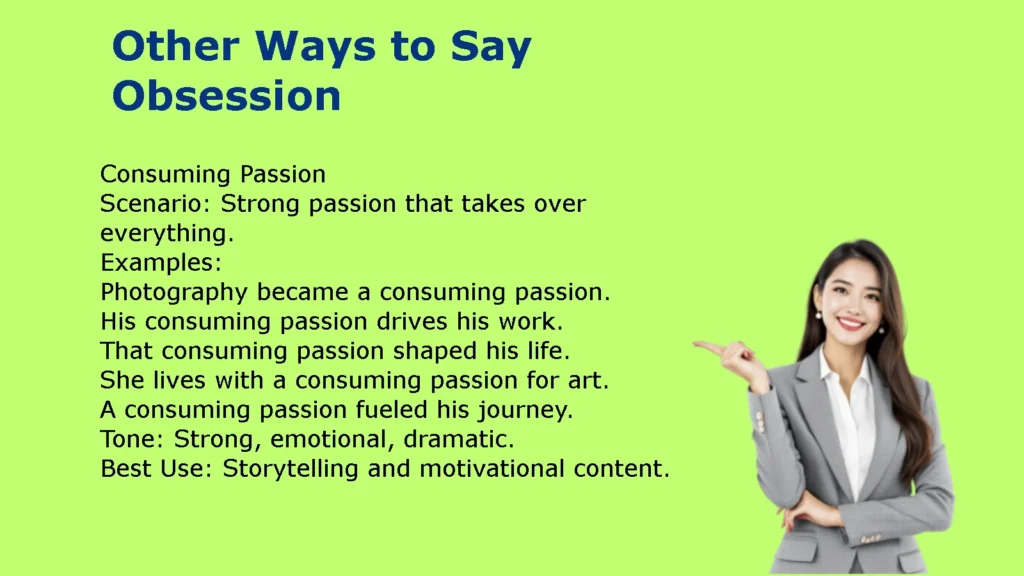
47. Consuming Passion
Scenario: Strong passion that takes over everything.
Examples:
- Photography became a consuming passion.
- His consuming passion drives his work.
- That consuming passion shaped his life.
- She lives with a consuming passion for art.
- A consuming passion fueled his journey.
Tone: Strong, emotional, dramatic.
Best Use: Storytelling and motivational content.
Conclusion
With these 47 alternatives for “obsession,” you now have a wide range of expressions—from neutral and professional terms like deep interest and focus, to intense and emotional ones like consuming passion and burning desire. Choosing the right word helps you communicate more precisely, whether you’re writing casually, professionally, or creatively.

