

Ever been in a conversation where everyone seems to agree, but you’re not completely sure if you’re actually on the same page? That small uncertainty can lead to confusion, missed expectations, and even unnecessary mistakes.
The problem is simple. Saying “on the same page” works, but it can feel a bit repetitive or informal in professional emails, meetings, or formal discussions. And here’s the kicker: if your wording isn’t clear, people may assume alignment when there isn’t any.
Many people look for other ways to say “on the same page”, especially in workplace communication, project discussions, and team coordination where clarity really matters.
But don’t worry—there’s an easy fix.
In this guide, you’ll discover other ways to say “on the same page”, including professional alternatives, casual expressions, and clearer phrases you can use in emails, meetings, and everyday conversations. You’ll also learn how small wording changes can improve clarity and make your communication sound more confident and precise.
So if you want to ensure better understanding and smoother communication in every situation, keep reading—you’re in the right place.
What Does “On the Same Page” Mean?
“On the same page” means that two or more people have the same understanding, agreement, or perspective about something. In other words, everyone involved clearly understands the situation, plan, or goal.
When to Use “On the Same Page”
You can use this phrase in meetings, teamwork discussions, group projects, or personal conversations. Additionally, it works well when confirming understanding before moving forward with a task or decision.
Is It Professional to Say “On the Same Page”?
Yes, it is widely used in professional environments. However, because it is so common, using more precise alternatives can make your communication sound more polished and intentional.
1. In Agreement
Scenario: Workplace discussions or decisions
Examples:
- We are in agreement about the project timeline
- I want to ensure we are in agreement on this approach
- The team is in agreement with the plan
- Are we in agreement before moving forward?
- We should confirm we are in agreement
Tone: Formal and clear
Best Use: Meetings and approvals
2. Aligned on the Plan
Scenario: Project coordination
Examples:
- We are aligned on the plan for next week
- Let’s make sure we are aligned on the strategy
- The team is aligned on the plan moving forward
- Are we fully aligned on the plan?
- We need to be aligned on the plan before execution
Tone: Professional and structured
Best Use: Project planning and teamwork
3. On the Same Understanding
Scenario: Clarifying communication
Examples:
- We are on the same understanding about deadlines
- Let’s get on the same understanding first
- I want to ensure we are on the same understanding
- Are we on the same understanding here?
- We should be on the same understanding before proceeding
Tone: Clear and neutral
Best Use: Avoiding miscommunication
4. In Sync
Scenario: Fast-paced teamwork
Examples:
- The team is in sync with the campaign goals
- We are fully in sync now
- Let’s stay in sync during the project
- Are we in sync on this task?
- We need to be in sync for better results
Tone: Modern and dynamic
Best Use: Agile and creative teams
5. On the Same Wavelength
Scenario: Informal or creative discussions
Examples:
- We are on the same wavelength about this idea
- I think we are on the same wavelength here
- Are we on the same wavelength?
- It feels like we are on the same wavelength
- Let’s get on the same wavelength before continuing
Tone: Friendly and conversational
Best Use: Casual or brainstorming sessions
6. Aligned in Understanding
Scenario: Professional clarification
Examples:
- We are aligned in understanding the requirements
- Let’s ensure we are aligned in understanding
- Are we aligned in understanding this task?
- The team is aligned in understanding the goals
- We must be aligned in understanding before starting
Tone: Formal and precise
Best Use: Business communication
7. Seeing Eye to Eye
Scenario: Agreement or consensus
Examples:
- We are seeing eye to eye on this issue
- I’m glad we are seeing eye to eye now
- Are we seeing eye to eye on the decision?
- The team is finally seeing eye to eye
- We need to see eye to eye before proceeding
Tone: Slightly informal but expressive
Best Use: Negotiations or discussions
8. On Common Ground
Scenario: Finding shared understanding
Examples:
- We are on common ground regarding the strategy
- Let’s find common ground first
- The team is on common ground now
- Are we on common ground here?
- We should work toward common ground
Tone: Balanced and diplomatic
Best Use: Conflict resolution
9. In Agreement on This
Scenario: Simple confirmation
Examples:
- We are in agreement on this plan
- Are we in agreement on this direction?
- I think we are in agreement on this
- The team is in agreement on this approach
- Let’s confirm we are in agreement on this
Tone: Direct and professional
Best Use: Quick confirmations
10. On the Same Page of Understanding
Scenario: Emphasis on clarity
Examples:
- We are on the same page of understanding the goal
- Let’s ensure we are on the same page of understanding
- Are we on the same page of understanding this task?
- The team is on the same page of understanding
- We need to be on the same page of understanding before moving forward
Tone: Formal and detailed
Best Use: Complex projects
11. Fully Aligned
Scenario: Strong agreement
Examples:
- We are fully aligned on the strategy
- The team is fully aligned now
- Are we fully aligned on this decision?
- We must be fully aligned before execution
- Everyone is fully aligned with the goals
Tone: Confident and decisive
Best Use: Leadership communication
12. Mutual Understanding
Scenario: Clear communication goal
Examples:
- We have a mutual understanding of the plan
- Let’s establish mutual understanding first
- Do we have a mutual understanding here?
- The team reached mutual understanding
- We need mutual understanding before proceeding
Tone: Formal and neutral
Best Use: Professional discussions
13. On the Same Track
Scenario: Progress-based communication
Examples:
- We are on the same track with this project
- Let’s ensure we stay on the same track
- Are we on the same track here?
- The team is on the same track now
- We need to be on the same track for success
Tone: Casual and professional mix
Best Use: Project updates
14. In Agreement and Understanding
Scenario: Strong clarity confirmation
Examples:
- We are in agreement and understanding of the plan
- Let’s confirm we are in agreement and understanding
- Are we in agreement and understanding this approach?
- The team is in agreement and understanding
- We must be in agreement and understanding before starting
Tone: Formal and precise
Best Use: Final approvals
15. Working in Alignment
Scenario: Team coordination
Examples:
- We are working in alignment with the goals
- The team is working in alignment now
- Let’s ensure we are working in alignment
- Are we working in alignment here?
- We must work in alignment for success
Tone: Professional and structured
Best Use: Corporate environments
16. On the Same Page Strategically
Scenario: Business planning or leadership discussions
Examples:
- We are on the same page strategically for this project
- Let’s ensure we are on the same page strategically
- Are we on the same page strategically here?
- The leadership team is on the same page strategically
- We must be on the same page strategically before execution
Tone: Formal and leadership-focused
Best Use: High-level planning
17. Shared Understanding
Scenario: Clear communication confirmation
Examples:
- We have a shared understanding of the goals
- Let’s build a shared understanding first
- Do we have a shared understanding here?
- The team reached a shared understanding
- We need a shared understanding before moving forward
Tone: Neutral and professional
Best Use: Meetings and coordination
18. Unified Perspective
Scenario: Strategic alignment
Examples:
- We are working with a unified perspective
- Let’s develop a unified perspective on this issue
- Do we have a unified perspective yet?
- The team has a unified perspective now
- We need a unified perspective before deciding
Tone: Formal and structured
Best Use: Leadership and strategy
19. Mutual Alignment
Scenario: Corporate collaboration
Examples:
- We have mutual alignment on the plan
- Let’s ensure mutual alignment first
- Are we in mutual alignment here?
- The departments are in mutual alignment
- Mutual alignment is required before execution
Tone: Professional and precise
Best Use: Business communication
20. In Agreement and Sync
Scenario: Team coordination
Examples:
- We are in agreement and sync on this project
- Let’s get in agreement and sync first
- Are we in agreement and sync now?
- The team is in agreement and sync
- We must be in agreement and sync before moving forward
Tone: Modern and collaborative
Best Use: Agile teams
21. Aligned Thinking
Scenario: Idea sharing or planning
Examples:
- We have aligned thinking on this strategy
- Let’s develop aligned thinking first
- Are we showing aligned thinking here?
- The team has aligned thinking now
- We need aligned thinking before execution
Tone: Analytical and structured
Best Use: Planning sessions
22. Common Understanding Achieved
Scenario: Final agreement confirmation
Examples:
- We have achieved common understanding
- Let’s ensure common understanding first
- Have we reached common understanding here?
- The team achieved common understanding
- Common understanding is necessary before proceeding
Tone: Formal and conclusive
Best Use: Final approvals
23. Synchronized Understanding
Scenario: Coordinated teamwork
Examples:
- We have synchronized understanding of the plan
- Let’s create synchronized understanding
- Are we in synchronized understanding now?
- The team is in synchronized understanding
- We need synchronized understanding before action
Tone: Technical and precise
Best Use: Structured projects
24. Unified Agreement
Scenario: Decision-making
Examples:
- We have unified agreement on this decision
- Let’s reach unified agreement first
- Are we in unified agreement here?
- The team reached unified agreement
- Unified agreement is required before launch
Tone: Formal and decisive
Best Use: Executive decisions
25. Coordinated Understanding
Scenario: Multi-team collaboration
Examples:
- We have coordinated understanding across teams
- Let’s build coordinated understanding
- Do we have coordinated understanding here?
- The teams reached coordinated understanding
- Coordinated understanding is key for success
Tone: Corporate and structured
Best Use: Large organizations
26. In Step with Each Other
Scenario: Informal teamwork
Examples:
- We are in step with each other on this project
- Let’s stay in step with each other
- Are we in step with each other now?
- The team is in step with each other
- We must remain in step with each other
Tone: Friendly and cooperative
Best Use: Casual team settings
27. Aligned on Expectations
Scenario: Clarifying roles or goals
Examples:
- We are aligned on expectations for this task
- Let’s ensure we are aligned on expectations
- Are we aligned on expectations here?
- The team is aligned on expectations now
- We must be aligned on expectations before starting
Tone: Professional and clear
Best Use: Work planning
28. Same Line of Thinking
Scenario: Idea discussion
Examples:
- We are on the same line of thinking
- Let’s get on the same line of thinking
- Are we on the same line of thinking here?
- The team is on the same line of thinking
- We need the same line of thinking before moving forward
Tone: Casual-professional mix
Best Use: Brainstorming sessions
29. Unified Direction
Scenario: Strategy alignment
Examples:
- We are moving in a unified direction
- Let’s establish a unified direction
- Are we in a unified direction here?
- The team is in a unified direction now
- Unified direction is important for success
Tone: Strategic and formal
Best Use: Leadership planning
30. Shared Direction
Scenario: Team planning
Examples:
- We are working in a shared direction
- Let’s confirm shared direction first
- Are we in shared direction here?
- The team has shared direction now
- Shared direction improves performance
Tone: Balanced and professional
Best Use: Project coordination
31. Consistent Understanding
Scenario: Avoiding confusion
Examples:
- We have a consistent understanding of the task
- Let’s ensure consistent understanding
- Do we have consistent understanding here?
- The team reached consistent understanding
- Consistent understanding is required
Tone: Clear and formal
Best Use: Documentation or planning
32. Agreement in Principle
Scenario: Early-stage decisions
Examples:
- We are in agreement in principle
- Let’s reach agreement in principle first
- Are we in agreement in principle here?
- The team has agreement in principle
- Agreement in principle is enough to proceed
Tone: Legal/formal
Best Use: Negotiations
33. Aligned Vision
Scenario: Long-term strategy
Examples:
- We share an aligned vision for this project
- Let’s develop an aligned vision
- Do we have an aligned vision here?
- The team has an aligned vision
- Aligned vision drives success
Tone: Inspirational and strategic
Best Use: Leadership discussions
34. Harmonized Understanding
Scenario: Cross-team collaboration
Examples:
- We have a harmonized understanding of goals
- Let’s create a harmonized understanding
- Are we in harmonized understanding here?
- The teams achieved harmonized understanding
- Harmonized understanding is essential
Tone: Formal and structured
Best Use: Large projects
35. Coordinated Agreement
Scenario: Group decisions
Examples:
- We reached coordinated agreement
- Let’s ensure coordinated agreement first
- Are we in coordinated agreement here?
- The team achieved coordinated agreement
- Coordinated agreement is required
Tone: Professional
Best Use: Corporate decisions
36. Unified Understanding
Scenario: Final clarity
Examples:
- We have a unified understanding now
- Let’s build unified understanding
- Are we in unified understanding here?
- The team reached unified understanding
- Unified understanding ensures success
Tone: Formal and complete
Best Use: Final approvals
37. Parallel Thinking
Scenario: Creative or analytical discussions
Examples:
- We are in parallel thinking on this idea
- Let’s ensure parallel thinking
- Are we in parallel thinking here?
- The team is in parallel thinking
- Parallel thinking helps collaboration
Tone: Creative and modern
Best Use: Brainstorming
38. Aligned Communication
Scenario: Team coordination
Examples:
- We have aligned communication on this topic
- Let’s ensure aligned communication
- Are we in aligned communication here?
- The team has aligned communication
- Aligned communication avoids confusion
Tone: Professional
Best Use: Workplace messaging
39. Shared Perspective
Scenario: Strategic or conceptual alignment
Examples:
- We share a shared perspective on this issue
- Let’s build a shared perspective
- Do we have a shared perspective here?
- The team developed a shared perspective
- Shared perspective improves decisions
Tone: Analytical
Best Use: Planning and strategy
40. Same Understanding Level
Scenario: Clarification of depth
Examples:
- We are at the same understanding level
- Let’s reach the same understanding level
- Are we at the same understanding level?
- The team is at the same understanding level
- Same understanding level is important
Tone: Neutral and explanatory
Best Use: Training or onboarding
41. Aligned Execution Plan
Scenario: Action-focused teamwork
Examples:
- We have an aligned execution plan
- Let’s finalize aligned execution plan
- Are we aligned on the execution plan?
- The team has an aligned execution plan
- Aligned execution plan ensures success
Tone: Action-oriented
Best Use: Project delivery
42. Coordinated Strategy
Scenario: Business strategy
Examples:
- We are working on a coordinated strategy
- Let’s build a coordinated strategy
- Are we aligned on coordinated strategy?
- The team developed coordinated strategy
- Coordinated strategy improves results
Tone: Strategic and formal
Best Use: Leadership planning
43. Unified Execution Approach
Scenario: Implementation phase
Examples:
- We have a unified execution approach
- Let’s ensure unified execution approach
- Are we on a unified execution approach?
- The team follows a unified execution approach
- Unified execution approach ensures clarity
Tone: Structured and professional
Best Use: Operations
44. Shared Execution Plan
Scenario: Task implementation
Examples:
- We have a shared execution plan
- Let’s confirm shared execution plan
- Are we aligned on shared execution plan?
- The team follows shared execution plan
- Shared execution plan reduces errors
Tone: Practical and clear
Best Use: Project management
45. Mutual Strategic Alignment
Scenario: Executive-level planning
Examples:
- We have mutual strategic alignment
- Let’s ensure mutual strategic alignment
- Are we in mutual strategic alignment?
- The team reached mutual strategic alignment
- Mutual strategic alignment is critical
Tone: Executive and formal
Best Use: Senior leadership
46. Cohesive Understanding
Scenario: Team unity
Examples:
- We have a cohesive understanding
- Let’s build cohesive understanding
- Are we in cohesive understanding here?
- The team developed cohesive understanding
- Cohesive understanding improves teamwork
Tone: Balanced and professional
Best Use: Team coordination
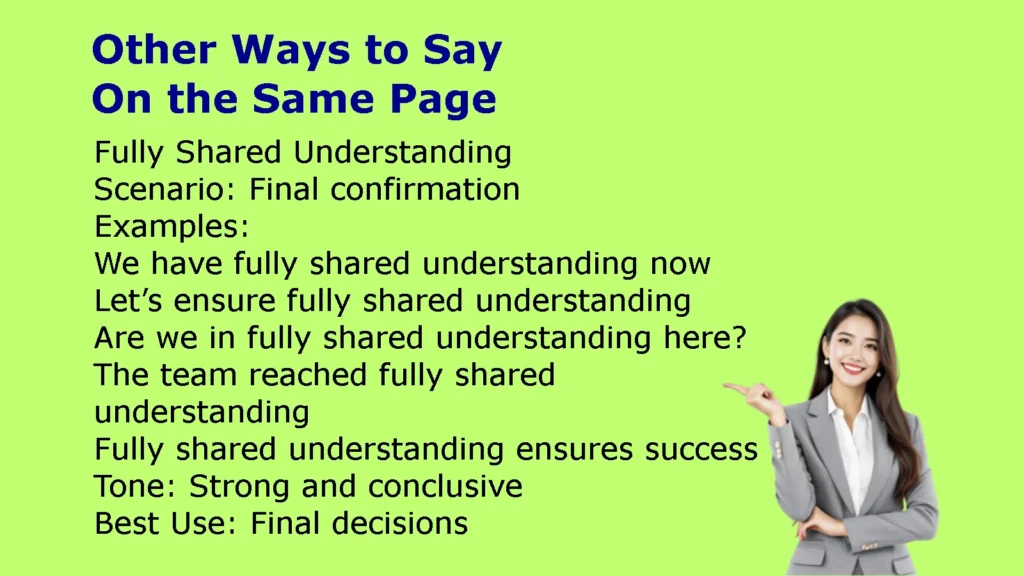
47. Fully Shared Understanding
Scenario: Final confirmation
Examples:
- We have fully shared understanding now
- Let’s ensure fully shared understanding
- Are we in fully shared understanding here?
- The team reached fully shared understanding
- Fully shared understanding ensures success
Tone: Strong and conclusive
Best Use: Final decisions
Conclusion
Instead of repeatedly using “on the same page,” these 47 alternatives help you express alignment, understanding, and teamwork in a more professional, precise, and impactful way. Depending on the context—whether casual, corporate, or leadership-level—you can now choose expressions that enhance clarity, improve communication, and make your writing more dynamic and polished.

