

Ever been in a situation where you want to say Other Ways to Say Pay for Your Own Meal without sounding rude, awkward, or too direct? Whether it’s a group dinner, a casual hangout, or a professional gathering, the way you phrase it can completely change the tone of the conversation.
The problem is simple. Saying “pay for your own meal” can feel blunt. And here’s the kicker: in some settings, it may even come across as impolite or socially uncomfortable, even if your intention is fair and clear.
Many people struggle with this in everyday situations. That’s why they search for more polite ways to say split the bill, casual ways to say cover your own meal, or even professional ways to handle group meal payments without creating tension.
But don’t worry—there’s an easy fix.
In this guide, you’ll discover Other Ways to Say Pay for Your Own Meal, including polite, friendly, and professional alternatives you can use in real conversations, texts, emails, and social plans. You’ll also learn how small wording changes can make you sound more respectful and socially smooth.
So if you want to improve your dining etiquette phrases and communicate more naturally in group settings, keep reading—you’re in the right place.
What Does “Pay for Your Own Meal” Mean?
“Pay for your own meal” means that each person is responsible for covering the cost of the food and drinks they order. In other words, everyone pays individually rather than having one person or organization cover the entire bill.
When to Use “Pay for Your Own Meal”
You can use this phrase when organizing social gatherings, work lunches, networking events, birthday dinners, or casual meetups where attendees are expected to pay for themselves. However, using softer alternatives often sounds more polite and welcoming.
Is It Professional/Polite to Say “Pay for Your Own Meal”?
Yes, it is professional and acceptable. However, depending on the situation, a gentler phrase such as “individual checks” or “everyone covers their own expenses” may sound more courteous. Therefore, choosing the right wording can help avoid misunderstandings while maintaining a positive tone.
1. Everyone Pays Their Own Way
Scenario: Casual group dinner.
Examples:
- Everyone pays their own way for tonight’s dinner.
- Just a reminder, everyone pays their own way.
- We’re keeping it simple—everyone pays their own way.
- For this outing, everyone pays their own way.
- As discussed, everyone pays their own way.
Tone: Friendly and straightforward.
Best Use: Informal gatherings with friends or colleagues.
2. Separate Checks
Scenario: Restaurant reservations.
Examples:
- We’ll be requesting separate checks.
- The restaurant can provide separate checks.
- Please note that we’ll use separate checks.
- Separate checks will make things easier.
- Let’s ask for separate checks at the end.
Tone: Practical and neutral.
Best Use: Restaurant-related conversations.
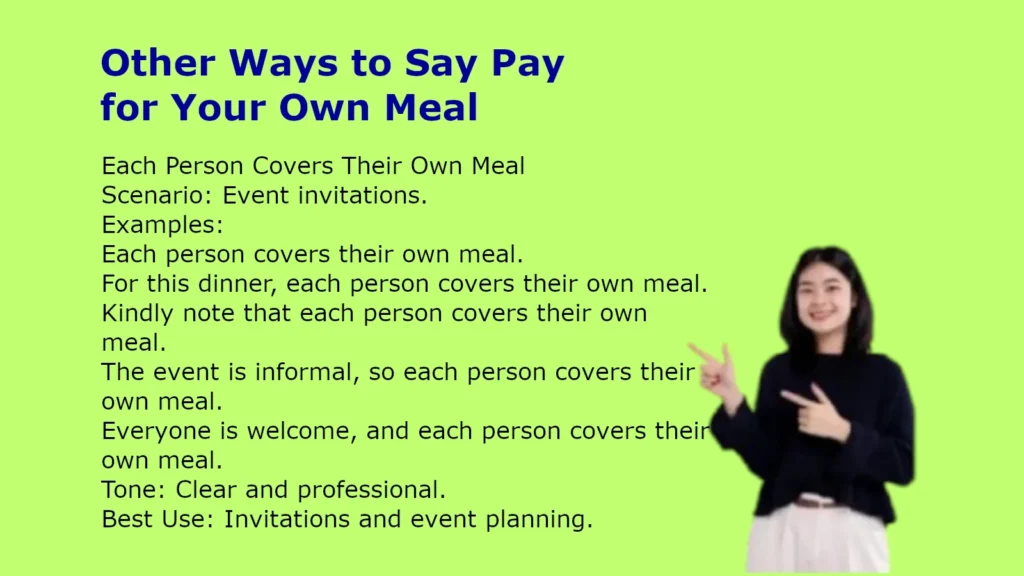
3. Each Person Covers Their Own Meal
Scenario: Event invitations.
Examples:
- Each person covers their own meal.
- For this dinner, each person covers their own meal.
- Kindly note that each person covers their own meal.
- The event is informal, so each person covers their own meal.
- Everyone is welcome, and each person covers their own meal.
Tone: Clear and professional.
Best Use: Invitations and event planning.
4. Individual Expenses Apply
Scenario: Professional events.
Examples:
- Individual expenses apply during the lunch meeting.
- Please be aware that individual expenses apply.
- For this gathering, individual expenses apply.
- Individual expenses apply to food and beverages.
- Attendees should note that individual expenses apply.
Tone: Formal and professional.
Best Use: Corporate communications.
5. Cover Your Own Tab
Scenario: Casual social outings.
Examples:
- Everyone will cover their own tab.
- Please plan to cover your own tab.
- We’ll meet for drinks, and everyone can cover their own tab.
- Cover your own tab for the evening.
- Guests are welcome to cover their own tab.
Tone: Casual and friendly.
Best Use: Bars, restaurants, and social events.
6. Pay Individually
Scenario: Group dining arrangements.
Examples:
- Everyone will pay individually.
- Guests can pay individually at the counter.
- We’ll all pay individually after dinner.
- Please plan to pay individually.
- The restaurant allows guests to pay individually.
Tone: Neutral and clear.
Best Use: General dining situations.
7. Self-Funded Meal
Scenario: Business or organizational events.
Examples:
- This is a self-funded meal.
- Participants should expect a self-funded meal.
- The lunch will be self-funded.
- Please note this is a self-funded event.
- Attendees are responsible for their self-funded meal.
Tone: Formal.
Best Use: Professional communications.
8. Everyone Covers Their Own Expenses
Scenario: Group travel or events.
Examples:
- Everyone covers their own expenses during the trip.
- For lunch, everyone covers their own expenses.
- Please note that everyone covers their own expenses.
- Attendees cover their own expenses.
- Everyone covers their own expenses throughout the event.
Tone: Professional and polite.
Best Use: Travel and event planning.
9. Dutch Treat
Scenario: Informal social gatherings.
Examples:
- Let’s make it a Dutch treat dinner.
- Tonight’s gathering is Dutch treat.
- We agreed on a Dutch treat lunch.
- It’s a Dutch treat event.
- The outing will be Dutch treat.
Tone: Friendly and traditional.
Best Use: Casual invitations.
10. Go Dutch
Scenario: Friendly meetups.
Examples:
- Let’s go Dutch tonight.
- We can go Dutch for dinner.
- How about we go Dutch on the meal?
- Everyone agreed to go Dutch.
- The group decided to go Dutch.
Tone: Casual and conversational.
Best Use: Friends and acquaintances.
11. Pay Your Own Share
Scenario: Shared meals.
Examples:
- Please pay your own share.
- Everyone can pay their own share.
- Guests are expected to pay their own share.
- We’ll divide the bill so everyone pays their own share.
- Kindly pay your own share at checkout.
Tone: Clear and practical.
Best Use: Group meals.
12. Split the Bill Individually
Scenario: Restaurant outings.
Examples:
- We’ll split the bill individually.
- Let’s split the bill individually tonight.
- The group agreed to split the bill individually.
- Please be prepared to split the bill individually.
- We can split the bill individually at the end.
Tone: Straightforward.
Best Use: Dining situations.
13. Personal Meal Cost
Scenario: Event announcements.
Examples:
- Guests are responsible for their personal meal cost.
- Please cover your personal meal cost.
- Each attendee handles their personal meal cost.
- Personal meal costs are not included.
- The event fee excludes personal meal costs.
Tone: Professional.
Best Use: Formal notices.
14. Attendees Pay for Their Own Meals
Scenario: Organized events.
Examples:
- Attendees pay for their own meals.
- Please note that attendees pay for their own meals.
- For this event, attendees pay for their own meals.
- Attendees pay for their own meals and drinks.
- Everyone is welcome, but attendees pay for their own meals.
Tone: Clear and professional.
Best Use: Event invitations.
15. Food Costs Are Not Included
Scenario: Event registration.
Examples:
- Food costs are not included.
- Please note that food costs are not included in the fee.
- Food costs are not included in registration.
- Attendees should be aware that food costs are not included.
- The package price excludes food costs.
Tone: Formal and informative.
Best Use: Conferences and organized events.
16. Purchase Your Own Meal
Scenario: Polite event notices.
Examples:
- Guests may purchase their own meal.
- Please purchase your own meal during the event.
- Attendees are welcome to purchase their own meal.
- Everyone can purchase their own meal.
- Participants should purchase their own meal.
Tone: Polite and neutral.
Best Use: Community gatherings.
17. Meals Are at Your Own Expense
Scenario: Business communication.
Examples:
- Meals are at your own expense.
- Please note that meals are at your own expense.
- During travel, meals are at your own expense.
- Attendees should understand that meals are at their own expense.
- The event covers admission, but meals are at your own expense.
Tone: Professional.
Best Use: Corporate settings.
18. Everyone Handles Their Own Bill
Scenario: Group dinners.
Examples:
- Everyone handles their own bill.
- For simplicity, everyone handles their own bill.
- Guests will handle their own bill.
- The group agreed that everyone handles their own bill.
- Please plan to handle your own bill.
Tone: Friendly and practical.
Best Use: Casual dinners.
19. Self-Pay Dining
Scenario: Event descriptions.
Examples:
- This is a self-pay dining event.
- Guests should expect self-pay dining.
- The gathering follows a self-pay dining format.
- Please note the self-pay dining arrangement.
- Self-pay dining applies to all attendees.
Tone: Professional.
Best Use: Event planning.
20. Meals Are Not Provided
Scenario: Formal announcements.
Examples:
- Meals are not provided.
- Please note that meals are not provided.
- Attendees should be aware that meals are not provided.
- Registration does not include meals.
- Meals are not provided during the event.
Tone: Formal and informative.
Best Use: Conferences and workshops.
21. Cover Your Own Dining Costs
Scenario: Group events.
Examples:
- Please cover your own dining costs.
- Everyone will cover their own dining costs.
- Guests are expected to cover their own dining costs.
- Participants should cover their own dining costs.
- Kindly cover your own dining costs.
Tone: Professional and polite.
Best Use: Invitations and announcements.
22. Personal Payment Required
Scenario: Formal notices.
Examples:
- Personal payment is required for meals.
- Please note that personal payment is required.
- Meals require personal payment.
- Attendees should expect personal payment requirements.
- Personal payment is required for food and beverages.
Tone: Formal.
Best Use: Official communications.
23. Pay for What You Order
Scenario: Casual dining.
Examples:
- Everyone can pay for what they order.
- Please pay for what you order.
- Guests will pay for what they order.
- Let’s keep it simple and pay for what we order.
- Everyone agreed to pay for what they order.
Tone: Casual and clear.
Best Use: Informal meals.
24. Individual Billing
Scenario: Restaurant arrangements.
Examples:
- The restaurant offers individual billing.
- We’ll use individual billing tonight.
- Please request individual billing if needed.
- Individual billing will be available.
- Guests may choose individual billing.
Tone: Professional.
Best Use: Dining logistics.
25. Everyone Is Responsible for Their Own Meal
Scenario: Invitations and planning.
Examples:
- Everyone is responsible for their own meal.
- Kindly note that everyone is responsible for their own meal.
- Attendees are responsible for their own meal.
- The event is open to all, and everyone is responsible for their own meal.
- Guests should understand they are responsible for their own meal.
Tone: Clear and respectful.
Best Use: General-purpose communication.
26. Handle Your Own Meal Costs
Scenario: Casual and professional settings.
Examples:
- Please handle your own meal costs.
- Everyone will handle their own meal costs.
- Guests are expected to handle their own meal costs.
- Attendees should handle their own meal costs.
- Kindly handle your own meal costs during the event.
Tone: Polite and practical.
Best Use: Event coordination.
27. No-Host Meal
Scenario: Formal invitations.
Examples:
- This is a no-host meal.
- Please note that the dinner is no-host.
- Guests should expect a no-host lunch.
- The gathering will be a no-host event.
- We’re planning a no-host dinner.
Tone: Formal and concise.
Best Use: Invitations and announcements.
28. Self-Paid Dining Arrangement
Scenario: Professional communication.
Examples:
- This event follows a self-paid dining arrangement.
- Guests should expect a self-paid dining arrangement.
- The lunch uses a self-paid dining arrangement.
- Please note the self-paid dining arrangement.
- Attendees participate under a self-paid dining arrangement.
Tone: Formal.
Best Use: Business events.
29. Everyone Pays Separately
Scenario: Friendly gatherings.
Examples:
- Everyone pays separately.
- For this dinner, everyone pays separately.
- Guests will pay separately at the restaurant.
- We agreed that everyone pays separately.
- Please remember that everyone pays separately.
Tone: Simple and direct.
Best Use: Everyday conversations.
30. Bring Money for Your Own Meal
Scenario: Informal reminders.
Examples:
- Please bring money for your own meal.
- Everyone should bring money for their own meal.
- Don’t forget to bring money for your own meal.
- Guests are asked to bring money for their own meal.
- Kindly bring money for your own meal.
Tone: Casual and friendly.
Best Use: Informal outings and gatherings.
31. Split the Cost Individually
Scenario: Group dining or meetups
Examples:
- We’ll split the cost individually tonight.
- Everyone agreed to split the cost individually.
- Let’s simply split the cost individually.
- The group will split the cost individually.
- Please be ready to split the cost individually.
Tone: Clear and practical
Best Use: Casual or semi-formal dining
32. Self-Responsibility for Meals
Scenario: Formal event notices
Examples:
- There is self-responsibility for meals at this event.
- Guests have self-responsibility for meals.
- Please note self-responsibility for meals applies.
- The arrangement includes self-responsibility for meals.
- Attendees accept self-responsibility for meals.
Tone: Formal and structured
Best Use: Official announcements
33. No Shared Bill
Scenario: Restaurant or dinner planning
Examples:
- There will be no shared bill tonight.
- We’re going with no shared bill.
- Please expect no shared bill arrangement.
- The dinner will have no shared bill.
- Everyone agreed on no shared bill.
Tone: Neutral and direct
Best Use: Informal group planning
34. Pay As You Go
Scenario: Casual outings
Examples:
- It’s a pay as you go dinner.
- We’ll just pay as you go.
- The event works on a pay as you go basis.
- Everyone will pay as you go.
- Please remember it’s pay as you go.
Tone: Casual and simple
Best Use: Friendly gatherings or cafés
35. Individual Payment Arrangement
Scenario: Formal planning or events
Examples:
- There is an individual payment arrangement for meals.
- The lunch follows an individual payment arrangement.
- Please note the individual payment arrangement.
- Attendees follow an individual payment arrangement.
- Meals are under an individual payment arrangement.
Tone: Professional and formal
Best Use: Corporate events
36. Each Guest Pays Their Own Bill
Scenario: Invitations
Examples:
- Each guest pays their own bill.
- Please note each guest pays their own bill.
- At this dinner, each guest pays their own bill.
- We expect each guest to pay their own bill.
- Everyone agreed each guest pays their own bill.
Tone: Polite and clear
Best Use: Event invitations
37. No Host Responsibility for Meals
Scenario: Organized events
Examples:
- There is no host responsibility for meals.
- Meals are under no host responsibility.
- Please note no host responsibility for meals.
- The host has no responsibility for meals.
- Guests understand no host responsibility applies.
Tone: Formal and explanatory
Best Use: Invitations or event policies
38. Self-Supported Dining
Scenario: Formal or semi-formal events
Examples:
- This is a self-supported dining event.
- Guests will have self-supported dining.
- Please expect self-supported dining.
- The lunch is self-supported dining.
- Attendees participate in self-supported dining.
Tone: Professional
Best Use: Business or group events
39. Separate Payment System
Scenario: Restaurant coordination
Examples:
- We’ll use a separate payment system.
- The restaurant supports a separate payment system.
- Please follow the separate payment system.
- Guests will use a separate payment system.
- The event uses a separate payment system.
Tone: Neutral and informative
Best Use: Organized dining setups
40. Each Person Settles Their Own Bill
Scenario: Casual group dining
Examples:
- Each person settles their own bill.
- Please ensure each person settles their own bill.
- We agreed each person settles their own bill.
- At the end, each person settles their own bill.
- Everyone will settle their own bill individually.
Tone: Clear and polite
Best Use: Friendly dinners
41. Individual Settlement Required
Scenario: Formal communication
Examples:
- Individual settlement is required for meals.
- Please note individual settlement is required.
- Meals require individual settlement.
- Attendees should make individual settlement.
- The arrangement includes individual settlement.
Tone: Formal and strict
Best Use: Official notices
42. Self-Payment Policy Applies
Scenario: Event instructions
Examples:
- A self-payment policy applies to meals.
- Please note the self-payment policy applies.
- Meals follow a self-payment policy.
- Attendees agree to self-payment policy.
- The event includes a self-payment policy.
Tone: Professional
Best Use: Formal documentation
43. Everyone Handles Their Own Dining Expenses
Scenario: Group planning
Examples:
- Everyone handles their own dining expenses.
- Please handle your own dining expenses.
- We agreed everyone handles their own dining expenses.
- Attendees will handle their own dining expenses.
- Guests are expected to handle their own dining expenses.
Tone: Polite and structured
Best Use: Event planning
44. Pay Directly at the Table
Scenario: Restaurant setup
Examples:
- Everyone will pay directly at the table.
- Please pay directly at the table.
- Guests can pay directly at the table.
- We’ll handle payment directly at the table.
- Each person pays directly at the table.
Tone: Simple and practical
Best Use: Restaurant coordination
45. No Group Billing
Scenario: Dining instructions
Examples:
- There will be no group billing.
- Please note no group billing.
- The restaurant follows no group billing.
- We’re doing no group billing tonight.
- Guests should expect no group billing.
Tone: Direct and clear
Best Use: Informal or formal dining
46. Split Payment at Checkout
Scenario: Restaurant dining
Examples:
- We’ll do split payment at checkout.
- Please prepare for split payment at checkout.
- The group agreed on split payment at checkout.
- Everyone will use split payment at checkout.
- Guests can choose split payment at checkout.
Tone: Practical and modern
Best Use: Restaurants and cafés
47. Personal Responsibility for Dining Costs
Scenario: Formal or corporate events
Examples:
- There is personal responsibility for dining costs.
- Please note personal responsibility for dining costs applies.
- Attendees accept personal responsibility for dining costs.
- Meals are under personal responsibility for dining costs.
- Guests understand personal responsibility for dining costs.
Tone: Formal and professional
Best Use: Business or official events
Conclusion
Altogether, these 47 alternative ways to say “pay for your own meal” give you flexible options for every situation—whether casual, professional, or formal. In contrast to using the same phrase repeatedly, these variations help you sound more polite, clear, and context-aware. Ultimately, choosing the right expression ensures smoother communication and better expectations in any social or business dining setting.

