
Ever found yourself repeating the word “said” so often in writing that your sentences start to feel flat and repetitive? The phrase Other Ways to Say Said is something every writer, student, and content creator searches for when they want to make dialogue more engaging and expressive.
The problem is simple. While “said” is correct and widely used, relying on it too much can make your writing feel basic or uninspired. And here’s the kicker: overusing it can also reduce the emotional impact of your dialogue.
Many writers face this challenge when trying to add more tone, emotion, or personality to conversations in stories, essays, or content writing. That’s why people often look for alternative words for said, different ways to show speech, or stronger dialogue verbs to make writing more dynamic.
But don’t worry—there’s an easy way to fix this.
In this guide, you’ll discover Other Ways to Say Said, including powerful, emotional, and context-based alternatives you can use in storytelling, formal writing, and casual dialogue. You’ll also learn when to replace it—and when it’s actually better to keep it simple.
So if you want to upgrade your writing style and make your dialogue sound more natural and expressive, keep reading—you’re in the right place.
What Does “Said” Mean?
“Said” is a verb used to show that someone is speaking. It is the most common dialogue tag in English writing. It simply reports speech without adding emotion or detail.
Example:
- “I’m tired,” she said.
When to Use “Said”
“Said” is perfect in both formal and informal writing, especially when you want clarity and simplicity. It is widely used in novels, articles, essays, and conversations.
However, when you want to add emotion, tone, or action, alternatives to “said” can make your writing stronger.
Is It Professional/Polite to Use “Said”?
Yes, “said” is completely professional and neutral. In fact, it is often preferred in formal writing because it does not distract the reader. However, creative writing benefits from variations to avoid repetition.
1. Replied
Scenario: Answering a question
Examples:
- “I don’t know,” he replied.
- She replied quickly to the message.
- “Yes, I agree,” they replied.
- He replied without hesitation.
- “I’ll come later,” she replied.
Tone: Neutral and conversational
Best Use: Everyday dialogue
2. Stated
Scenario: Formal or clear expression
Examples:
- He stated the facts clearly.
- “This is final,” she stated.
- The teacher stated the rules.
- She stated her opinion confidently.
- He stated the deadline again.
Tone: Formal and direct
Best Use: Professional writing
3. Asked
Scenario: Questioning
Examples:
- “Where are you going?” she asked.
- He asked for help politely.
- “Can you explain?” they asked.
- She asked about the meeting.
- He asked a simple question.
Tone: Curious and neutral
Best Use: Questions in dialogue
4. Whispered
Scenario: Quiet or secret speech
Examples:
- “Be quiet,” she whispered.
- He whispered in her ear.
- They whispered during the meeting.
- “Don’t tell anyone,” he whispered.
- She whispered softly.
Tone: Secretive and soft
Best Use: Intimate or secret moments
5. Shouted
Scenario: Loud speech
Examples:
- “Stop!” he shouted.
- She shouted across the room.
- They shouted for help.
- He shouted in anger.
- “Come here!” she shouted.
Tone: Loud and intense
Best Use: Conflict or urgency
6. Mumbled
Scenario: Unclear speech
Examples:
- He mumbled an apology.
- She mumbled something under her breath.
- “I don’t know,” he mumbled.
- They mumbled quietly.
- He mumbled his response.
Tone: Unclear or shy
Best Use: Nervous speech
7. Murmured
Scenario: Soft speech
Examples:
- She murmured softly.
- He murmured a reply.
- “It’s okay,” she murmured.
- They murmured in agreement.
- He murmured to himself.
Tone: Calm and gentle
Best Use: Emotional scenes
8. Announced
Scenario: Public or important statement
Examples:
- He announced the winner.
- She announced the news.
- “We are ready,” they announced.
- The teacher announced the results.
- He announced the plan.
Tone: Formal and clear
Best Use: Public communication
9. Declared
Scenario: Strong statement
Examples:
- She declared her decision.
- He declared his innocence.
- “I will win,” he declared.
- They declared independence.
- She declared the rule final.
Tone: Strong and assertive
Best Use: Important statements
10. Responded
Scenario: Replying
Examples:
- He responded quickly.
- She responded to the question.
- They responded calmly.
- “No problem,” he responded.
- She responded with a smile.
Tone: Neutral and professional
Best Use: Formal replies
11. Exclaimed
Scenario: Emotion or surprise
Examples:
- “Wow!” she exclaimed.
- He exclaimed in joy.
- They exclaimed together.
- She exclaimed loudly.
- “Amazing!” he exclaimed.
Tone: Emotional and expressive
Best Use: Surprise or excitement
12. Remarked
Scenario: Casual observation
Examples:
- He remarked on the weather.
- She remarked softly.
- “That’s interesting,” he remarked.
- They remarked about the change.
- She remarked during the meeting.
Tone: Neutral and thoughtful
Best Use: Conversations
13. Explained
Scenario: Giving details
Examples:
- He explained the problem.
- She explained clearly.
- “Here’s how it works,” he explained.
- They explained the process.
- She explained step by step.
Tone: Informative
Best Use: Teaching or clarity
14. Insisted
Scenario: Strong opinion
Examples:
- He insisted on coming.
- She insisted it was true.
- “I’m sure,” he insisted.
- They insisted on fairness.
- She insisted again.
Tone: Firm and determined
Best Use: Strong opinions
15. Suggested
Scenario: Advice or idea
Examples:
- He suggested a solution.
- She suggested going early.
- “Try this,” he suggested.
- They suggested a plan.
- She suggested another option.
Tone: Helpful and polite
Best Use: Recommendations
16. Agreed
Scenario: Agreement
Examples:
- He agreed immediately.
- She agreed with the idea.
- “Yes,” they agreed.
- They all agreed.
- He agreed politely.
Tone: Positive and cooperative
Best Use: Group discussions
17. Complained
Scenario: Negative expression
Examples:
- He complained about the noise.
- She complained loudly.
- “It’s unfair,” he complained.
- They complained together.
- She complained again.
Tone: Negative or frustrated
Best Use: Problems or issues
18. Warned
Scenario: Alert or caution
Examples:
- He warned them.
- She warned about danger.
- “Be careful,” he warned.
- They warned the team.
- She warned again.
Tone: Serious and cautious
Best Use: Safety messages
19. Apologized
Scenario: Saying sorry
Examples:
- He apologized sincerely.
- She apologized quickly.
- “I’m sorry,” he apologized.
- They apologized together.
- She apologized for the mistake.
Tone: Polite and regretful
Best Use: Mistakes or correction
20. Reassured
Scenario: Comforting
Examples:
- He reassured her.
- She reassured the team.
- “It’s okay,” he reassured.
- They reassured everyone.
- She reassured calmly.
Tone: Calm and supportive
Best Use: Emotional comfort
21. Noted
Scenario: Acknowledging information
Examples:
- He noted the change in schedule.
- She noted the instructions carefully.
- “I understand,” he noted.
- They noted the updates.
- She noted the deadline.
Tone: Formal and observant
Best Use: Professional or instructional writing
22. Added
Scenario: Continuing speech or giving extra info
Examples:
- He added more details.
- She added, “Don’t forget.”
- “We should leave early,” he added.
- They added new points.
- She added another suggestion.
Tone: Neutral and conversational
Best Use: Dialogue with extra information
23. Continued
Scenario: Ongoing speech
Examples:
- He continued his explanation.
- She continued speaking calmly.
- “As I was saying,” he continued.
- They continued the discussion.
- She continued after a pause.
Tone: Neutral and flowing
Best Use: Longer speech or narration
24. Interrupted
Scenario: Cutting someone off
Examples:
- He interrupted her mid-sentence.
- She interrupted the meeting.
- “Wait,” he interrupted.
- They interrupted loudly.
- She interrupted politely.
Tone: Disruptive or urgent
Best Use: Conversations with interruptions
25. Repeated
Scenario: Saying something again
Examples:
- He repeated the question.
- She repeated the instructions.
- “I said no,” he repeated.
- They repeated the message.
- She repeated herself slowly.
Tone: Emphasizing or clarifying
Best Use: Confusion or emphasis
26. Confirmed
Scenario: Verifying information
Examples:
- He confirmed the appointment.
- She confirmed the details.
- “Yes, it’s true,” he confirmed.
- They confirmed the plan.
- She confirmed the booking.
Tone: Clear and professional
Best Use: Formal communication
27. Promised
Scenario: Commitment
Examples:
- He promised to help.
- She promised to return.
- “I will be there,” he promised.
- They promised support.
- She promised again.
Tone: Trustworthy and emotional
Best Use: Personal commitments
28. Confessed
Scenario: Revealing truth
Examples:
- He confessed his mistake.
- She confessed everything.
- “It was me,” he confessed.
- They confessed honestly.
- She confessed the truth.
Tone: Emotional and serious
Best Use: Secrets or honesty
29. Sighed
Scenario: Emotional or tired speech
Examples:
- He sighed before speaking.
- She sighed softly.
- “Fine,” he sighed.
- They sighed in relief.
- She sighed heavily.
Tone: Exhausted or emotional
Best Use: Emotional dialogue
30. Laughed
Scenario: Humor or joy
Examples:
- He laughed at the joke.
- She laughed loudly.
- “That’s funny,” he laughed.
- They laughed together.
- She laughed softly.
Tone: Happy and light
Best Use: Humorous scenes
31. Chuckled
Scenario: Light laugh
Examples:
- He chuckled quietly.
- She chuckled at the comment.
- “Nice one,” he chuckled.
- They chuckled together.
- She chuckled softly.
Tone: Warm and casual
Best Use: Friendly humor
32. Gasped
Scenario: Shock or surprise
Examples:
- She gasped in shock.
- He gasped loudly.
- “No way!” she gasped.
- They gasped together.
- He gasped suddenly.
Tone: Surprised and emotional
Best Use: Dramatic moments
33. Cried
Scenario: Emotional sadness
Examples:
- She cried softly.
- He cried in pain.
- “I miss you,” she cried.
- They cried together.
- He cried silently.
Tone: Sad and emotional
Best Use: Emotional storytelling
34. Yelled
Scenario: Loud and angry speech
Examples:
- He yelled at them.
- She yelled across the street.
- “Stop it!” he yelled.
- They yelled loudly.
- She yelled in frustration.
Tone: Strong and emotional
Best Use: Conflict scenes
35. Screamed
Scenario: Extreme emotion or fear
Examples:
- She screamed loudly.
- He screamed in fear.
- “Help!” she screamed.
- They screamed together.
- She screamed suddenly.
Tone: Intense and dramatic
Best Use: Fear or shock
36. Breathed
Scenario: Soft emotional speech
Examples:
- She breathed a reply.
- He breathed, “Finally.”
- They breathed in relief.
- “I’m okay,” she breathed.
- He breathed softly.
Tone: Calm or emotional
Best Use: Intimate moments
37. Hesitated
Scenario: Uncertain speech
Examples:
- He hesitated before answering.
- She hesitated to speak.
- “I’m not sure,” he hesitated.
- They hesitated together.
- She hesitated briefly.
Tone: Uncertain or thoughtful
Best Use: Doubt or hesitation
38. Demanded
Scenario: Strong request
Examples:
- He demanded answers.
- She demanded attention.
- “Tell me now,” he demanded.
- They demanded justice.
- She demanded action.
Tone: Forceful and strict
Best Use: Authority or anger
39. Urged
Scenario: Strong encouragement
Examples:
- He urged her to try.
- She urged them forward.
- “Go quickly,” he urged.
- They urged action.
- She urged caution.
Tone: Encouraging and urgent
Best Use: Advice or motivation
40. Whined
Scenario: Complaining in a childish tone
Examples:
- He whined about work.
- She whined softly.
- “It’s not fair,” he whined.
- They whined together.
- She whined again.
Tone: Annoyed or childish
Best Use: Informal dialogue
41. Boasted
Scenario: Proud speech
Examples:
- He boasted about his success.
- She boasted confidently.
- “I did it,” he boasted.
- They boasted together.
- She boasted loudly.
Tone: Proud or arrogant
Best Use: Confidence or arrogance
42. Joked
Scenario: Humor
Examples:
- He joked about the situation.
- She joked lightly.
- “Just kidding,” he joked.
- They joked together.
- She joked often.
Tone: Funny and casual
Best Use: Light conversations
43. Teased
Scenario: Playful speech
Examples:
- He teased her gently.
- She teased him back.
- “Nice try,” he teased.
- They teased each other.
- She teased playfully.
Tone: Playful and friendly
Best Use: Friends or romance
44. Informed
Scenario: Giving information
Examples:
- He informed the team.
- She informed them politely.
- “You should know,” he informed.
- They informed everyone.
- She informed the group.
Tone: Formal and clear
Best Use: Professional communication
45. Comforted
Scenario: Soothing someone
Examples:
- He comforted her.
- She comforted the child.
- “It’s okay,” he comforted.
- They comforted each other.
- She comforted gently.
Tone: Soft and caring
Best Use: Emotional support
46. Encouraged
Scenario: Motivation
Examples:
- He encouraged her to continue.
- She encouraged the team.
- “You can do it,” he encouraged.
- They encouraged each other.
- She encouraged kindly.
Tone: Positive and supportive
Best Use: Motivation or support
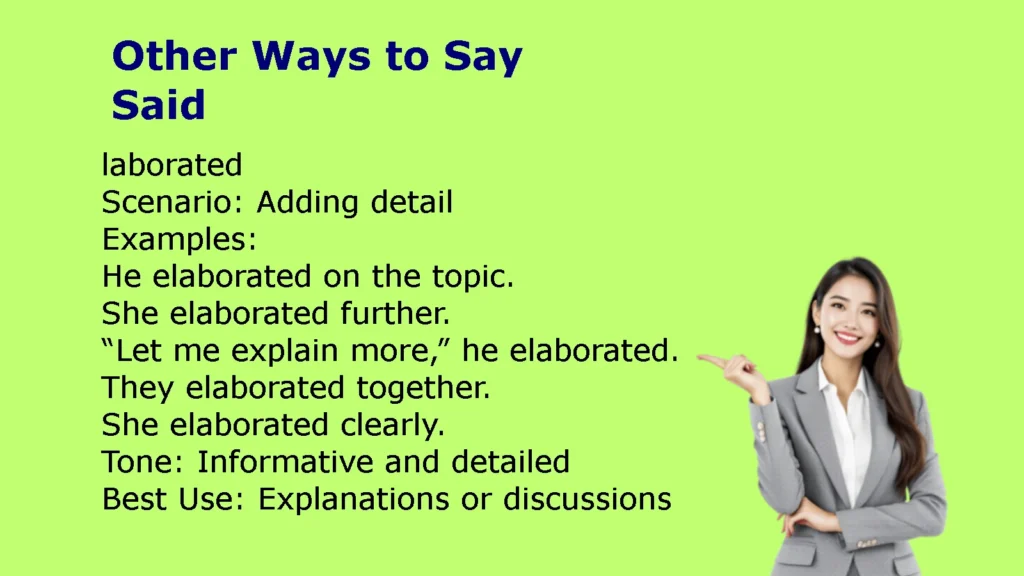
47. Elaborated
Scenario: Adding detail
Examples:
- He elaborated on the topic.
- She elaborated further.
- “Let me explain more,” he elaborated.
- They elaborated together.
- She elaborated clearly.
Tone: Informative and detailed
Best Use: Explanations or discussions
Conclusion
Using different ways to say “said” can completely transform your writing style. Instead of repetition, you can now express tone, emotion, and context more clearly. From simple words like “replied” to expressive ones like “exclaimed” or “whispered,” these 47 alternatives help you create richer, more engaging dialogue in any form of writing.

