

Other Ways to Say “With That Being Said” is a phrase many writers and speakers rely on when transitioning between ideas—but it can quickly start to feel repetitive or overly formal. Have you ever noticed how often it appears in essays, emails, or even casual conversations? If so, you’re not alone. The real problem is finding smoother, more natural alternatives that still keep your ideas connected.
This guide is here to fix that. It promises you a collection of powerful replacements that fit different tones—whether you’re writing professionally, speaking casually, or trying to make your content flow more naturally. You’ll not only learn what to say instead, but also when to use each option effectively.
But here’s the kicker: better transitions don’t just improve your sentences—they improve how your ideas are understood. And it gets better…
You’ll also discover practical examples and usage tips so you can confidently replace “with that being said” without losing clarity or impact. By the end, your writing and speech will feel more polished, fluid, and intentional.
What Does “With That Being Said” Mean?
“With that being said” is a transition phrase used to introduce a contrast, exception, or concluding thought. Essentially, it connects two ideas while acknowledging what was previously stated.
When to Use “With That Being Said”
You can use it in essays, professional writing, speeches, emails, and conversations. Moreover, it works especially well when you want to shift direction, add balance, or present a final point.
Is It Professional or Polite?
Yes, it is both professional and polite. However, because it is commonly used, relying on it too often can make writing feel repetitive. Consequently, learning alternatives can help improve clarity and style.
1. That Said
Scenario: Casual or professional writing
Examples:
- The project is challenging. That said, it is achievable.
- She was tired. That said, she continued working.
- The results were mixed. That said, we improved.
- It’s expensive. That said, it’s worth it.
- He is new. That said, he performed well.
Tone: Neutral and concise
Best Use: Everyday writing and speaking
2. However
Scenario: Formal writing or contrast
Examples:
- The plan is simple. However, it requires effort.
- She studied hard. However, she didn’t pass.
- It is risky. However, it may succeed.
- The cost is high. However, the quality is better.
- He tried his best. However, it wasn’t enough.
Tone: Formal and direct
Best Use: Essays, reports, professional communication
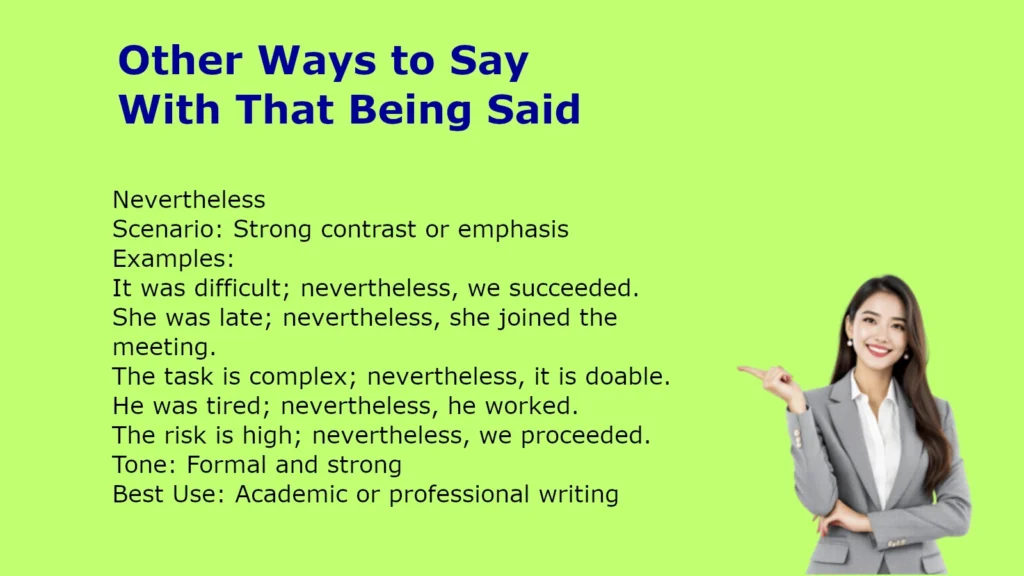
3. Nevertheless
Scenario: Strong contrast or emphasis
Examples:
- It was difficult; nevertheless, we succeeded.
- She was late; nevertheless, she joined the meeting.
- The task is complex; nevertheless, it is doable.
- He was tired; nevertheless, he worked.
- The risk is high; nevertheless, we proceeded.
Tone: Formal and strong
Best Use: Academic or professional writing
4. Nonetheless
Scenario: Slightly formal contrast
Examples:
- It was raining; nonetheless, we went out.
- She was busy; nonetheless, she helped.
- The work is hard; nonetheless, it is rewarding.
- He failed once; nonetheless, he continued.
- The idea is risky; nonetheless, it’s promising.
Tone: Formal and smooth
Best Use: Essays and reports
5. Even So
Scenario: Conversational contrast
Examples:
- It was late. Even so, we stayed.
- She was tired. Even so, she finished the task.
- The weather was bad. Even so, they traveled.
- It was expensive. Even so, I bought it.
- He was sick. Even so, he worked.
Tone: Natural and conversational
Best Use: Everyday speech
6. Still
Scenario: Short contrast statement
Examples:
- It was hard. Still, we succeeded.
- She was busy. Still, she called.
- It was risky. Still, we tried.
- He was late. Still, he joined.
- The task was long. Still, it was completed.
Tone: Simple and direct
Best Use: Speaking or informal writing
7. All the Same
Scenario: Slightly informal contrast
Examples:
- It was expensive. All the same, I bought it.
- She was tired. All the same, she worked.
- The journey was long. All the same, it was worth it.
- He disagreed. All the same, he helped.
- The plan changed. All the same, we continued.
Tone: Conversational
Best Use: Casual writing or speech
8. Having Said That
Scenario: Formal speech or writing
Examples:
- The plan is risky. Having said that, it may work.
- She is inexperienced. Having said that, she is talented.
- It’s expensive. Having said that, it’s useful.
- The process is slow. Having said that, it is reliable.
- He is new. Having said that, he performs well.
Tone: Balanced and professional
Best Use: Presentations and essays
9. On the Other Hand
Scenario: Comparing two ideas
Examples:
- The job pays well. On the other hand, it is stressful.
- She is experienced. On the other hand, she is slow.
- The product is cheap. On the other hand, it breaks easily.
- It is fast. On the other hand, it is expensive.
- He is strict. On the other hand, he is fair.
Tone: Analytical
Best Use: Essays and arguments
10. That Being the Case
Scenario: Logical conclusion
Examples:
- The deadline is close. That being the case, we must hurry.
- She is unavailable. That being the case, we reschedule.
- It is raining. That being the case, we stay indoors.
- He is sick. That being the case, he won’t attend.
- The cost increased. That being the case, we reconsider.
Tone: Formal and logical
Best Use: Reports or structured writing
11. In Any Case
Scenario: Regardless of situation
Examples:
- It may rain. In any case, we are going.
- She may refuse. In any case, we will try.
- It is difficult. In any case, it must be done.
- He may be late. In any case, start the meeting.
- The plan may change. In any case, we proceed.
Tone: Decisive and firm
Best Use: Instructions or decisions
12. At Any Rate
Scenario: Moving forward despite context
Examples:
- It was confusing. At any rate, we completed it.
- She was late. At any rate, she arrived.
- The plan failed. At any rate, we learned.
- It was hard. At any rate, it is done.
- He disagreed. At any rate, we moved on.
Tone: Neutral and transitional
Best Use: Storytelling or explanations
13. Be That as It May
Scenario: Formal contrast or concession
Examples:
- He is young. Be that as it may, he is capable.
- It is risky. Be that as it may, we will try.
- She is busy. Be that as it may, she helped.
- The cost is high. Be that as it may, it is worth it.
- It is difficult. Be that as it may, we continue.
Tone: Formal and respectful
Best Use: Academic writing
14. Regardless
Scenario: Emphasizing continuation
Examples:
- It is difficult. Regardless, we proceed.
- She is tired. Regardless, she works.
- The weather is bad. Regardless, we go.
- He disagreed. Regardless, the decision stands.
- It is risky. Regardless, we try.
Tone: Strong and assertive
Best Use: Direct communication
15. Either Way
Scenario: Neutral outcome
Examples:
- It may rain. Either way, we are ready.
- She may come. Either way, we proceed.
- It is hard. Either way, it must be done.
- He agrees or not. Either way, we continue.
- The result varies. Either way, we move forward.
Tone: Neutral and flexible
Best Use: Casual explanation
16. Still and All
Scenario: Informal emphasis
Examples:
- It was hard. Still and all, we finished.
- She was late. Still and all, she helped.
- It was risky. Still and all, we tried.
- He was tired. Still and all, he worked.
- The job was long. Still and all, it is done.
Tone: Informal and expressive
Best Use: Casual speech
17. Even Though That’s the Case
Scenario: Elaborate contrast
Examples:
- The plan is slow. Even though that’s the case, it works.
- She is busy. Even though that’s the case, she helps.
- It is expensive. Even though that’s the case, I bought it.
- He is new. Even though that’s the case, he performs well.
- The task is hard. Even though that’s the case, we continue.
Tone: Detailed and formal
Best Use: Essays or reports
18. With That in Mind
Scenario: Transition to conclusion or action
Examples:
- The deadline is close. With that in mind, we must act quickly.
- She is experienced. With that in mind, we hired her.
- It is risky. With that in mind, we planned carefully.
- He is new. With that in mind, we trained him.
- Costs are high. With that in mind, we adjusted the budget.
Tone: Thoughtful and strategic
Best Use: Business writing
19. That Considered
Scenario: Formal reasoning
Examples:
- The risks are high; that considered, we declined.
- She is busy; that considered, we rescheduled.
- It is expensive; that considered, we reconsidered.
- He is new; that considered, he did well.
- The timing is poor; that considered, we delayed it.
Tone: Analytical
Best Use: Reports or evaluations
20. All Things Considered
Scenario: Summary or conclusion
Examples:
- All things considered, it was a good decision.
- All things considered, we succeeded.
- All things considered, the outcome is positive.
- All things considered, it worked well.
- All things considered, we are satisfied.
Tone: Reflective and balanced
Best Use: Conclusions
21. In Contrast
Scenario: Showing clear difference
Examples:
- The first option is slow. In contrast, the second is faster.
- She prefers quiet. In contrast, he enjoys noise.
- The plan is risky. In contrast, this one is safer.
- It is cheap. In contrast, it lacks quality.
- He is strict. In contrast, she is flexible.
Tone: Analytical and comparative
Best Use: Essays, comparisons, reports
22. By Comparison
Scenario: Comparing two ideas
Examples:
- This method is simple. By comparison, the old one is complex.
- She is experienced. By comparison, he is new.
- The first option is costly. By comparison, the second is affordable.
- It is fast. By comparison, others are slower.
- His work is detailed. By comparison, others are basic.
Tone: Neutral and structured
Best Use: Academic or analytical writing
23. Alternatively
Scenario: Presenting another option
Examples:
- We can proceed today. Alternatively, we can wait.
- You may call me. Alternatively, email me.
- Take the train. Alternatively, drive.
- Start now. Alternatively, schedule it later.
- Choose option A. Alternatively, choose option B.
Tone: Practical and flexible
Best Use: Instructions or decision-making
24. On the Contrary
Scenario: Direct contradiction
Examples:
- It was not easy. On the contrary, it was very hard.
- She is not lazy. On the contrary, she works hard.
- It didn’t fail. On the contrary, it succeeded.
- He is not new. On the contrary, he is experienced.
- The task isn’t simple. On the contrary, it is complex.
Tone: Strong and corrective
Best Use: Arguments or debates
25. In Spite of That
Scenario: Showing persistence
Examples:
- It was raining. In spite of that, we went out.
- She was tired. In spite of that, she worked.
- The cost is high. In spite of that, we bought it.
- He was sick. In spite of that, he attended.
- It was difficult. In spite of that, we succeeded.
Tone: Determined and strong
Best Use: Storytelling or reports
26. That Notwithstanding
Scenario: Formal contrast
Examples:
- The risks are high. That notwithstanding, we proceeded.
- She was late. That notwithstanding, she contributed.
- It is costly. That notwithstanding, it is useful.
- He disagreed. That notwithstanding, we continued.
- The situation is complex. That notwithstanding, we acted.
Tone: Formal and legal-like
Best Use: Academic or professional writing
27. Yet
Scenario: Short contrast
Examples:
- It was hard, yet we succeeded.
- She is young, yet skilled.
- He is tired, yet working.
- It is expensive, yet worth it.
- The task is long, yet manageable.
Tone: Concise and impactful
Best Use: Writing or speeches
28. But Still
Scenario: Informal contrast
Examples:
- It was late, but still we continued.
- She was tired, but still helped.
- It is risky, but still worth trying.
- He was busy, but still joined.
- The task is hard, but still doable.
Tone: Casual and conversational
Best Use: Everyday communication
29. Despite That
Scenario: Emphasizing effort
Examples:
- It was raining. Despite that, we played.
- She was ill. Despite that, she worked.
- The plan failed. Despite that, we learned.
- He was late. Despite that, he came.
- It was tough. Despite that, we finished.
Tone: Determined and positive
Best Use: Narratives or reports
30. In Light of This
Scenario: Logical conclusion
Examples:
- The deadline is close. In light of this, we must act.
- She is unavailable. In light of this, we rescheduled.
- Costs increased. In light of this, we adjusted plans.
- He is inexperienced. In light of this, we trained him.
- The risk is high. In light of this, we paused.
Tone: Formal and thoughtful
Best Use: Business or academic writing
31. For That Reason
Scenario: Cause and effect
Examples:
- The system failed. For that reason, we stopped.
- She was late. For that reason, she missed it.
- It was unsafe. For that reason, we canceled.
- He disagreed. For that reason, he left.
- The cost rose. For that reason, we reconsidered.
Tone: Logical and clear
Best Use: Reports or explanations
32. As Such
Scenario: Formal conclusion
Examples:
- The data was incomplete. As such, we paused.
- She was unprepared. As such, she failed.
- It is risky. As such, we avoided it.
- He is new. As such, he needs training.
- The plan changed. As such, we adapted.
Tone: Professional and concise
Best Use: Business writing
33. Consequently
Scenario: Result-based transition
Examples:
- It rained heavily. Consequently, the event was canceled.
- She didn’t study. Consequently, she failed.
- The system crashed. Consequently, work stopped.
- He was late. Consequently, he missed it.
- Costs increased. Consequently, we adjusted.
Tone: Formal and structured
Best Use: Academic writing
34. Therefore
Scenario: Logical reasoning
Examples:
- It is unsafe. Therefore, we stopped.
- She is busy. Therefore, she declined.
- The data is unclear. Therefore, we paused.
- He is ill. Therefore, he stayed home.
- It is expensive. Therefore, we reconsidered.
Tone: Formal and clear
Best Use: Essays and reports
35. Accordingly
Scenario: Action based on logic
Examples:
- The rules changed. Accordingly, we adjusted.
- She was absent. Accordingly, we rescheduled.
- It is risky. Accordingly, we paused.
- He resigned. Accordingly, we reorganized.
- The cost rose. Accordingly, we revised plans.
Tone: Professional and precise
Best Use: Business communication
36. Given That
Scenario: Condition-based reasoning
Examples:
- Given that it is late, we should stop.
- Given that she is busy, we postponed it.
- Given that costs are high, we reconsidered.
- Given that he is new, we trained him.
- Given that it failed, we changed approach.
Tone: Logical and structured
Best Use: Formal writing
37. All That Said
Scenario: Summarizing point
Examples:
- All that said, the project was successful.
- All that said, we still achieved results.
- All that said, it was worth it.
- All that said, we moved forward.
- All that said, improvements are needed.
Tone: Reflective and balanced
Best Use: Conclusions
38. Mind You
Scenario: Informal emphasis
Examples:
- It was hard. Mind you, we succeeded.
- She was tired. Mind you, she finished.
- It is risky. Mind you, it works.
- He is new. Mind you, he performed well.
- The task is long. Mind you, it’s done.
Tone: Conversational and engaging
Best Use: Informal writing
39. That Aside
Scenario: Shifting focus
Examples:
- That aside, let’s focus on results.
- That aside, the plan works well.
- That aside, we succeeded.
- That aside, improvements are needed.
- That aside, everything is fine.
Tone: Transitional and neutral
Best Use: Discussions or presentations
40. Leaving That Aside
Scenario: Moving to main point
Examples:
- Leaving that aside, we must act now.
- Leaving that aside, the results are good.
- Leaving that aside, we continue.
- Leaving that aside, it is acceptable.
- Leaving that aside, we proceed forward.
Tone: Structured and clear
Best Use: Formal communication
41. Putting That Aside
Scenario: Refocusing discussion
Examples:
- Putting that aside, let’s continue.
- Putting that aside, the work is done.
- Putting that aside, we move forward.
- Putting that aside, results are strong.
- Putting that aside, action is needed.
Tone: Neutral and directive
Best Use: Meetings or reports
42. More Importantly
Scenario: Emphasizing key point
Examples:
- More importantly, we succeeded.
- More importantly, the team improved.
- More importantly, results were achieved.
- More importantly, we learned a lot.
- More importantly, progress was made.
Tone: Strong and focused
Best Use: Reports or presentations
43. Even Then
Scenario: Persistent contrast
Examples:
- Even then, we succeeded.
- Even then, she helped.
- Even then, it worked.
- Even then, he continued.
- Even then, results improved.
Tone: Determined and subtle
Best Use: Narratives or storytelling
44. At the Same Time
Scenario: Balanced ideas
Examples:
- At the same time, we must stay careful.
- At the same time, it is risky.
- At the same time, it is useful.
- At the same time, we improved.
- At the same time, challenges remain.
Tone: Balanced and thoughtful
Best Use: Essays or discussions
45. Having Said All That
Scenario: Final reflection
Examples:
- Having said all that, we succeeded.
- Having said all that, improvements are needed.
- Having said all that, it worked well.
- Having said all that, we continue.
- Having said all that, the plan stands.
Tone: Reflective and formal
Best Use: Conclusions
46. When All Is Said and Done
Scenario: Final conclusion
Examples:
- When all is said and done, we succeeded.
- When all is said and done, it was worth it.
- When all is said and done, we learned.
- When all is said and done, progress matters.
- When all is said and done, results speak.
Tone: Reflective and final
Best Use: Endings or summaries
47. Ultimately
Scenario: Final conclusion or decision
Examples:
- Ultimately, we succeeded.
- Ultimately, the plan worked.
- Ultimately, we made progress.
- Ultimately, it was worth it.
- Ultimately, results matter most.
Tone: Strong and conclusive
Best Use: Final statements
Conclusion
Although “with that being said” is widely used, relying on it too often can make writing sound repetitive. Therefore, using these 47 powerful alternatives helps you communicate more clearly, transition ideas smoothly, and sound more professional in both writing and speech. Ultimately, choosing the right phrase depends on tone, context, and intent.

