

Have you ever wanted to ask someone to lower their voice without sounding rude? Finding Polite Ways to Ask Someone to Be Quiet can make a big difference, whether you’re in the office, a classroom, a meeting, or even at home.
The challenge is that saying “be quiet” directly can come across as harsh or disrespectful. That’s why many people search for polite ways to say be quiet, how to ask someone to be quiet politely, and professional ways to tell someone to be quiet without hurting their feelings. And here’s the kicker: the right wording can help you resolve the situation while keeping the conversation friendly and respectful.
The good news? There are plenty of courteous alternatives that sound natural in both personal and professional settings.
In this guide, you’ll discover the best Polite Ways to Ask Someone to Be Quiet, along with polite alternatives to “be quiet,” respectful phrases, professional expressions, and gentle ways to ask for silence. You’ll also learn when to use each phrase, see real-life examples, and find the perfect expression for formal, casual, or workplace conversations.
By the end, you’ll have a collection of polite, effective phrases that help you ask for quiet with confidence while maintaining positive relationships.
What Does “Be Quiet” Mean?
“Be quiet” is a request asking someone to stop talking or reduce the amount of noise they’re making. While the phrase is clear and effective, it may come across as commanding. Choosing a more polite alternative can help maintain positive relationships and avoid sounding disrespectful.
When to Use “Be Quiet”
This phrase is commonly used when someone is speaking too loudly, interrupting, or creating unnecessary noise. However, in workplaces, classrooms, meetings, libraries, or formal settings, softer alternatives are usually more appropriate.
Is It Professional/Polite to Say “Be Quiet”?
Not always. Although “Be quiet” is grammatically correct, it can sound blunt, especially in professional or unfamiliar settings. Phrases like “Could you keep your voice down?” or “Would you mind speaking a little more quietly?” are considered much more polite and respectful.
1. Could You Please Lower Your Voice?
Scenario: Someone is speaking loudly in a shared space.
Examples:
- Could you please lower your voice? I’m trying to concentrate.
- Would you mind lowering your voice a little?
- Could you lower your voice during the meeting?
- Please lower your voice so everyone can focus.
- I’d appreciate it if you could lower your voice.
Tone: Polite and respectful.
Best Use: Offices, meetings, classrooms, and public places.
2. Would You Mind Speaking a Little More Quietly?
Scenario: Friendly request during a conversation.
Examples:
- Would you mind speaking a little more quietly?
- Could you speak a bit more softly?
- Would you mind lowering your volume?
- I’d appreciate it if you spoke a little more quietly.
- Could we keep our voices down?
Tone: Gentle and considerate.
Best Use: Friends, coworkers, or public environments.
3. Could We Keep the Noise Down?
Scenario: Addressing a group politely.
Examples:
- Could we keep the noise down, please?
- Let’s keep the noise down for everyone.
- Can we all lower the noise level?
- I’d appreciate it if we kept the noise down.
- Please help keep the noise down.
Tone: Inclusive and courteous.
Best Use: Meetings, classrooms, libraries, or shared workspaces.
4. Please Keep Your Voice Down
Scenario: Someone is becoming too loud.
Examples:
- Please keep your voice down.
- Could you keep your voice down for a moment?
- Please keep your voice down while others are working.
- Let’s keep our voices down.
- I’d appreciate it if you kept your voice down.
Tone: Polite but direct.
Best Use: Offices, restaurants, hospitals, and public places.
5. Could You Speak More Softly?
Scenario: One-on-one conversation.
Examples:
- Could you speak more softly?
- Would you mind speaking more softly?
- Could we speak a little more quietly?
- Please speak more softly.
- I’d appreciate a softer voice.
Tone: Warm and gentle.
Best Use: Friends, family, or close colleagues.
6. Let’s Keep It Quiet
Scenario: Encouraging everyone to reduce noise.
Examples:
- Let’s keep it quiet in here.
- Let’s keep things quiet while people are working.
- Let’s stay quiet for a few minutes.
- Let’s keep the room quiet.
- Let’s keep conversations low.
Tone: Friendly and cooperative.
Best Use: Groups, classrooms, libraries.
7. Could You Use Your Indoor Voice?
Scenario: Speaking to children or joking with friends.
Examples:
- Could you use your indoor voice?
- Let’s all use our indoor voices.
- Please remember your indoor voice.
- Can you switch to your indoor voice?
- Let’s keep our indoor voices on.
Tone: Lighthearted and friendly.
Best Use: Children, family, informal settings.
8. I’d Appreciate It If You Could Be a Little Quieter
Scenario: Respectful workplace request.
Examples:
- I’d appreciate it if you could be a little quieter.
- I’d appreciate a little less noise.
- Could you be a bit quieter?
- It would really help if you could lower your voice.
- Thank you for keeping it down.
Tone: Professional and courteous.
Best Use: Offices and professional settings.
9. Could You Keep It Down?
Scenario: Casual request.
Examples:
- Could you keep it down?
- Please keep it down for a few minutes.
- Could everyone keep it down?
- I’d appreciate it if you kept it down.
- Let’s keep it down a bit.
Tone: Casual and polite.
Best Use: Friends, roommates, coworkers.
10. Would You Mind Being a Little Quieter?
Scenario: Respectful request.
Examples:
- Would you mind being a little quieter?
- Could you be just a bit quieter?
- Would you mind lowering the volume?
- I’d appreciate a little less noise.
- Could we keep things a little quieter?
Tone: Kind and respectful.
Best Use: Nearly any polite situation.
11. Could You Please Whisper?
Scenario: Library or quiet environment.
Examples:
- Could you please whisper?
- Let’s whisper while we’re here.
- Would you mind whispering?
- Please use a whispering voice.
- Could we keep this conversation to whispers?
Tone: Soft and gentle.
Best Use: Libraries, museums, hospitals.
12. Let’s Be Respectful of Others Around Us
Scenario: Shared public space.
Examples:
- Let’s be respectful of others around us.
- We should keep the noise down for everyone.
- Let’s remember people are working nearby.
- Please be mindful of those around us.
- Let’s help keep this space peaceful.
Tone: Diplomatic and considerate.
Best Use: Public places and offices.
13. Could You Turn the Volume Down?
Scenario: Music or electronic devices.
Examples:
- Could you turn the volume down?
- Would you mind lowering the volume?
- Please reduce the volume a little.
- Could we keep the sound lower?
- I’d appreciate it if you turned it down.
Tone: Polite and practical.
Best Use: TVs, speakers, phones.
14. Can We Have a Little Quiet, Please?
Scenario: Group setting.
Examples:
- Can we have a little quiet, please?
- I’d like a little quiet.
- Could we have a moment of silence?
- Let’s have a little quiet.
- Please settle down for a moment.
Tone: Calm and respectful.
Best Use: Meetings, classrooms, presentations.
15. Could You Hold the Conversation for a Moment?
Scenario: Temporary interruption.
Examples:
- Could you hold the conversation for a moment?
- Let’s pause the conversation briefly.
- Could we continue this later?
- Can we take a short break from talking?
- Let’s wait a minute before continuing.
Tone: Professional and courteous.
Best Use: Meetings and presentations.
16. Could We Have Some Silence?
Scenario: Quiet environment needed.
Examples:
- Could we have some silence, please?
- Let’s have a moment of silence.
- I’d appreciate some silence.
- Please remain silent for a moment.
- Let’s keep silent until we’re finished.
Tone: Formal and respectful.
Best Use: Ceremonies, classrooms, meetings.
17. Could You Pause for a Moment?
Scenario: Someone is speaking continuously.
Examples:
- Could you pause for a moment?
- Let’s pause the conversation briefly.
- Would you mind stopping for a second?
- Hold on just a moment, please.
- Could I have a moment of quiet?
Tone: Polite and calm.
Best Use: Discussions and meetings.
18. Would You Mind Giving Me a Little Peace and Quiet?
Scenario: Need to focus or relax.
Examples:
- Would you mind giving me a little peace and quiet?
- I could really use a little quiet right now.
- Could I have some peace and quiet?
- I’d appreciate a few quiet minutes.
- Can we keep things peaceful?
Tone: Friendly and personal.
Best Use: Home or shared spaces.
19. Could You Keep Conversations to a Minimum?
Scenario: Focused work environment.
Examples:
- Could you keep conversations to a minimum?
- Let’s limit conversations for now.
- Please keep chatting to a minimum.
- Could we save conversations until later?
- Let’s minimize distractions.
Tone: Professional.
Best Use: Offices and study areas.
20. Please Be Mindful of the Noise
Scenario: General reminder.
Examples:
- Please be mindful of the noise.
- Let’s all be mindful of our volume.
- Please consider others nearby.
- Keep noise to a minimum.
- Thank you for being considerate.
Tone: Respectful.
Best Use: Public and shared spaces.
21. Could You Give Me a Moment to Focus?
Scenario: Need uninterrupted concentration.
Examples:
- Could you give me a moment to focus?
- I just need a quiet minute.
- Could I finish this first?
- Please give me a little time to concentrate.
- I’ll be with you shortly.
Tone: Professional and polite.
Best Use: Offices or studying.
22. Let’s Keep the Conversation Brief
Scenario: During important work.
Examples:
- Let’s keep the conversation brief.
- Could we continue this later?
- Let’s finish this first.
- Can we talk afterward?
- Let’s stay focused.
Tone: Professional.
Best Use: Meetings and workplaces.
23. Would You Mind Waiting Until I’m Finished?
Scenario: Someone keeps talking.
Examples:
- Would you mind waiting until I’m finished?
- Please let me finish first.
- Could you hold that thought?
- I’ll listen in just a moment.
- Let me complete this first.
Tone: Respectful.
Best Use: Discussions and presentations.
24. Let’s Save This Conversation for Later
Scenario: Wrong time to chat.
Examples:
- Let’s save this conversation for later.
- Can we discuss this afterward?
- Let’s continue after the meeting.
- We’ll talk when there’s more time.
- Can we pick this up later?
Tone: Friendly and professional.
Best Use: Workplace conversations.
25. Could You Please Stop Talking for a Moment?
Scenario: Need immediate quiet.
Examples:
- Could you please stop talking for a moment?
- Please give me just a minute.
- Could you pause for a second?
- I need a quiet moment.
- Let’s pause briefly.
Tone: Direct but polite.
Best Use: Urgent situations.
26. I’d Like a Little Quiet Time
Scenario: Personal request.
Examples:
- I’d like a little quiet time.
- I need a few quiet minutes.
- I’d appreciate some quiet.
- I’m taking a short quiet break.
- Could we have some silence?
Tone: Calm and personal.
Best Use: Home or office.
27. Could You Please Respect the Quiet Zone?
Scenario: Quiet designated areas.
Examples:
- Could you please respect the quiet zone?
- Let’s observe the quiet area rules.
- Please keep voices low.
- Thank you for respecting the quiet space.
- Let’s keep this area peaceful.
Tone: Formal.
Best Use: Libraries, hospitals, study rooms.
28. May We Keep Our Voices Low?
Scenario: Group reminder.
Examples:
- May we keep our voices low?
- Let’s keep our voices low today.
- Please speak quietly.
- Let’s maintain a low volume.
- Thank you for helping keep things quiet.
Tone: Respectful and inclusive.
Best Use: Meetings, classrooms, waiting rooms.
29. Could You Give Everyone a Little More Quiet?
Scenario: Shared environment.
Examples:
- Could you give everyone a little more quiet?
- Others are trying to focus.
- Let’s help everyone concentrate.
- Please reduce the noise.
- Thank you for your consideration.
Tone: Diplomatic.
Best Use: Offices and study spaces.
30. Could You Please Keep Things Quiet for a While?
Scenario: Temporary quiet request.
Examples:
- Could you please keep things quiet for a while?
- I’d appreciate some quiet for the next few minutes.
- Let’s keep things quiet until we’re done.
- Please help maintain a quiet environment.
- Thank you for keeping things peaceful.
Tone: Warm and polite.
Best Use: Any situation where temporary quiet is needed.
31. Could You Please Keep the Conversation Down?
Scenario: People are chatting loudly nearby.
Examples:
- Could you please keep the conversation down?
- Would you mind lowering the conversation a little?
- Please keep the conversation quiet while others are working.
- I’d appreciate it if you kept the conversation down.
- Could we speak a little more softly?
Tone: Polite and considerate.
Best Use: Offices, libraries, waiting rooms, or shared workspaces.
32. Would You Mind Keeping It a Bit Quieter?
Scenario: Friendly request to reduce noise.
Examples:
- Would you mind keeping it a bit quieter?
- Could you keep it just a little quieter?
- I’d really appreciate a quieter environment.
- Please keep it down for a few minutes.
- Would you mind lowering the noise level?
Tone: Warm and respectful.
Best Use: Friends, coworkers, or neighbors.
33. Could Everyone Settle Down, Please?
Scenario: Addressing a group that’s becoming noisy.
Examples:
- Could everyone settle down, please?
- Let’s all settle down for a moment.
- Please settle down so we can begin.
- Everyone, could we quiet down?
- Thank you for settling down.
Tone: Calm and authoritative.
Best Use: Classrooms, meetings, group activities.
34. Could We Have Your Attention, Please?
Scenario: You need everyone to stop talking.
Examples:
- Could we have your attention, please?
- May I have everyone’s attention?
- Let’s pause the conversations for a moment.
- I’d like everyone’s attention, please.
- Could everyone focus up here?
Tone: Professional and courteous.
Best Use: Meetings, conferences, classrooms, presentations.
35. Please Try to Keep the Noise to a Minimum
Scenario: Maintaining a quiet atmosphere.
Examples:
- Please try to keep the noise to a minimum.
- We’d appreciate everyone keeping noise to a minimum.
- Let’s minimize unnecessary noise.
- Please help maintain a quiet environment.
- Thank you for keeping noise levels low.
Tone: Professional and respectful.
Best Use: Hospitals, offices, libraries, hotels.
36. Could You Speak a Little More Gently?
Scenario: Someone is naturally speaking loudly.
Examples:
- Could you speak a little more gently?
- Would you mind using a softer tone?
- Could you lower your speaking volume?
- Please speak a little more gently.
- I’d appreciate a quieter voice.
Tone: Kind and thoughtful.
Best Use: Personal conversations or customer service situations.
37. Let’s Keep Our Voices at a Respectful Volume
Scenario: Group reminder during discussions.
Examples:
- Let’s keep our voices at a respectful volume.
- Please remember to speak softly.
- Let’s be mindful of how loud we’re speaking.
- Everyone, let’s keep our voices down.
- Thanks for helping keep things calm.
Tone: Cooperative and respectful.
Best Use: Team meetings, classrooms, community events.
38. Could You Please Be a Little Less Loud?
Scenario: Friendly request when someone becomes overly enthusiastic.
Examples:
- Could you please be a little less loud?
- Would you mind lowering your voice?
- Let’s keep things a little quieter.
- Please speak just a bit more softly.
- I’d appreciate a lower volume.
Tone: Casual but polite.
Best Use: Friends, family, coworkers.
39. Would You Mind Giving Us Some Quiet?
Scenario: Asking for silence in a shared area.
Examples:
- Would you mind giving us some quiet?
- We could use a little quiet over here.
- Could we have some peace for a few minutes?
- We’d appreciate a quieter space.
- Could you help us keep things quiet?
Tone: Respectful and friendly.
Best Use: Shared offices, study areas, waiting rooms.
40. Could We Tone It Down a Little?
Scenario: Noise is becoming distracting.
Examples:
- Could we tone it down a little?
- Let’s tone it down for a while.
- Can we lower the volume a bit?
- I’d appreciate if we toned things down.
- Let’s keep things calm.
Tone: Casual and cooperative.
Best Use: Friends, offices, informal gatherings.
41. Please Keep Conversations Quiet
Scenario: Quiet zones or workspaces.
Examples:
- Please keep conversations quiet.
- Quiet conversations are appreciated here.
- Let’s keep our discussions at a low volume.
- Please speak softly.
- Thank you for keeping conversations quiet.
Tone: Formal and courteous.
Best Use: Libraries, offices, hospitals.
42. Could You Save That Conversation for Later?
Scenario: Conversation is interrupting important work.
Examples:
- Could you save that conversation for later?
- Let’s finish this first and chat afterward.
- Would you mind continuing this later?
- We can discuss it after the meeting.
- Let’s come back to this later.
Tone: Professional and diplomatic.
Best Use: Workplace meetings and study sessions.
43. Can We Enjoy a Little Silence?
Scenario: Creating a peaceful atmosphere.
Examples:
- Can we enjoy a little silence?
- Let’s have a few quiet moments.
- I’d love a little silence right now.
- Shall we enjoy the quiet for a bit?
- Let’s take a peaceful pause.
Tone: Calm and soothing.
Best Use: Meditation, travel, home, nature.
44. Would You Please Keep Your Voice Low?
Scenario: Respectful reminder.
Examples:
- Would you please keep your voice low?
- Please keep your voice low while others are working.
- Could you use a lower voice?
- I’d appreciate a quieter tone.
- Let’s all keep our voices low.
Tone: Polite and direct.
Best Use: Public places, meetings, classrooms.
45. Could We Have a Quieter Environment?
Scenario: Asking an entire group to reduce noise.
Examples:
- Could we have a quieter environment?
- Let’s work together to keep things quiet.
- We’d appreciate a quieter atmosphere.
- Please help create a peaceful environment.
- Can everyone lower the noise level?
Tone: Inclusive and respectful.
Best Use: Offices, schools, workshops.
46. Would You Mind Reducing the Noise?
Scenario: General request about excessive noise.
Examples:
- Would you mind reducing the noise?
- Could you reduce the noise a little?
- We’d appreciate less noise.
- Please help reduce the noise level.
- Thank you for being considerate.
Tone: Professional and polite.
Best Use: Apartments, workplaces, public spaces.
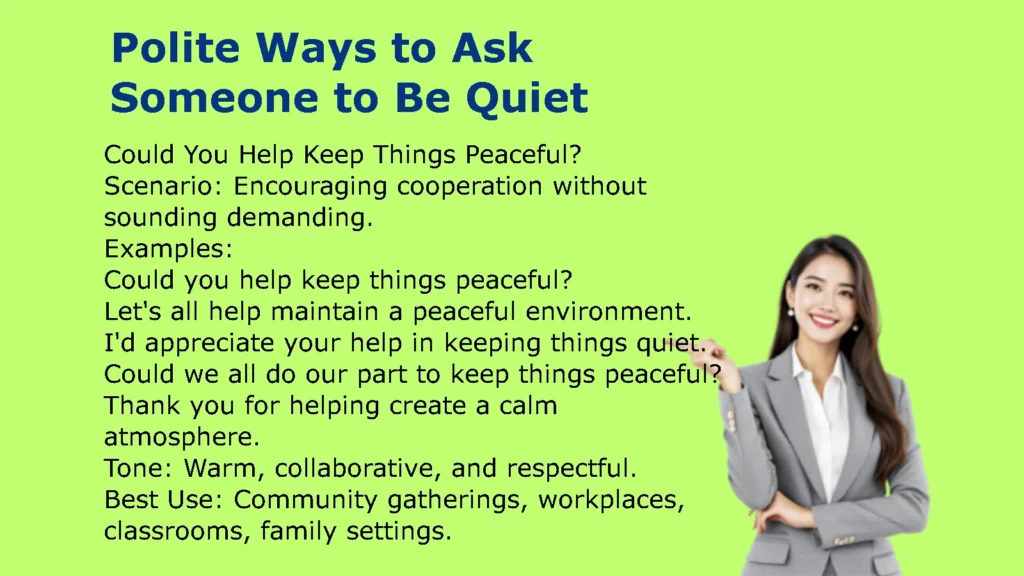
47. Could You Help Keep Things Peaceful?
Scenario: Encouraging cooperation without sounding demanding.
Examples:
- Could you help keep things peaceful?
- Let’s all help maintain a peaceful environment.
- I’d appreciate your help in keeping things quiet.
- Could we all do our part to keep things peaceful?
- Thank you for helping create a calm atmosphere.
Tone: Warm, collaborative, and respectful.
Best Use: Community gatherings, workplaces, classrooms, family settings.
Conclusion
Asking someone to be quiet doesn’t have to sound harsh or unfriendly. By choosing polite and considerate alternatives, you can reduce noise while maintaining respect and positive relationships. Whether you’re in a workplace, classroom, library, or simply talking with friends and family, these polite ways to ask someone to be quiet help you communicate your request with kindness, professionalism, and confidence.

