

Ever wondered how to say Other Ways to Say A Long Time without repeating the same phrase over and over in your writing or conversations? Whether you’re describing waiting, experience, or duration, the way you phrase it can make your language sound more natural and engaging.
The challenge is simple. “A long time” is common, but it can feel repetitive and plain. And here’s the kicker: using the same expression too often can make your writing sound less polished, especially in essays, emails, or storytelling.
Many people look for more natural ways to say a long duration, alternative phrases for a long period, or even creative expressions for something that lasted a long time to make their language more expressive and varied.
But don’t worry—there’s an easy solution.
In this guide, you’ll discover Other Ways to Say A Long Time, including formal, casual, and creative alternatives you can use in writing, speaking, and storytelling. You’ll also learn how small word changes can instantly make your sentences sound smoother and more professional.
So if you want to improve your vocabulary and sound more natural in everyday communication, you’re in the right place.
What Does “A Long Time” Mean?
“A long time” refers to a period that feels extended in duration. It can describe days, months, or even years depending on the context. It often expresses waiting, absence, or a gap between events or meetings.
When to Use “A Long Time”
You can use “a long time” when talking about:
- Not seeing someone for a while
- Waiting for something
- Describing duration or experience
- Reflecting on past events
It works in both casual and formal conversations.
Is It Professional or Polite to Say “A Long Time”?
Yes, it is both polite and neutral. However, in more expressive or formal communication, alternatives like “an extended period” or “a considerable time” may sound more polished.
30 Other Ways to Say “A Long Time”
1. It’s Been Ages
Scenario: Casual reunion with friends
Examples:
- It’s been ages since we last met.
- Wow, it’s been ages! How have you been?
- It’s been ages since school days.
- It’s been ages—let’s catch up soon.
- I can’t believe it’s been ages already.
Tone: Friendly and emotional
Best Use: Informal conversations and reunions
2. It’s Been Forever
Scenario: Expressing long gap dramatically
Examples:
- It’s been forever since we talked.
- It feels like it’s been forever!
- It’s been forever since that trip.
- It’s been forever—I missed this.
- Has it really been forever?
Tone: Emotional and expressive
Best Use: Close friends or family
3. A Long Stretch of Time
Scenario: Neutral description
Examples:
- It was a long stretch of time without updates.
- A long stretch of time has passed since then.
- We waited a long stretch of time.
- It felt like a long stretch of time.
- That was a long stretch of time apart.
Tone: Neutral and descriptive
Best Use: Writing or formal conversation
4. Quite a While
Scenario: General everyday speech
Examples:
- It’s been quite a while since we met.
- I haven’t seen you in quite a while.
- Quite a while has passed.
- It took quite a while to finish.
- We waited quite a while for results.
Tone: Neutral and friendly
Best Use: Everyday communication
5. A Good While
Scenario: Casual emphasis on duration
Examples:
- It’s been a good while since then.
- We talked a good while ago.
- I waited a good while for you.
- It took a good while to finish.
- A good while has passed since we met.
Tone: Relaxed and conversational
Best Use: Informal speech
6. A Considerable Time
Scenario: Formal or professional use
Examples:
- A considerable time has passed since the meeting.
- It took a considerable time to complete.
- We waited a considerable time for approval.
- It’s been a considerable time since then.
- The process required a considerable time.
Tone: Formal and professional
Best Use: Work or academic writing
7. A Lengthy Period
Scenario: Formal description
Examples:
- It was a lengthy period of waiting.
- A lengthy period has passed since then.
- The project took a lengthy period.
- We spent a lengthy period preparing.
- A lengthy period of silence followed.
Tone: Formal and structured
Best Use: Reports or documentation
8. A Fair Amount of Time
Scenario: Neutral everyday use
Examples:
- It took a fair amount of time.
- We spent a fair amount of time there.
- A fair amount of time has passed.
- I waited a fair amount of time.
- It requires a fair amount of time.
Tone: Neutral and balanced
Best Use: General conversations
9. Ages and Ages
Scenario: Strong emphasis on long gap
Examples:
- It’s been ages and ages since we met.
- Ages and ages have passed.
- I waited ages and ages.
- It felt like ages and ages.
- We haven’t spoken in ages and ages.
Tone: Emotional and exaggerated
Best Use: Casual storytelling
10. For Quite Some Time
Scenario: Neutral formal expression
Examples:
- I’ve known him for quite some time.
- It has been ongoing for quite some time.
- We waited for quite some time.
- For quite some time, things were unclear.
- She has been here for quite some time.
Tone: Neutral and formal
Best Use: Writing or professional speech
11. A While Back
Scenario: Referring to the past
Examples:
- We met a while back.
- I saw him a while back.
- That happened a while back.
- I spoke to her a while back.
- It was decided a while back.
Tone: Casual
Best Use: Informal conversations
12. A Long Time Ago
Scenario: Past events
Examples:
- That happened a long time ago.
- We met a long time ago.
- It was a long time ago.
- I learned this a long time ago.
- A long time ago, things were different.
Tone: Narrative and reflective
Best Use: Storytelling
13. In Ages
Scenario: British-style casual speech
Examples:
- Haven’t seen you in ages.
- It’s been in ages since then.
- I haven’t been there in ages.
- In ages, things have changed.
- We talked in ages ago.
Tone: Casual and colloquial
Best Use: Informal conversation
14. Over Time
Scenario: Gradual duration
Examples:
- Things changed over time.
- Over time, we improved.
- It developed over time.
- Over time, we lost touch.
- Skills improve over time.
Tone: Neutral and explanatory
Best Use: Academic or professional writing
15. A Prolonged Period
Scenario: Formal emphasis
Examples:
- A prolonged period of inactivity followed.
- It lasted a prolonged period.
- We experienced a prolonged period of change.
- A prolonged period was needed.
- The delay lasted a prolonged period.
Tone: Formal
Best Use: Reports or analysis
16. A Decent While
Scenario: Friendly casual talk
Examples:
- It’s been a decent while.
- I haven’t seen you in a decent while.
- A decent while has passed.
- We waited a decent while.
- It took a decent while.
Tone: Casual and warm
Best Use: Everyday speech
17. Ages Past
Scenario: Slightly poetic
Examples:
- In ages past, things were simple.
- We met in ages past.
- That was in ages past.
- Stories from ages past.
- In ages past, we were different.
Tone: Poetic and reflective
Best Use: Writing or storytelling
18. A Lengthy Time
Scenario: Neutral formal variation
Examples:
- It took a lengthy time to finish.
- A lengthy time passed.
- We waited a lengthy time.
- It required a lengthy time.
- A lengthy time has gone by.
Tone: Formal
Best Use: Professional writing
19. A Stretch of Time
Scenario: General neutral use
Examples:
- A stretch of time has passed.
- It was a long stretch of time.
- We spent a stretch of time there.
- A stretch of time went unnoticed.
- That stretch of time was difficult.
Tone: Neutral
Best Use: General conversation
20. A Long Interval
Scenario: Technical or formal
Examples:
- There was a long interval between updates.
- A long interval passed.
- We had a long interval of silence.
- It occurred after a long interval.
- A long interval separated events.
Tone: Formal and structured
Best Use: Academic or technical writing
21. A While Ago
Scenario: Simple past reference
Examples:
- I saw him a while ago.
- That happened a while ago.
- We talked a while ago.
- I finished it a while ago.
- It was done a while ago.
Tone: Casual
Best Use: Everyday speech
22. A Fair Stretch
Scenario: Informal duration
Examples:
- We waited a fair stretch.
- It was a fair stretch of time.
- A fair stretch has passed.
- It took a fair stretch.
- We worked for a fair stretch.
Tone: Casual
Best Use: Informal conversation
23. A Long Period
Scenario: Neutral formal use
Examples:
- It was a long period of silence.
- A long period passed.
- We worked over a long period.
- A long period was required.
- It lasted a long period.
Tone: Neutral
Best Use: General writing
24. Ages Ago
Scenario: Strong past emphasis
Examples:
- We met ages ago.
- That happened ages ago.
- I saw him ages ago.
- It was ages ago.
- I learned that ages ago.
Tone: Casual and emotional
Best Use: Conversations
25. A Good Stretch of Time
Scenario: Friendly emphasis
Examples:
- We spent a good stretch of time there.
- It was a good stretch of time.
- A good stretch of time passed.
- We worked a good stretch of time.
- It felt like a good stretch of time.
Tone: Casual
Best Use: Informal speech
26. For a Long Time
Scenario: Basic expression
Examples:
- I waited for a long time.
- We talked for a long time.
- It lasted for a long time.
- I stayed for a long time.
- They worked for a long time.
Tone: Neutral
Best Use: Everyday communication
27. A Significant Period
Scenario: Formal emphasis
Examples:
- A significant period has passed.
- It lasted a significant period.
- We waited a significant period.
- A significant period was needed.
- It changed over a significant period.
Tone: Formal
Best Use: Academic or professional use
28. A Long Gap
Scenario: Emphasizing separation
Examples:
- There was a long gap between meetings.
- A long gap passed.
- We had a long gap in communication.
- A long gap occurred.
- It filled a long gap.
Tone: Neutral
Best Use: Casual or professional
29. Ages Have Passed
Scenario: Dramatic expression
Examples:
- Ages have passed since we met.
- It feels like ages have passed.
- Ages have passed in silence.
- Since then, ages have passed.
- Ages have passed without change.
Tone: Emotional and dramatic
Best Use: Storytelling or casual talk
30. A Long Time Has Gone By
Scenario: Reflective tone
Examples:
- A long time has gone by since then.
- A long time has gone by quickly.
- It feels like a long time has gone by.
- A long time has gone by unnoticed.
- So much has changed as a long time has gone by.
Tone: Reflective and thoughtful
Best Use: Writing or emotional conversations
31. A Lengthy Span of Time
Scenario: Formal description of duration
Examples:
- A lengthy span of time has passed since then.
- It took a lengthy span of time to recover.
- We stayed there for a lengthy span of time.
- A lengthy span of time separated the events.
- The process required a lengthy span of time.
Tone: Formal and descriptive
Best Use: Academic or professional writing
32. A Distant Past
Scenario: Referring to something far back in time
Examples:
- That happened in the distant past.
- We met in the distant past.
- It feels like a distant past now.
- Memories from a distant past came back.
- In the distant past, things were different.
Tone: Reflective and nostalgic
Best Use: Storytelling or reflection
33. A Bygone Era
Scenario: Talking about earlier times
Examples:
- That was from a bygone era.
- We lived in a bygone era.
- It feels like a bygone era now.
- Stories from a bygone era are fascinating.
- That belongs to a bygone era.
Tone: Poetic and nostalgic
Best Use: Writing and storytelling
34. A Long Haul
Scenario: Emphasizing effort over time
Examples:
- It’s been a long haul since we started.
- We’re in this for the long haul.
- That project was a long haul.
- It’s been a long haul journey.
- After a long haul, we finally succeeded.
Tone: Determined and conversational
Best Use: Work, motivation, informal speech
35. A Drawn-Out Period
Scenario: Something that feels extended
Examples:
- It was a drawn-out period of waiting.
- The process became a drawn-out period.
- We went through a drawn-out period.
- It felt like a drawn-out period of silence.
- A drawn-out period followed the delay.
Tone: Slightly negative, formal
Best Use: Reports or explanation
36. A Protracted Span
Scenario: Formal, extended duration
Examples:
- A protracted span of silence followed.
- It lasted a protracted span of time.
- We experienced a protracted span of delays.
- A protracted span separated the events.
- The situation continued for a protracted span.
Tone: Formal and technical
Best Use: Academic or official writing
37. A Stretch
Scenario: Casual and short expression
Examples:
- It’s been a stretch since we last met.
- We worked there for a stretch.
- That was a tough stretch of time.
- It felt like a long stretch.
- A stretch has passed since then.
Tone: Casual and flexible
Best Use: Everyday speech
38. A Number of Years
Scenario: Talking about long duration in years
Examples:
- It’s been a number of years since then.
- We worked together for a number of years.
- A number of years have passed.
- I lived there for a number of years.
- After a number of years, we met again.
Tone: Neutral and factual
Best Use: General or professional communication
39. A Good Number of Years
Scenario: Emphasizing longer time
Examples:
- A good number of years have passed.
- We stayed friends for a good number of years.
- It took a good number of years to finish.
- I haven’t seen him in a good number of years.
- A good number of years went by quickly.
Tone: Friendly and reflective
Best Use: Casual storytelling
40. Many Moons
Scenario: Idiomatic, very long time
Examples:
- I haven’t seen you in many moons.
- Many moons have passed since then.
- It’s been many moons since we met.
- We talked many moons ago.
- Many moons later, we reunited.
Tone: Playful and poetic
Best Use: Casual or creative writing
41. Back in the Day
Scenario: Nostalgic reference to past
Examples:
- Back in the day, things were simpler.
- We met back in the day.
- Back in the day, we used to talk daily.
- It was back in the day when we were kids.
- Back in the day, life was different.
Tone: Nostalgic and casual
Best Use: Informal conversation
42. In Quite Some Time
Scenario: Slight emphasis on gap
Examples:
- I haven’t seen you in quite some time.
- It’s been in quite some time since then.
- We talked in quite some time ago.
- I haven’t visited in quite some time.
- In quite some time, things changed.
Tone: Neutral and slightly formal
Best Use: General communication
43. A Long Spell
Scenario: Extended duration of time
Examples:
- We stayed there for a long spell.
- A long spell of silence followed.
- It lasted a long spell.
- A long spell has passed since then.
- We worked together for a long spell.
Tone: Neutral and descriptive
Best Use: Casual or written contexts
44. A Prolonged Stretch
Scenario: Formal or descriptive duration
Examples:
- It was a prolonged stretch of inactivity.
- We went through a prolonged stretch of waiting.
- A prolonged stretch passed before results came.
- It lasted a prolonged stretch of time.
- A prolonged stretch followed the delay.
Tone: Formal and structured
Best Use: Reports or analysis
45. Far in the Past
Scenario: Referring to distant history
Examples:
- That happened far in the past.
- We met far in the past.
- It feels far in the past now.
- Far in the past, things were different.
- Memories from far in the past remain.
Tone: Reflective and nostalgic
Best Use: Storytelling or memory sharing
46. After Many Years
Scenario: Reunion or return after time
Examples:
- We met again after many years.
- After many years, things changed.
- I returned after many years.
- After many years, we finally spoke.
- They reunited after many years.
Tone: Emotional and reflective
Best Use: Reunions or storytelling
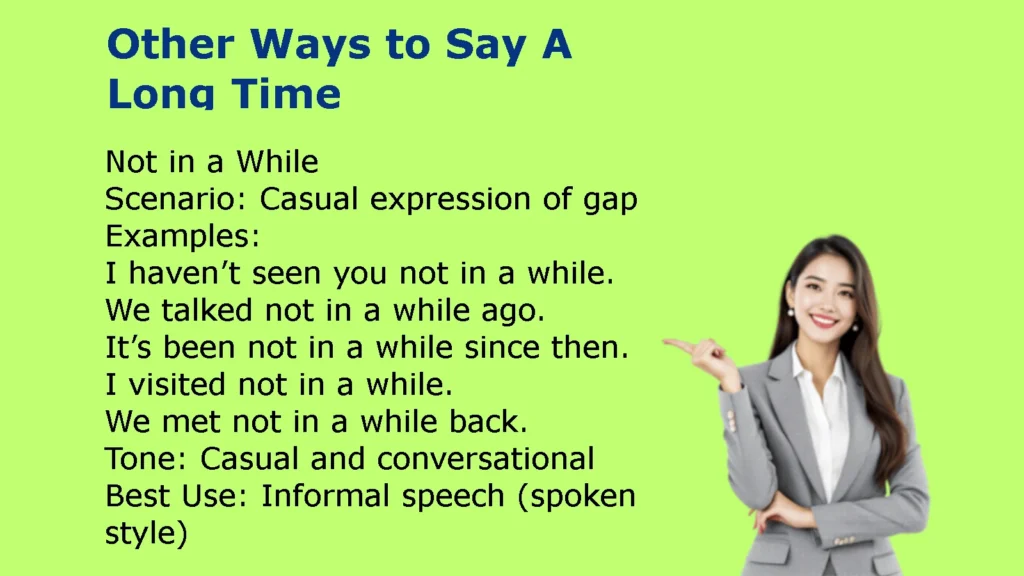
47. Not in a While
Scenario: Casual expression of gap
Examples:
- I haven’t seen you not in a while.
- We talked not in a while ago.
- It’s been not in a while since then.
- I visited not in a while.
- We met not in a while back.
Tone: Casual and conversational
Best Use: Informal speech (spoken style)
Conclusion
With these 47 alternative ways to say “a long time,” you now have a rich collection of expressions for every situation—from casual chats and emotional reunions to formal writing and storytelling. Using varied phrases helps your communication sound more natural, expressive, and engaging in both speech and writing.

