

Ever noticed how often we rely on the phrase “as a result” in writing? The problem is, using Other Ways to Say As a Result too frequently can make your content feel repetitive, mechanical, and less engaging.
You’re not alone if you’ve struggled with this. Whether you’re writing essays, blog posts, or professional emails, finding the right transition words can be tricky. And here’s the kicker: overusing the same phrase can weaken your writing flow and reduce impact.
But don’t worry—there are plenty of better alternatives.
In this guide, you’ll discover Other Ways to Say As a Result, including powerful phrases like “therefore,” “consequently,” “for this reason,” “thus,” and “as a consequence.” You’ll also learn when to use each expression so your writing sounds more natural, polished, and professional.
So if you want to improve clarity, avoid repetition, and upgrade your writing style instantly, you’re in the right place. Let’s dive in.
What Does “As a Result” Mean?
“As a result” is a transition phrase used to show consequence or outcome. It connects an action or situation to its effect.
Example:
It rained heavily; as a result, the match was canceled.
It helps readers understand cause-and-effect relationships clearly.
When to Use “As a Result”
You can use “as a result” in writing, speaking, academic essays, business reports, and storytelling when you want to show an outcome.
It works well in:
- Formal writing
- Academic essays
- Professional emails
- News reports
- Explanations and storytelling
Is It Professional/Polite to Say “As a Result”?
Yes, it is fully professional and widely accepted. However, using variations can improve readability and make your writing sound more natural and less repetitive.
1. Therefore
Scenario: Formal writing or logical conclusions
Examples:
- It was raining heavily; therefore, the match was postponed.
- He didn’t study; therefore, he failed the test.
- The roads were blocked; therefore, we stayed home.
- She was late; therefore, she missed the meeting.
- The demand increased; therefore, prices went up.
Tone: Formal and logical
Best Use: Academic writing, reports, essays
2. Consequently
Scenario: Cause-and-effect explanation
Examples:
- The company lost revenue; consequently, layoffs were announced.
- He ignored warnings; consequently, he got injured.
- The system failed; consequently, data was lost.
- She skipped practice; consequently, she lost the match.
- Traffic increased; consequently, delays occurred.
Tone: Formal and structured
Best Use: Business and academic contexts
3. Because of this
Scenario: Simple explanation
Examples:
- It started raining; because of this, we stayed indoors.
- He was late; because of this, he missed the interview.
- The power went out; because of this, work stopped.
- She didn’t eat; because of this, she felt weak.
- The road was closed; because of this, we took a detour.
Tone: Neutral and conversational
Best Use: Everyday writing and speaking
4. For this reason
Scenario: Explaining outcomes clearly
Examples:
- The project failed; for this reason, it was redesigned.
- He was unwell; for this reason, he stayed home.
- Sales dropped; for this reason, the strategy changed.
- The system crashed; for this reason, updates were applied.
- She was unprepared; for this reason, she lost points.
Tone: Formal and clear
Best Use: Reports and explanations
5. As such
Scenario: Summarizing consequence
Examples:
- The rules were strict; as such, attendance was low.
- He is the manager; as such, he makes decisions.
- The plan changed; as such, deadlines were updated.
- It was urgent; as such, immediate action was taken.
- The offer expired; as such, we declined.
Tone: Formal and concise
Best Use: Business and academic writing
6. Thus
Scenario: Logical conclusion
Examples:
- He studied hard; thus, he passed easily.
- The machine broke down; thus, production stopped.
- She trained daily; thus, she improved quickly.
- The road was flooded; thus, travel was impossible.
- They worked together; thus, the project succeeded.
Tone: Academic and formal
Best Use: Essays and technical writing
7. Hence
Scenario: Reason-based result
Examples:
- He was unwell; hence, he stayed home.
- The data was missing; hence, the report was delayed.
- She was late; hence, she missed the meeting.
- The system failed; hence, downtime occurred.
- It was expensive; hence, fewer buyers showed interest.
Tone: Formal and logical
Best Use: Academic or professional writing
8. So
Scenario: Casual conversation
Examples:
- It was raining, so we stayed home.
- He was tired, so he went to bed early.
- The food was cold, so I didn’t eat it.
- She was late, so she missed class.
- The store was closed, so we left.
Tone: Informal and simple
Best Use: Everyday speech
9. Due to this
Scenario: Explaining cause-effect
Examples:
- The storm was strong; due to this, flights were canceled.
- He forgot his notes; due to this, he struggled.
- The system crashed; due to this, work stopped.
- She was late; due to this, she missed instructions.
- Traffic was heavy; due to this, delays occurred.
Tone: Neutral and professional
Best Use: Reports and explanations
10. As a consequence
Scenario: Formal result description
Examples:
- He violated rules; as a consequence, he was suspended.
- The budget was cut; as a consequence, projects were reduced.
- She ignored advice; as a consequence, she failed.
- The system overheated; as a consequence, it shut down.
- Demand increased; as a consequence, prices rose.
Tone: Formal and serious
Best Use: Academic or official writing
11. That’s Why
Scenario: Casual explanation of result
Examples:
- It was raining heavily; that’s why we stayed home.
- He didn’t study; that’s why he failed.
- The alarm didn’t ring; that’s why I woke up late.
- She was tired; that’s why she left early.
- The road was blocked; that’s why we changed route.
Tone: Informal and conversational
Best Use: Everyday speech and texting
12. Owing to This
Scenario: Formal cause-effect connection
Examples:
- Owing to this delay, the meeting was rescheduled.
- He was ill; owing to this, he missed the exam.
- The system crashed; owing to this, data was lost.
- Traffic increased; owing to this, we were late.
- She resigned; owing to this, the project slowed down.
Tone: Formal and professional
Best Use: Reports and business writing
13. On Account of This
Scenario: Formal reasoning
Examples:
- On account of this issue, the launch was postponed.
- He was unwell; on account of this, he stayed home.
- Sales dropped; on account of this, strategies changed.
- The weather was bad; on account of this, flights were delayed.
- She was absent; on account of this, she missed instructions.
Tone: Formal and explanatory
Best Use: Academic or official writing
14. In Turn
Scenario: Chain reaction
Examples:
- He worked hard, in turn improving his skills.
- The company expanded, in turn creating jobs.
- Demand increased, in turn raising prices.
- She studied more, in turn boosting her grades.
- The system improved, in turn increasing efficiency.
Tone: Formal and logical
Best Use: Reports and analytical writing
15. Accordingly
Scenario: Logical response
Examples:
- The rules changed; accordingly, the policy was updated.
- He was late; accordingly, he was penalized.
- The budget was cut; accordingly, plans were revised.
- She passed the exam; accordingly, she was promoted.
- The issue was urgent; accordingly, action was taken.
Tone: Formal and structured
Best Use: Business and academic writing
16. For That Reason
Scenario: Clear justification
Examples:
- He was unprepared; for that reason, he failed.
- The project was delayed; for that reason, costs increased.
- She was absent; for that reason, she missed updates.
- The system failed; for that reason, work stopped.
- It was risky; for that reason, we avoided it.
Tone: Neutral to formal
Best Use: Explanations and reports
17. As a Result of This
Scenario: Direct cause-effect
Examples:
- As a result of this mistake, the project was delayed.
- As a result of this decision, profits increased.
- As a result of this error, data was lost.
- As a result of this change, performance improved.
- As a result of this action, consequences followed.
Tone: Formal and precise
Best Use: Academic writing
18. Which Led To
Scenario: Sequence of events
Examples:
- He ignored warnings, which led to failure.
- Heavy rain, which led to flooding in the area.
- Poor planning, which led to delays.
- Increased demand, which led to higher prices.
- Lack of effort, which led to poor results.
Tone: Neutral and descriptive
Best Use: Storytelling and reports
19. Which Resulted In
Scenario: Formal outcome description
Examples:
- He missed practice, which resulted in poor performance.
- The storm intensified, which resulted in damage.
- Budget cuts, which resulted in layoffs.
- She studied hard, which resulted in success.
- The error occurred, which resulted in system failure.
Tone: Formal and clear
Best Use: Academic or technical writing
20. Which Caused
Scenario: Direct cause-effect
Examples:
- The storm, which caused flooding in the city.
- His mistake, which caused delays.
- The outage, which caused disruption.
- Poor planning, which caused confusion.
- Heavy traffic, which caused lateness.
Tone: Neutral and explanatory
Best Use: Reports and descriptions
21. In Consequence
Scenario: Formal result expression
Examples:
- In consequence, the policy was changed.
- He failed to comply; in consequence, he was fined.
- The system crashed; in consequence, work stopped.
- She was late; in consequence, she missed the test.
- Demand dropped; in consequence, prices fell.
Tone: Formal and academic
Best Use: Essays and official writing
22. Subsequently
Scenario: Time-based result
Examples:
- He applied late and subsequently missed the opportunity.
- The system failed and subsequently restarted.
- She resigned and subsequently joined another company.
- The rules changed and subsequently improved results.
- He trained hard and subsequently won the match.
Tone: Formal and professional
Best Use: Reports and storytelling
23. Leading To
Scenario: Continuous cause-effect
Examples:
- Poor planning, leading to delays.
- Heavy rain, leading to flooding.
- Lack of sleep, leading to fatigue.
- High demand, leading to shortages.
- System errors, leading to crashes.
Tone: Neutral and descriptive
Best Use: Technical writing
24. And So
Scenario: Simple conclusion
Examples:
- It was late, and so we left.
- He was tired, and so he slept early.
- The store was closed, and so we went back.
- She was unwell, and so she stayed home.
- The road was blocked, and so we changed route.
Tone: Informal and conversational
Best Use: Everyday speech
25. Ergo
Scenario: Logical/formal reasoning
Examples:
- He is the owner; ergo, he decides.
- The data is missing; ergo, the report is incomplete.
- She trained hard; ergo, she succeeded.
- The system failed; ergo, downtime occurred.
- It is illegal; ergo, it was rejected.
Tone: Formal and academic
Best Use: Logical or philosophical writing
26. Thereby
Scenario: Formal result or effect
Examples:
- He reduced costs, thereby increasing profits.
- She studied daily, thereby improving her grades.
- The system was updated, thereby improving speed.
- He followed rules, thereby avoiding penalties.
- The change was made, thereby fixing the issue.
Tone: Formal and professional
Best Use: Reports and academic writing
27. With This Result
Scenario: Emphasized outcome
Examples:
- He ignored advice, with this result, failure followed.
- The system crashed, with this result, data was lost.
- She trained hard, with this result, she won.
- The demand increased, with this result, prices rose.
- The error occurred, with this result, delays happened.
Tone: Formal and descriptive
Best Use: Academic writing
28. Because of That
Scenario: Casual explanation
Examples:
- It rained; because of that, we stayed home.
- He was late; because of that, he missed class.
- The food was bad; because of that, we left early.
- She forgot; because of that, she failed.
- The road was closed; because of that, we changed plans.
Tone: Informal and simple
Best Use: Everyday speech
29. From This
Scenario: Deriving outcome
Examples:
- From this mistake, we learned a lesson.
- From this data, conclusions were drawn.
- From this change, results improved.
- From this failure, success followed.
- From this effort, progress was made.
Tone: Formal and reflective
Best Use: Academic or analytical writing
30. Resulting In
Scenario: Direct outcome phrase
Examples:
- Heavy rain, resulting in floods.
- Poor planning, resulting in delays.
- High demand, resulting in shortages.
- System failure, resulting in downtime.
- Lack of effort, resulting in poor results.
Tone: Formal and descriptive
Best Use: Reports and analysis
31. As a Follow-Up
Scenario: When one action naturally follows another
Examples:
- He missed the meeting; as a follow-up, he sent an apology email.
- The issue was reported; as a follow-up, the team investigated it.
- She submitted the form; as a follow-up, approval was requested.
- The complaint was logged; as a follow-up, action was taken.
- The project ended; as a follow-up, feedback was collected.
Tone: Formal and structured
Best Use: Business processes and workflows
32. In Effect
Scenario: Showing practical result or reality
Examples:
- The new rule, in effect, changed the entire system.
- He resigned, in effect leaving the team short-staffed.
- The update, in effect, improved performance.
- The decision, in effect, ended the project.
- The delay, in effect, caused financial loss.
Tone: Formal and analytical
Best Use: Reports and evaluations
33. On That Account
Scenario: Reason-based outcome
Examples:
- He was unprepared; on that account, he failed.
- The system was unstable; on that account, it was replaced.
- She was absent; on that account, she missed instructions.
- The budget was low; on that account, changes were made.
- The weather worsened; on that account, the event was canceled.
Tone: Formal and explanatory
Best Use: Academic or formal writing
34. With That Outcome
Scenario: Emphasizing final result
Examples:
- He ignored advice, with that outcome being failure.
- The system crashed, with that outcome being data loss.
- She trained daily, with that outcome being victory.
- The plan changed, with that outcome being delays.
- The effort increased, with that outcome being success.
Tone: Formal and descriptive
Best Use: Analytical writing
35. In Light of This
Scenario: Decision based on situation
Examples:
- In light of this issue, the policy was revised.
- In light of this failure, changes were made.
- In light of this data, new strategies were developed.
- In light of this delay, deadlines were extended.
- In light of this feedback, improvements were added.
Tone: Formal and professional
Best Use: Business and academic writing
36. Due to Which
Scenario: Linking cause and result
Examples:
- He was late, due to which he missed the briefing.
- The system failed, due to which work stopped.
- She resigned, due to which the project slowed.
- The road was closed, due to which traffic increased.
- The error occurred, due to which data was lost.
Tone: Neutral and formal
Best Use: Reports and explanations
37. Which Brought About
Scenario: Explaining what caused an outcome
Examples:
- Poor planning, which brought about delays.
- Heavy rain, which brought about flooding.
- His efforts, which brought about success.
- The mistake, which brought about system failure.
- The decision, which brought about change.
Tone: Formal and descriptive
Best Use: Academic and analytical writing
38. Which Triggered
Scenario: Immediate cause-effect
Examples:
- The announcement, which triggered panic.
- The update, which triggered system errors.
- His comment, which triggered a reaction.
- The policy change, which triggered protests.
- The failure, which triggered investigation.
Tone: Neutral to formal
Best Use: News-style or analytical writing
39. Which Produced
Scenario: Direct result formation
Examples:
- The training, which produced excellent results.
- The experiment, which produced new data.
- The strategy, which produced growth.
- The error, which produced system failure.
- The effort, which produced success.
Tone: Formal and neutral
Best Use: Reports and research writing
40. Which Generated
Scenario: Creating an outcome or effect
Examples:
- The campaign, which generated awareness.
- The update, which generated improvements.
- The issue, which generated concern.
- The work, which generated results.
- The policy, which generated debate.
Tone: Formal and professional
Best Use: Business and marketing writing
41. Which Brought On
Scenario: Causing something to happen
Examples:
- The stress, which brought on illness.
- The failure, which brought on criticism.
- The change, which brought on confusion.
- The pressure, which brought on mistakes.
- The delay, which brought on frustration.
Tone: Neutral and explanatory
Best Use: General writing
42. Henceforth
Scenario: From this point forward result/decision
Examples:
- The rule was changed; henceforth, all entries must be approved.
- The system failed; henceforth, backups will be required.
- The policy was updated; henceforth, stricter checks apply.
- The error was found; henceforth, monitoring increased.
- The issue was resolved; henceforth, procedures improved.
Tone: Formal and official
Best Use: Legal, academic, or policy writing
43. On This Basis
Scenario: Decision or result based on evidence
Examples:
- On this basis, the proposal was accepted.
- On this basis, changes were implemented.
- On this basis, the plan was rejected.
- On this basis, the project continued.
- On this basis, action was taken.
Tone: Formal and logical
Best Use: Reports and decision-making contexts
44. As Matters Turned Out
Scenario: Retrospective result
Examples:
- As matters turned out, the decision was correct.
- As matters turned out, the plan failed.
- As matters turned out, he succeeded.
- As matters turned out, delays were unavoidable.
- As matters turned out, the risk paid off.
Tone: Reflective and narrative
Best Use: Storytelling or reports
45. The Outcome Being
Scenario: Stating final result
Examples:
- He ignored advice, the outcome being failure.
- The system crashed, the outcome being data loss.
- She worked hard, the outcome being success.
- The plan changed, the outcome being delays.
- The effort increased, the outcome being improvement.
Tone: Formal and descriptive
Best Use: Academic and analytical writing
46. So That
Scenario: Result-oriented explanation
Examples:
- He studied hard so that he could pass the exam.
- She saved money so that she could buy a car.
- The system was upgraded so that performance improved.
- They worked together so that the project succeeded.
- He left early so that he wouldn’t be late.
Tone: Neutral and flexible
Best Use: Everyday and formal writing
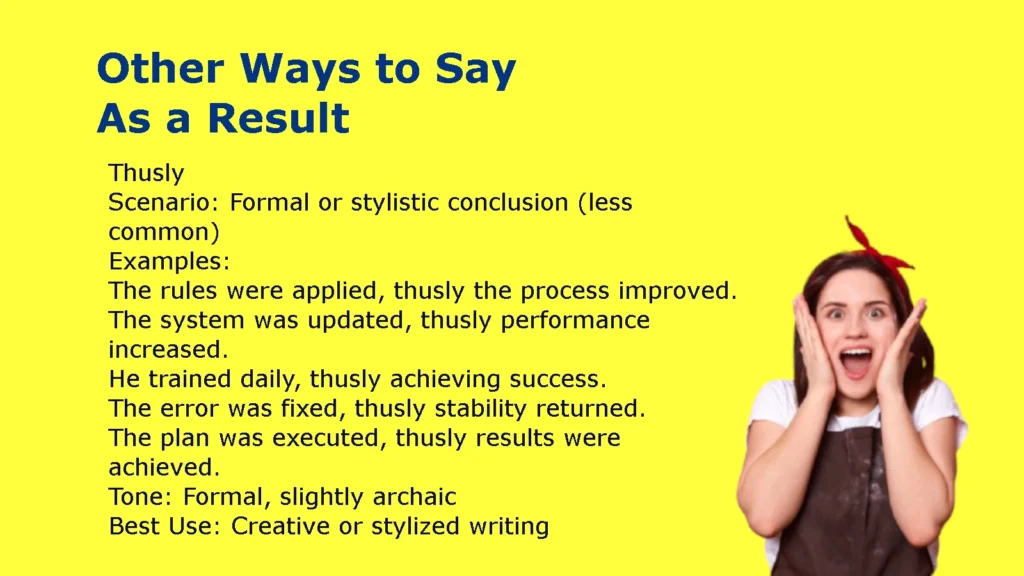
47. Thusly
Scenario: Formal or stylistic conclusion (less common)
Examples:
- The rules were applied, thusly the process improved.
- The system was updated, thusly performance increased.
- He trained daily, thusly achieving success.
- The error was fixed, thusly stability returned.
- The plan was executed, thusly results were achieved.
Tone: Formal, slightly archaic
Best Use: Creative or stylized writing
Final Conclusion
These 47 alternatives to “as a result” give you a wide range of options for academic, professional, and casual writing. Choosing the right phrase helps you control tone, improve readability, and make your writing more natural and engaging.

