

Other Ways to Say Make Sure can instantly upgrade your communication, especially when you want to sound more professional, clear, or polite—have you ever noticed how often we repeat “make sure” in emails, instructions, or everyday messages? You’re not alone. It’s one of the most commonly overused phrases in both casual and workplace writing.
Many people rely on “make sure” because it feels simple and direct, but it can sometimes sound repetitive or too informal depending on the context. Agreeing with this challenge, it’s not always easy to find alternatives that keep your message clear without sounding harsh or robotic. But here’s the promise: there are plenty of natural, effective ways to replace it. In this guide, you will learn other ways to say make sure for different situations—formal, instructional, and casual—so your communication becomes more polished and varied.
What Does “Make Sure” Mean?
“Make sure” means to confirm, verify, or take steps to ensure something happens correctly or is completed properly. It is used when you want to emphasize certainty or responsibility.
When to Use “Make Sure”
You use “make sure” in instructions, reminders, workplace communication, academic writing, and everyday conversations when you want someone to confirm or double-check something.
Is It Professional to Say “Make Sure”?
Yes, it is acceptable in both casual and professional contexts. However, in formal writing or business communication, alternatives like “ensure,” “verify,” or “confirm” often sound more polished.
1. Ensure
Scenario: Formal writing or workplace instructions
Examples:
- Ensure all documents are submitted on time
- Please ensure accuracy before sending the report
- Ensure the system is updated regularly
- Ensure compliance with company policies
- Ensure all steps are completed correctly
Tone: Formal and professional
Best Use: Business emails, reports
2. Confirm
Scenario: Checking or verifying information
Examples:
- Confirm the meeting time with the client
- Please confirm your attendance
- Confirm all details before proceeding
- I will confirm the order shortly
- Confirm the schedule with the team
Tone: Clear and formal
Best Use: Emails, scheduling
3. Verify
Scenario: Accuracy checking
Examples:
- Verify the information before submission
- Please verify your identity
- Verify all data carefully
- We need to verify the results
- Verify the details in the report
Tone: Technical and precise
Best Use: Academic or technical writing
4. Double-check
Scenario: Informal or work-related caution
Examples:
- Double-check the email before sending
- Please double-check the figures
- I always double-check my work
- Double-check the schedule
- Double-check the details for errors
Tone: Friendly but careful
Best Use: Everyday workplace communication
5. Be sure
Scenario: Casual instructions
Examples:
- Be sure to lock the door
- Be sure you submit it on time
- Be sure to read the instructions
- Be sure everything is correct
- Be sure to arrive early
Tone: Simple and direct
Best Use: Everyday speech or instructions
6. Make certain
Scenario: Formal emphasis
Examples:
- Make certain all files are backed up
- Please make certain the data is correct
- Make certain the task is completed
- Make certain you follow the rules
- Make certain everything is ready
Tone: Formal and strong
Best Use: Professional writing
7. See to it
Scenario: Responsibility or instruction
Examples:
- See to it the work is done properly
- Please see to it that everything is ready
- I will see to it personally
- See to it the task is completed
- See to it there are no mistakes
Tone: Slightly authoritative
Best Use: Instructions or leadership communication
8. Check
Scenario: Simple instruction
Examples:
- Check the document before submission
- Please check your email
- Check the list carefully
- Check the results again
- Check all requirements
Tone: Neutral and simple
Best Use: Short instructions
9. Validate
Scenario: Technical or data-focused work
Examples:
- Validate the information before use
- Please validate the data
- Validate all inputs carefully
- Validate the results
- Validate system accuracy
Tone: Technical and formal
Best Use: IT, data, or research
10. Be certain
Scenario: Emphasis on clarity
Examples:
- Be certain you understand the instructions
- Be certain before making a decision
- Be certain everything is correct
- Be certain to follow steps
- Be certain of the details
Tone: Strong and clear
Best Use: Instructions and guidance
11. Ascertain
Scenario: Formal or academic writing
Examples:
- Ascertain the facts before reporting
- We need to ascertain the truth
- Ascertain the cause of the issue
- Please ascertain the details
- They tried to ascertain the results
Tone: Academic and formal
Best Use: Reports or research
12. Guarantee
Scenario: Assurance or commitment
Examples:
- Guarantee the accuracy of the report
- We guarantee timely delivery
- Please guarantee completion
- I guarantee the quality
- Guarantee customer satisfaction
Tone: Confident and strong
Best Use: Business or promises
13. Take care to
Scenario: Instruction with caution
Examples:
- Take care to follow instructions
- Take care to avoid mistakes
- Take care to check details
- Take care to complete steps
- Take care to remain accurate
Tone: Polite and careful
Best Use: Instructions or guidance
14. Pay attention to
Scenario: Learning or instruction
Examples:
- Pay attention to the details
- Please pay attention to instructions
- Pay attention to deadlines
- Pay attention to accuracy
- Pay attention to safety rules
Tone: Educational
Best Use: Training or learning environments
15. Be mindful of
Scenario: Thoughtful instruction
Examples:
- Be mindful of deadlines
- Be mindful of the rules
- Be mindful of your tone
- Be mindful of errors
- Be mindful of the process
Tone: Gentle and professional
Best Use: Workplace communication
16. Keep in mind
Scenario: Reminder
Examples:
- Keep in mind the deadline
- Keep in mind the instructions
- Keep in mind the rules
- Keep in mind the requirements
- Keep in mind the risks
Tone: Friendly reminder
Best Use: Casual professional communication
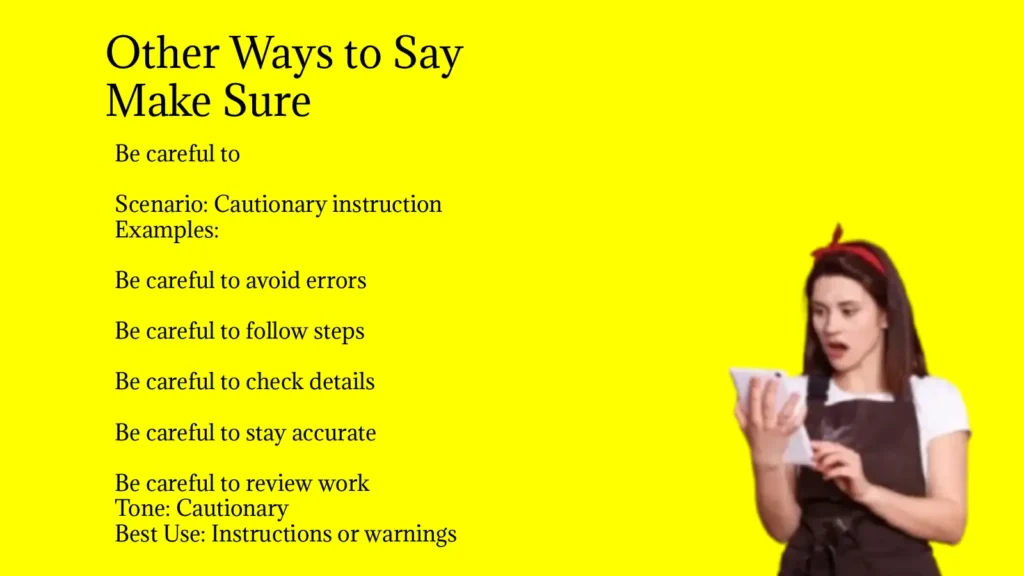
17. Be careful to
Scenario: Cautionary instruction
Examples:
- Be careful to avoid errors
- Be careful to follow steps
- Be careful to check details
- Be careful to stay accurate
- Be careful to review work
Tone: Cautionary
Best Use: Instructions or warnings
18. Ensure that
Scenario: Formal instruction
Examples:
- Ensure that all files are saved
- Ensure that the report is complete
- Ensure that deadlines are met
- Ensure that data is accurate
- Ensure that rules are followed
Tone: Professional and precise
Best Use: Business writing
19. Make certain that
Scenario: Formal emphasis
Examples:
- Make certain that everything is ready
- Make certain that files are correct
- Make certain that tasks are done
- Make certain that instructions are followed
- Make certain that nothing is missed
Tone: Strong and formal
Best Use: Reports or instructions
20. Confirm that
Scenario: Verification
Examples:
- Confirm that the data is correct
- Confirm that the meeting is scheduled
- Confirm that everything is complete
- Confirm that details are accurate
- Confirm that requirements are met
Tone: Formal and clear
Best Use: Professional communication
21. Review
Scenario: Checking work
Examples:
- Review the document before submission
- Please review your work
- Review all details carefully
- Review the report
- Review the instructions
Tone: Professional and neutral
Best Use: Work or academic tasks
22. Inspect
Scenario: Detailed checking
Examples:
- Inspect the data carefully
- Inspect the system before use
- Inspect all components
- Inspect the results
- Inspect the work thoroughly
Tone: Technical and precise
Best Use: Technical or quality control
23. Oversee
Scenario: Supervision role
Examples:
- Oversee the project carefully
- I will oversee the process
- Oversee all team tasks
- Oversee production quality
- Oversee implementation
Tone: Leadership-focused
Best Use: Managerial roles
24. Look into
Scenario: Investigation or checking
Examples:
- Look into the issue
- Please look into the matter
- I will look into the details
- Look into the complaint
- Look into the problem
Tone: Investigative and casual
Best Use: Problem-solving contexts
25. Follow through
Scenario: Completion-focused
Examples:
- Follow through with the plan
- Please follow through on tasks
- I will follow through on the project
- Follow through carefully
- Follow through until completion
Tone: Action-oriented
Best Use: Task completion
26. Keep track of
Scenario: Monitoring progress
Examples:
- Keep track of deadlines
- Keep track of progress
- Keep track of updates
- Keep track of changes
- Keep track of tasks
Tone: Practical and organized
Best Use: Project management
27. Take responsibility for
Scenario: Accountability
Examples:
- Take responsibility for the task
- Take responsibility for errors
- Take responsibility for completion
- Take responsibility for results
- Take responsibility for the project
Tone: Formal and accountable
Best Use: Leadership or work roles
28. Comply with
Scenario: Rules or regulations
Examples:
- Comply with company rules
- Comply with safety standards
- Comply with instructions
- Comply with regulations
- Comply with policies
Tone: Formal and legal
Best Use: Compliance contexts
29. Stick to
Scenario: Instructions or plans
Examples:
- Stick to the schedule
- Stick to the plan
- Stick to the instructions
- Stick to the guidelines
- Stick to the process
Tone: Simple and directive
Best Use: Everyday instructions
30. Be diligent about
Scenario: Work ethic emphasis
Examples:
- Be diligent about your tasks
- Be diligent about deadlines
- Be diligent about accuracy
- Be diligent about reporting
- Be diligent about checking work
Tone: Professional and motivational
Best Use: Performance expectations
31. Be attentive to
Scenario: Focused instructions or reminders
Examples:
- Be attentive to details in the report
- Be attentive to deadlines
- Be attentive to instructions
- Be attentive to changes in the plan
- Be attentive to safety rules
Tone: Careful and professional
Best Use: Workplace or training environments
32. Ensure compliance with
Scenario: Formal rules or policies
Examples:
- Ensure compliance with company policies
- Ensure compliance with safety standards
- Ensure compliance with regulations
- Ensure compliance with guidelines
- Ensure compliance with legal requirements
Tone: Formal and strict
Best Use: Legal, corporate, compliance writing
33. Make certain of
Scenario: Verification or confirmation
Examples:
- Make certain of the facts before reporting
- Make certain of the schedule
- Make certain of the details
- Make certain of accuracy
- Make certain of completion
Tone: Formal and precise
Best Use: Professional writing
34. Take precautions to
Scenario: Safety or risk avoidance
Examples:
- Take precautions to avoid errors
- Take precautions to ensure safety
- Take precautions to protect data
- Take precautions to prevent mistakes
- Take precautions to follow rules
Tone: Cautious and responsible
Best Use: Safety or risk-related instructions
35. Cross-check
Scenario: Verification of information
Examples:
- Cross-check the data before submission
- Cross-check all entries
- Cross-check the report for errors
- Cross-check the details carefully
- Cross-check the figures
Tone: Analytical and precise
Best Use: Data, finance, technical work
36. Look over carefully
Scenario: Reviewing work
Examples:
- Look over the document carefully
- Look over your answers
- Look over the report before sending
- Look over all details
- Look over the instructions
Tone: Simple and practical
Best Use: Everyday work tasks
37. Pay close attention to
Scenario: Detailed focus
Examples:
- Pay close attention to instructions
- Pay close attention to deadlines
- Pay close attention to errors
- Pay close attention to updates
- Pay close attention to requirements
Tone: Emphasizing focus
Best Use: Training or learning environments
38. Double-verify
Scenario: Extra confirmation
Examples:
- Double-verify the results
- Double-verify the data
- Double-verify your work
- Double-verify all details
- Double-verify before submission
Tone: Cautious and technical
Best Use: High-accuracy tasks
39. Be assured that
Scenario: Providing confidence or instruction
Examples:
- Be assured that everything is correct
- Be assured that the process is complete
- Be assured that the task is handled
- Be assured that we will check it
- Be assured that details are accurate
Tone: Reassuring and formal
Best Use: Customer communication
40. Follow instructions carefully
Scenario: Direct guidance
Examples:
- Follow instructions carefully to avoid errors
- Follow instructions carefully during setup
- Follow instructions carefully in the process
- Follow instructions carefully for safety
- Follow instructions carefully step by step
Tone: Clear and instructional
Best Use: Manuals or training
41. Stay certain of
Scenario: Confidence in accuracy
Examples:
- Stay certain of the facts
- Stay certain of your results
- Stay certain of the process
- Stay certain of the details
- Stay certain of the plan
Tone: Confident and steady
Best Use: Guidance or advice
42. Keep ensured that
Scenario: Continuous confirmation (formal tone)
Examples:
- Keep ensured that tasks are completed
- Keep ensured that deadlines are met
- Keep ensured that quality is maintained
- Keep ensured that instructions are followed
- Keep ensured that everything is correct
Tone: Formal and structured
Best Use: Corporate or managerial communication
43. Take care that
Scenario: Careful instruction
Examples:
- Take care that no mistakes occur
- Take care that deadlines are met
- Take care that instructions are followed
- Take care that everything is correct
- Take care that data is accurate
Tone: Gentle and careful
Best Use: Instructions or warnings
Conclusion
Instead of repeatedly using “make sure,” these 47 powerful alternatives help you sound more precise, professional, and expressive in writing and speech. Whether you’re giving instructions, writing emails, or preparing reports, choosing the right phrase improves clarity, tone, and impact significantly.

