

Ever sent an email and then immediately thought, “That didn’t sound quite right”? You’re not alone—and that’s exactly why Other Ways to Say Never Mind in an Email is something so many professionals search for when trying to sound clearer and more polite in communication.
It’s easy to come across as abrupt or unclear when you use “never mind” in emails, especially in professional or formal settings. Agreeing on the need for better phrasing helps avoid misunderstandings and keeps your tone polished. But here’s the kicker: the right alternative can instantly make your message sound more respectful and professional.
In this guide, you’ll discover a variety of thoughtful and context-appropriate alternatives you can use instead of “never mind.” Promise? You’ll never struggle to find the right tone again. And it gets better…
We’ll also break down when to use each phrase so you don’t accidentally sound too casual or too formal. Whether you’re correcting yourself, canceling a request, or clarifying confusion, this list will help you communicate with confidence. In short, you’ll learn how to refine your email tone while keeping your message clear, polite, and effective.
What Does “Never Mind” Mean?
“Never mind” is used to tell someone to ignore what was previously said or to indicate that something is no longer important. In emails, it usually means you are withdrawing a request, correcting information, or changing your mind.
When to Use “Never Mind” Alternatives in Emails
You can use these alternatives when:
- You want to correct a mistake
- You no longer need assistance or information
- You are updating instructions
- You want to avoid sounding abrupt or dismissive
Is It Professional/Polite to Say “Never Mind” in an Email?
“Never mind” can feel too casual or even rude in professional emails. While it’s fine in informal texting, email communication benefits from softer, clearer phrases like “please disregard” or “no longer needed.”
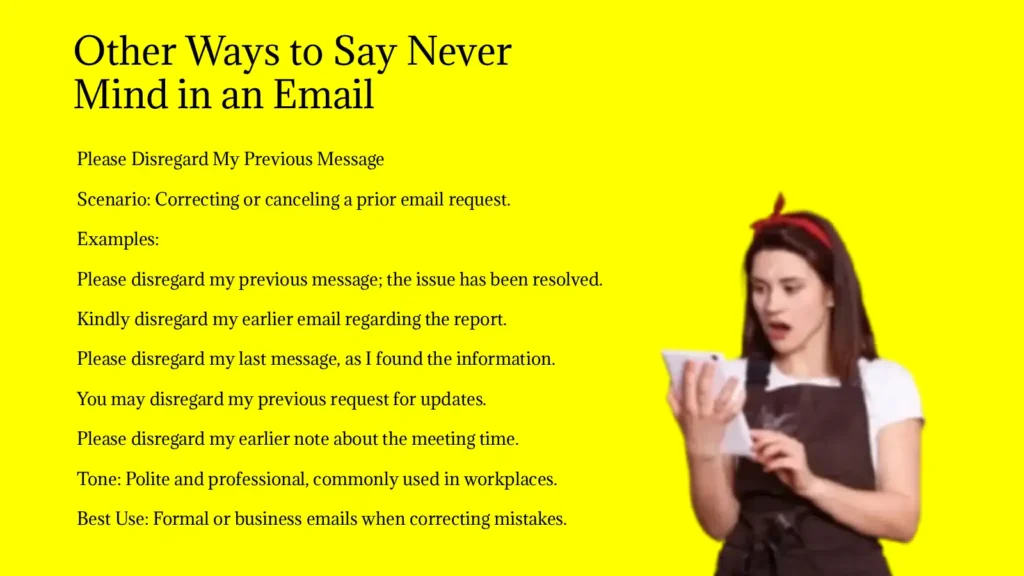
1. Please Disregard My Previous Message
Scenario: Correcting or canceling a prior email request.
Examples:
- Please disregard my previous message; the issue has been resolved.
- Kindly disregard my earlier email regarding the report.
- Please disregard my last message, as I found the information.
- You may disregard my previous request for updates.
- Please disregard my earlier note about the meeting time.
Tone: Polite and professional, commonly used in workplaces.
Best Use: Formal or business emails when correcting mistakes.
2. No Longer Needed
Scenario: Canceling a request or task.
Examples:
- The document is no longer needed at this time.
- No longer needed, as I have already received the information.
- This request is no longer needed—thank you.
- The assistance is no longer needed, as the issue is resolved.
- No longer needed for now, but I appreciate your help.
Tone: Clear, concise, professional.
Best Use: Work emails and task cancellations.
3. Please Ignore My Last Email
Scenario: You sent something incorrect or unnecessary.
Examples:
- Please ignore my last email; I sent it by mistake.
- Kindly ignore my previous message regarding the schedule.
- Please ignore my last email, as I have updated the details.
- You may ignore my earlier message.
- Please ignore my last email and refer to this one instead.
Tone: Direct but polite.
Best Use: Corrections or follow-up emails.
4. Apologies, That Is No Longer Relevant
Scenario: Updating outdated information.
Examples:
- Apologies, that is no longer relevant due to recent changes.
- That information is no longer relevant; please ignore it.
- Apologies, the previous request is no longer relevant.
- This is no longer relevant based on updated details.
- Apologies for the confusion; that is no longer relevant.
Tone: Professional and considerate.
Best Use: Work communication involving updates.
5. Please Disregard That Request
Scenario: Cancelling a specific request.
Examples:
- Please disregard that request; I have already resolved it.
- Kindly disregard that request for now.
- Please disregard my request from earlier today.
- You may disregard that request completely.
- Please disregard that request and wait for further instructions.
Tone: Clear and formal.
Best Use: Business or administrative emails.
6. That Is No Longer Required
Scenario: Something is no longer needed or relevant.
Examples:
- That report is no longer required.
- The update is no longer required at this stage.
- That action is no longer required, thank you.
- No further action is required on that.
- That information is no longer required.
Tone: Formal, concise, task-focused.
Best Use: Workplace instructions or task management.
7. I Have Already Found the Information
Scenario: You no longer need help.
Examples:
- I have already found the information, thank you.
- I’ve located the details, so no further help is needed.
- I found what I needed, thank you for your assistance.
- I have already resolved this on my end.
- I’ve got the information now, thanks.
Tone: Appreciative and polite.
Best Use: When someone offered help you no longer need.
8. Let’s Set That Aside for Now
Scenario: Postponing or deprioritizing something.
Examples:
- Let’s set that aside for now and focus on the main task.
- We can set this aside for now and revisit later.
- Let’s set that aside until further notice.
- For now, let’s set that aside.
- We’ll set that aside and return to it later if needed.
Tone: Collaborative and neutral.
Best Use: Team discussions or planning emails.
9. I’ll Get Back to You If Needed
Scenario: No longer needing immediate action.
Examples:
- I’ll get back to you if anything else is needed.
- For now, I’m good, but I’ll reach out if required.
- I’ll contact you if further assistance is needed.
- I’ll follow up if necessary.
- I’ll let you know if I need anything else.
Tone: Polite, open-ended, professional.
Best Use: Closing conversations politely.
10. This Can Be Ignored for Now
Scenario: Temporary cancellation or delay.
Examples:
- This can be ignored for now, thanks.
- Please note this can be ignored at this time.
- This can be ignored until further notice.
- You may ignore this for now.
- This message can be ignored as it is outdated.
Tone: Neutral and clear.
Best Use: Internal team emails or updates.
11. Please Disregard This Matter
Scenario: Formal correction or cancellation.
Examples:
- Please disregard this matter as it has already been resolved.
- Kindly disregard this matter for now.
- Please disregard this matter and proceed with the updated instructions.
- You may disregard this matter entirely.
- Please disregard this matter due to recent changes.
Tone: Formal, respectful, and clear.
Best Use: Business emails, official communication.
12. Kindly Ignore My Earlier Note
Scenario: Soft correction of a previous message.
Examples:
- Kindly ignore my earlier note; I have updated the details.
- Please kindly ignore my earlier note regarding the deadline.
- Kindly ignore my earlier note and refer to this email instead.
- Kindly ignore my previous note due to an error.
- Kindly ignore my earlier note as it is no longer accurate.
Tone: Polite and professional.
Best Use: Workplace corrections or updates.
13. That Has Been Resolved
Scenario: Issue is already fixed.
Examples:
- That has been resolved, so no further action is needed.
- The issue has been resolved on my end.
- That has already been resolved, thank you.
- This matter has been resolved earlier today.
- It has been resolved, so please ignore my previous message.
Tone: Confident, clear, professional.
Best Use: Status updates in work emails.
14. No Action Required
Scenario: Canceling instructions or tasks.
Examples:
- No action required from your side.
- This is just an update; no action required.
- No action required as the issue is closed.
- No action required for this email.
- At this point, no action is required.
Tone: Direct and professional.
Best Use: Internal instructions or task updates.
15. Please Consider This Void
Scenario: Formal cancellation (legal/official tone).
Examples:
- Please consider this email void.
- Kindly consider the previous instruction void.
- Please consider that request void due to updates.
- This request should be considered void.
- Please treat my earlier message as void.
Tone: Very formal, authoritative.
Best Use: Legal, finance, or official communications.
16. Disregard Previous Instruction
Scenario: Updating directions or guidance.
Examples:
- Please disregard previous instruction and follow the updated one.
- Kindly disregard the previous instruction.
- Disregard the earlier instruction due to changes.
- Please disregard previous instructions shared today.
- The previous instruction should be disregarded.
Tone: Professional and directive.
Best Use: Team or project communication.
17. That’s No Longer Applicable
Scenario: Situation has changed.
Examples:
- That’s no longer applicable due to recent updates.
- The earlier instruction is no longer applicable.
- This is no longer applicable to the current situation.
- That information is no longer applicable.
- Please note that it’s no longer applicable.
Tone: Neutral and informative.
Best Use: Work updates or policy changes.
18. Please Ignore That Detail
Scenario: Small correction or clarification.
Examples:
- Please ignore that detail; it was incorrect.
- Kindly ignore that detail in my previous message.
- Please ignore that detail and focus on the updated version.
- That detail can be ignored.
- Please ignore that detail as it has changed.
Tone: Light correction, polite.
Best Use: Minor edits in emails.
19. I Apologize, That Was Incorrect
Scenario: Correcting mistake politely.
Examples:
- I apologize, that was incorrect information.
- Apologies, that statement was incorrect.
- I apologize for the confusion; that was wrong.
- That was incorrect—please refer to the updated details.
- Sorry, that information was not accurate.
Tone: Humble and professional.
Best Use: Error correction in formal emails.
20. Let’s Revisit This Later
Scenario: Postponing discussion.
Examples:
- Let’s revisit this later when we have more details.
- We can revisit this topic later.
- Let’s revisit this once things are clearer.
- This can be revisited later if needed.
- Let’s revisit this at a better time.
Tone: Collaborative and polite.
Best Use: Meetings and planning emails.
21. Please Hold Off on That
Scenario: Pausing action.
Examples:
- Please hold off on that request for now.
- Kindly hold off until further notice.
- Please hold off on proceeding.
- Hold off on that task for the moment.
- Please hold off as updates are pending.
Tone: Polite but directive.
Best Use: Work coordination emails.
22. This Is No Longer a Priority
Scenario: De-escalating importance.
Examples:
- This is no longer a priority at this stage.
- The task is no longer a priority.
- Please note this is no longer a priority.
- That issue is no longer a priority.
- We have marked this as no longer a priority.
Tone: Neutral and managerial.
Best Use: Project updates or task management.
23. You May Ignore the Previous Email
Scenario: Direct correction of earlier message.
Examples:
- You may ignore the previous email sent today.
- Kindly ignore the previous email.
- You may disregard the earlier email.
- Please ignore the email I sent before this.
- You may ignore my previous message.
Tone: Clear and polite.
Best Use: Email corrections or follow-ups.
24. That Was Sent in Error
Scenario: Mistaken email.
Examples:
- That was sent in error; please ignore it.
- The previous message was sent in error.
- Apologies, that email was sent in error.
- That message was sent in error and can be disregarded.
- Please ignore—it was sent in error.
Tone: Honest and professional.
Best Use: Mistaken or accidental emails.
25. Please Refer to My Updated Message
Scenario: Replacing old information.
Examples:
- Please refer to my updated message instead.
- Kindly refer to the updated email.
- Please refer to my latest message for correct details.
- Refer to my updated instructions.
- Please see my updated message below.
Tone: Clear and corrective.
Best Use: Replacing outdated emails.
26. Consider This Updated Information
Scenario: Providing correction.
Examples:
- Please consider this updated information instead.
- Kindly consider the updated details.
- Consider this corrected information.
- Please consider the updated version of this message.
- This is the updated information—please consider it.
Tone: Professional and informative.
Best Use: Formal corrections or revisions.
27. No Further Action Needed
Scenario: Closing a request.
Examples:
- No further action needed from your side.
- This matter requires no further action.
- No further action is needed at this time.
- No further action needed; thank you.
- At this point, no further action is needed.
Tone: Final and clear.
Best Use: Task completion emails.
28. Let’s Disregard That for Now
Scenario: Temporary dismissal.
Examples:
- Let’s disregard that for now and continue.
- We can disregard that for the moment.
- Let’s disregard that until we have more info.
- For now, let’s disregard that detail.
- Let’s disregard that and move forward.
Tone: Collaborative and soft.
Best Use: Team discussions.
29. That Can Be Ignored Moving Forward
Scenario: Long-term cancellation.
Examples:
- That can be ignored moving forward.
- Please note this can be ignored going forward.
- That instruction can be ignored in future communication.
- You may ignore that moving forward.
- That detail can be ignored from now on.
Tone: Clear and final.
Best Use: Policy or process updates.
30. I’ll Update You If Needed
Scenario: Closing message politely.
Examples:
- I’ll update you if anything changes.
- I’ll let you know if further action is needed.
- I’ll reach out if an update is required.
- I’ll inform you if this becomes relevant again.
- I’ll contact you if needed.
Tone: Polite, professional, reassuring.
Best Use: Ending email threads.
31. Please Treat the Previous Message as Obsolete
Scenario: Formal correction in professional email.
Examples:
- Please treat the previous message as obsolete.
- Kindly treat my earlier email as obsolete.
- Please consider that information obsolete.
- The previous message should be treated as obsolete.
- Treat my last note as obsolete.
Tone: Formal and precise.
Best Use: Work updates or corrected instructions.
32. Kindly Set Aside My Earlier Instruction
Scenario: Replacing or canceling guidance.
Examples:
- Kindly set aside my earlier instruction.
- Please set aside the previous instructions.
- Set aside my earlier note and follow this one.
- Kindly set aside what was mentioned before.
- Please set aside my prior instruction.
Tone: Polite and directive.
Best Use: Team coordination emails.
33. Please Void the Earlier Communication
Scenario: Official cancellation.
Examples:
- Please void the earlier communication.
- Kindly void my previous email.
- Please void that message due to updates.
- The earlier communication is void.
- Please consider the prior message void.
Tone: Very formal.
Best Use: Legal, finance, or official notices.
34. Disregard Prior Correspondence
Scenario: Formal correction of earlier emails.
Examples:
- Please disregard prior correspondence.
- Kindly disregard previous correspondence.
- Disregard prior communication due to updates.
- Please disregard earlier correspondence on this matter.
- Prior correspondence should be disregarded.
Tone: Professional and formal.
Best Use: Business or corporate communication.
35. Please Overlook My Earlier Note
Scenario: Soft correction.
Examples:
- Please overlook my earlier note.
- Kindly overlook the previous message.
- Please overlook my earlier comment.
- Overlook my previous email.
- Please overlook that earlier detail.
Tone: Polite and gentle.
Best Use: Minor corrections.
36. That Information Has Been Superseded
Scenario: Updated information replaces old one.
Examples:
- That information has been superseded by new updates.
- The earlier details have been superseded.
- Please note this has been superseded.
- That report has been superseded.
- Superseded by the updated version below.
Tone: Formal and clear.
Best Use: Reports or technical updates.
37. Please Refer Only to This Email Going Forward
Scenario: Replacing previous instructions.
Examples:
- Please refer only to this email going forward.
- Kindly use this email as the correct reference.
- Refer only to this updated message.
- Please follow only this communication moving forward.
- This email should be your only reference.
Tone: Clear and directive.
Best Use: Process updates or corrections.
38. The Earlier Message Is Now Outdated
Scenario: Updating information.
Examples:
- The earlier message is now outdated.
- Please note the previous email is outdated.
- That message is now outdated.
- The earlier instructions are outdated.
- This supersedes the outdated message.
Tone: Neutral and professional.
Best Use: General updates.
39. Please Ignore Any Confusion From My Last Email
Scenario: Clarifying mistake.
Examples:
- Please ignore any confusion from my last email.
- Apologies, ignore confusion caused by my previous message.
- Please disregard confusion in my earlier email.
- Ignore any unclear details from my last message.
- Sorry for confusion—please ignore my last email.
Tone: Apologetic and polite.
Best Use: Error correction.
40. Consider the Previous Note Withdrawn
Scenario: Formal withdrawal.
Examples:
- Consider the previous note withdrawn.
- The earlier request is withdrawn.
- Please consider my prior message withdrawn.
- That instruction is now withdrawn.
- Consider that message officially withdrawn.
Tone: Formal and final.
Best Use: Official or structured communication.
41. I Retract My Previous Message
Scenario: Strong correction or mistake.
Examples:
- I retract my previous message.
- I would like to retract my earlier email.
- I retract the statement made earlier.
- Please note I retract my last message.
- I am retracting my previous instruction.
Tone: Formal and accountable.
Best Use: Serious corrections.
42. Please Dismiss My Earlier Request
Scenario: Canceling a request.
Examples:
- Please dismiss my earlier request.
- Kindly dismiss the previous instruction.
- Dismiss my earlier message.
- Please dismiss that request entirely.
- My earlier request can be dismissed.
Tone: Clear and professional.
Best Use: Task cancellation.
43. That Point Is No Longer Relevant
Scenario: Removing outdated detail.
Examples:
- That point is no longer relevant.
- The earlier point is no longer relevant.
- Please ignore that irrelevant detail.
- That issue is no longer relevant now.
- It is no longer relevant to the discussion.
Tone: Neutral and informative.
Best Use: Discussions or updates.
44. Let’s Proceed Without Considering My Last Message
Scenario: Moving forward with correction.
Examples:
- Let’s proceed without considering my last message.
- Please proceed without my earlier note.
- Let’s continue without that instruction.
- Move forward ignoring my last message.
- Proceed without considering previous details.
Tone: Collaborative and clear.
Best Use: Team workflows.
45. Please Reset to the Updated Instructions
Scenario: Replacing earlier guidance.
Examples:
- Please reset to the updated instructions.
- Reset and follow the latest email only.
- Kindly reset to the new guidance.
- Please reset based on this email.
- Reset to the updated details below.
Tone: Directive and structured.
Best Use: Project coordination.
46. Apologies, Please Disregard Earlier Confusion
Scenario: Polite correction.
Examples:
- Apologies, please disregard earlier confusion.
- Sorry for confusion—please disregard my last message.
- Apologies, ignore earlier confusion.
- Please disregard confusion caused earlier.
- Sorry, please ignore my previous unclear message.
Tone: Apologetic and professional.
Best Use: Mistakes or unclear emails.
47. Please Act Only on the Information Below
Scenario: Final corrected instruction.
Examples:
- Please act only on the information below.
- Kindly follow only the details in this email.
- Act only on the updated instructions below.
- Please ignore previous messages and act on this.
- Only the information below should be considered.
Tone: Final, authoritative, and clear.
Best Use: Important updates or final instructions.
Conclusion
Using “never mind” in emails can sound abrupt, but these 47 professional alternatives help you communicate more clearly and respectfully. Whether you need to cancel, correct, or update information, these phrases ensure your message stays polite, structured, and easy to understand in any professional setting.

