

Ever found yourself repeatedly using Other Ways to Say That Is Why in writing or conversation and feeling like it sounds too repetitive or basic? This small phrase is useful, but overusing it can make your speech or writing feel flat and less engaging.
The problem is simple. “That is why” works, but it often feels too formal or too predictable depending on the context. And here’s the kicker: using the same connector again and again can weaken the flow of your ideas, especially in essays, emails, or storytelling.
Many people look for more formal ways to say that is why, alternative phrases for that is why, or even better transition words for explaining reasons to make their language sound smoother and more natural.
But don’t worry—there’s an easy solution.
In this guide, you’ll discover Other Ways to Say That Is Why, including formal, casual, and professional alternatives you can use in writing, speaking, essays, and workplace communication. You’ll also learn how these reason-explaining phrases can improve clarity and make your sentences more polished.
So if you want to upgrade your vocabulary and make your explanations flow better, keep reading—you’re in the right place.
What Does “That Is Why” Mean?
“That is why” is used to explain the reason behind something or to show cause and effect. It connects an action or situation with its result in a clear and logical way.
Example:
- It was raining heavily; that is why we stayed home.
When to Use “That Is Why”
You use “that is why” when you want to explain a result or conclusion based on a previous statement. It works in both spoken and written English, especially in storytelling, explanations, and reasoning.
Is It Professional or Polite to Say “That Is Why”?
Yes, it is both professional and polite. However, in formal writing or business communication, using variations can make your language sound more polished and less repetitive.
1. For That Reason
Scenario: Explaining logic or decision
Examples:
- The roads were closed; for that reason, we took a different route.
- He was late; for that reason, he missed the meeting.
Tone: Formal and clear
Best Use: Professional writing and reports
2. That’s the Reason
Scenario: Simple explanation
Examples:
- She was unwell; that’s the reason she didn’t attend.
- The shop was closed; that’s the reason we left early.
Tone: Neutral and simple
Best Use: Everyday conversation
3. Because of That
Scenario: Casual explanation
Examples:
- It was raining; because of that, the match was canceled.
- He forgot the keys; because of that, we had to wait.
Tone: Conversational
Best Use: Informal speaking or texting
4. As a Result
Scenario: Cause and effect
Examples:
- He didn’t study; as a result, he failed the test.
- The traffic was heavy; as a result, we arrived late.
Tone: Formal and logical
Best Use: Academic or business writing
5. Therefore
Scenario: Logical conclusion
Examples:
- It was freezing cold; therefore, we stayed indoors.
- She worked hard; therefore, she succeeded.
Tone: Formal and professional
Best Use: Essays and reports
6. So
Scenario: Simple everyday explanation
Examples:
- I was tired, so I went to bed early.
- It started raining, so we canceled the trip.
Tone: Casual and natural
Best Use: Spoken English
7. This Is Why
Scenario: Direct explanation
Examples:
- He didn’t prepare well; this is why he failed.
- The road was blocked; this is why we were late.
Tone: Neutral and clear
Best Use: Everyday communication
8. Due To This
Scenario: Slightly formal reasoning
Examples:
- The flight was delayed; due to this, we missed the event.
- He was ill; due to this, he stayed home.
Tone: Formal
Best Use: Writing and reports
9. Owing To This
Scenario: Formal explanation
Examples:
- The storm was severe; owing to this, schools were closed.
- He was injured; owing to this, he couldn’t play.
Tone: Very formal
Best Use: Official writing
10. Hence
Scenario: Logical conclusion
Examples:
- It was too dark; hence, we stopped driving.
- She studied hard; hence, she passed easily.
Tone: Formal and academic
Best Use: Essays and presentations
11. As Such
Scenario: Linking idea to result
Examples:
- He had no experience; as such, he wasn’t selected.
- The system failed; as such, operations stopped.
Tone: Formal
Best Use: Business writing
12. Consequently
Scenario: Result of an action
Examples:
- He missed training; consequently, his performance dropped.
- The bridge was damaged; consequently, traffic was rerouted.
Tone: Formal
Best Use: Reports and essays
13. On That Account
Scenario: Formal reasoning
Examples:
- She was unwell; on that account, she stayed home.
- The weather was bad; on that account, the event was postponed.
Tone: Formal and traditional
Best Use: Formal writing
14. For This Reason
Scenario: Clear explanation
Examples:
- He was late; for this reason, he missed the speech.
- The shop was closed; for this reason, we left.
Tone: Formal
Best Use: Writing and speech
15. That Explains Why
Scenario: Clarifying reason
Examples:
- He studied hard; that explains why he succeeded.
- It rained heavily; that explains why the roads are flooded.
Tone: Neutral
Best Use: Conversations
16. In Light Of This
Scenario: Formal reasoning
Examples:
- The results were poor; in light of this, changes were made.
- The situation worsened; in light of this, action was taken.
Tone: Formal and professional
Best Use: Business communication
17. Accordingly
Scenario: Logical response
Examples:
- The rules changed; accordingly, we adjusted plans.
- He failed the exam; accordingly, he retook the course.
Tone: Formal
Best Use: Reports
18. As a Consequence
Scenario: Result-based explanation
Examples:
- He didn’t prepare; as a consequence, he lost the game.
- The system crashed; as a consequence, data was lost.
Tone: Formal
Best Use: Academic writing
19. That’s the Cause
Scenario: Simple explanation
Examples:
- He was late; that’s the cause of the delay.
- The rain stopped play; that’s the cause of the cancellation.
Tone: Neutral
Best Use: Casual explanation
20. On That Basis
Scenario: Decision explanation
Examples:
- He lacked experience; on that basis, he was rejected.
- The report was weak; on that basis, changes were made.
Tone: Formal
Best Use: Business contexts
21. For This Cause
Scenario: Formal reasoning
Examples:
- The rules were violated; for this cause, action was taken.
- He was absent; for this cause, he was warned.
Tone: Formal
Best Use: Official writing
22. As A Result Of That
Scenario: Cause-effect relation
Examples:
- He missed training; as a result of that, he fell behind.
- The power failed; as a result of that, work stopped.
Tone: Neutral formal
Best Use: Reports
23. Which Is Why
Scenario: Natural explanation
Examples:
- I was tired, which is why I left early.
- It was raining, which is why we stayed home.
Tone: Conversational
Best Use: Everyday English
24. That Being The Case
Scenario: Formal reasoning
Examples:
- The budget is low; that being the case, we must cut costs.
- He is unwell; that being the case, he cannot travel.
Tone: Formal
Best Use: Business discussions
25. As It Turned Out
Scenario: Outcome explanation
Examples:
- It rained; as it turned out, the event was indoors.
- He was late; as it turned out, the meeting was delayed.
Tone: Narrative
Best Use: Storytelling
26. That’s The Explanation
Scenario: Direct clarification
Examples:
- He missed the bus; that’s the explanation for his delay.
- The system failed; that’s the explanation.
Tone: Neutral
Best Use: Simple communication
27. This Accounts For
Scenario: Explaining reason
Examples:
- Heavy rain; this accounts for the flood.
- Low attendance; this accounts for the cancellation.
Tone: Formal
Best Use: Reports
28. As Is Evident From This
Scenario: Logical reasoning
Examples:
- He trained daily; as is evident from this, he improved.
- The road was blocked; as is evident from this, traffic stopped.
Tone: Formal
Best Use: Academic writing
29. Which Explains
Scenario: Simple reasoning
Examples:
- He was sick, which explains his absence.
- The power was off, which explains the delay.
Tone: Neutral
Best Use: Everyday communication
30. Hence The Reason
Scenario: Emphasizing cause
Examples:
- It was raining heavily; hence the reason we stayed home.
- He was unprepared; hence the reason he failed.
Tone: Formal and emphatic
Best Use: Writing and explanation
31. That’s Why
Scenario: Direct and conversational explanation
Examples:
- It was raining, that’s why we stayed inside.
- He didn’t prepare, that’s why he failed.
Tone: Casual and natural
Best Use: Everyday speech and texting
32. Which Is the Reason
Scenario: Slightly formal clarification
Examples:
- The meeting was postponed, which is the reason for the delay.
- She was unwell, which is the reason she stayed home.
Tone: Neutral and clear
Best Use: Writing and explanations
33. This Is the Reason
Scenario: Direct explanation of cause
Examples:
- The roads were blocked; this is the reason we were late.
- He missed practice; this is the reason for his poor performance.
Tone: Clear and simple
Best Use: Formal and informal use
34. That Serves As the Reason
Scenario: Emphasizing explanation
Examples:
- The system failed; that serves as the reason for the delay.
- He was absent; that serves as the reason for the warning.
Tone: Formal
Best Use: Reports and documentation
35. For Which Reason
Scenario: Formal linking phrase
Examples:
- The weather was bad, for which reason the event was canceled.
- He didn’t study, for which reason he failed.
Tone: Academic/formal
Best Use: Essays and formal writing
36. On That Ground
Scenario: Justification or reasoning
Examples:
- He was late; on that ground, he was penalized.
- The report was weak; on that ground, changes were required.
Tone: Formal and structured
Best Use: Legal or official writing
37. On That Note
Scenario: Smooth transition with reasoning
Examples:
- The project failed; on that note, we need a new strategy.
- He left early; on that note, the meeting ended quickly.
Tone: Semi-formal
Best Use: Presentations and discussions
38. As Things Stood
Scenario: Situational reasoning
Examples:
- As things stood, the plan was not workable.
- The weather was bad; as things stood, cancellation was necessary.
Tone: Formal and reflective
Best Use: Reports or narrative writing
39. Given That
Scenario: Conditional reasoning
Examples:
- Given that it was late, we decided to stop.
- Given that he was sick, he didn’t attend.
Tone: Formal and logical
Best Use: Academic and professional writing
40. Seeing That
Scenario: Informal reasoning
Examples:
- Seeing that it was raining, we stayed home.
- Seeing that he was tired, we left early.
Tone: Conversational
Best Use: Everyday speech
41. In That Case
Scenario: Conditional conclusion
Examples:
- You’re busy? In that case, we’ll reschedule.
- The road is closed? In that case, we’ll take another route.
Tone: Neutral and practical
Best Use: Conversations and planning
42. That Being So
Scenario: Formal conclusion
Examples:
- The budget is limited; that being so, we must adjust plans.
- He is unavailable; that being so, we will proceed without him.
Tone: Formal
Best Use: Business writing
43. As It Happened
Scenario: Storytelling explanation
Examples:
- He missed the bus; as it happened, it broke down later.
- We left early; as it happened, the meeting was delayed.
Tone: Narrative
Best Use: Storytelling or casual explanation
44. That’s What Caused It
Scenario: Simple cause explanation
Examples:
- The rain increased; that’s what caused the flood.
- He forgot the keys; that’s what caused the delay.
Tone: Casual and clear
Best Use: Informal communication
45. Which Led To That
Scenario: Chain of events
Examples:
- He didn’t study, which led to that failure.
- The storm worsened, which led to that damage.
Tone: Formal and logical
Best Use: Reports and essays
46. Resulting In That
Scenario: Outcome-based explanation
Examples:
- He missed training, resulting in that poor performance.
- The system crashed, resulting in that delay.
Tone: Formal and analytical
Best Use: Academic or technical writing
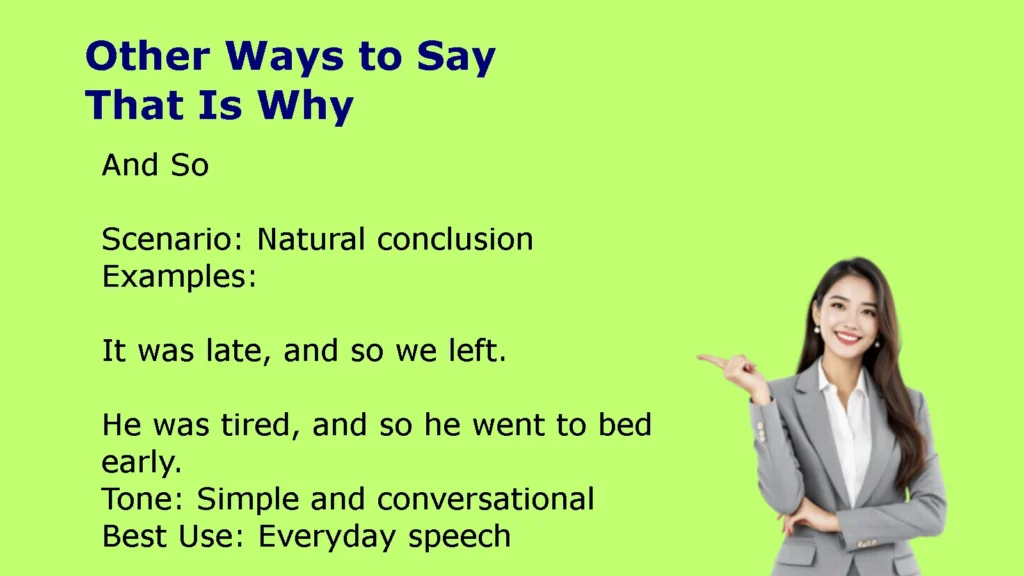
47. And So
Scenario: Natural conclusion
Examples:
- It was late, and so we left.
- He was tired, and so he went to bed early.
Tone: Simple and conversational
Best Use: Everyday speech
Conclusion
Now you have 47 powerful alternatives to “that is why,” ranging from casual and conversational phrases to formal and academic expressions. Using these variations helps you make your writing more natural, fluent, and engaging while avoiding repetition. Whether you’re writing essays, emails, or casual messages, these phrases will help you express cause and effect more effectively and professionally.

